| | | | |  | By Megan R. Wilson | - Visa fees squeeze rural care: A new $100,000 H-1B visa fee is destabilizing already-short-staffed providers, with rural medical facilities warning they can’t recruit U.S.-born clinicians to fill the gaps and scrambling to obtain elusive exemptions.
- BIOSECURE is back: Compromise text of a defense authorization bill released on Sunday includes restrictions on partnerships with Chinese life sciences companies but adopts a softer stance than the original measure.
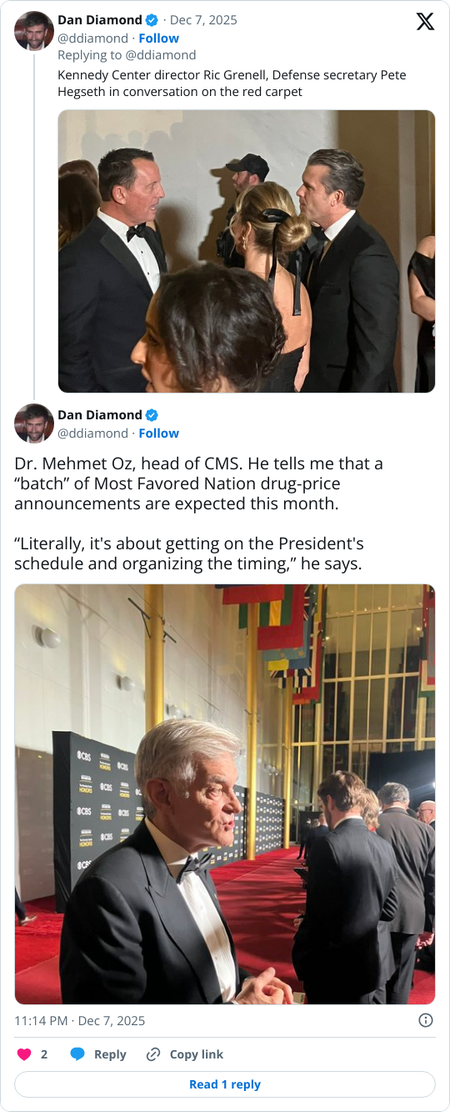
- MFN preview: There’s a “bundle” of drug pricing deal announcements coming this month, CMS Administrator Mehmet Oz tells The Washington Post.
Good afternoon and welcome to the Health Brief newsletter. All eyes are on congressional efforts to avert health insurance premium spikes following a looming expiration of the enhanced Affordable Care Act subsidies — which, as of now, appear doomed. A Senate vote on the Democrats’ proposal is expected later this week, so I’ll be talking more about that in the coming days. But, for now, let’s zoom out on some of the other biggest headlines in health care: visas and staffing, vaccine policy, and efforts to curb Chinese influence in biotech. Are you a staffer working on health care legislation? I’d love to learn more about it. You can find me at megan.wilson@washpost.com, or message me securely on Signal at megan.434. → For your calendar: Dec. 12: Make sure you sign up to attend WP Intelligence’s first health policy webinar! Editorial director Luiza Savage will be talking about AI in health care with WPI lead health care analyst Rebecca Adams and co-founder of Town Hall Ventures Andy Slavitt. This newsletter is published by WP Intelligence, The Washington Post’s subscription service for professionals that provides business, policy and thought leaders with actionable insights. WP Intelligence operates independently from the Washington Post newsroom. Learn more about WP Intelligence. | 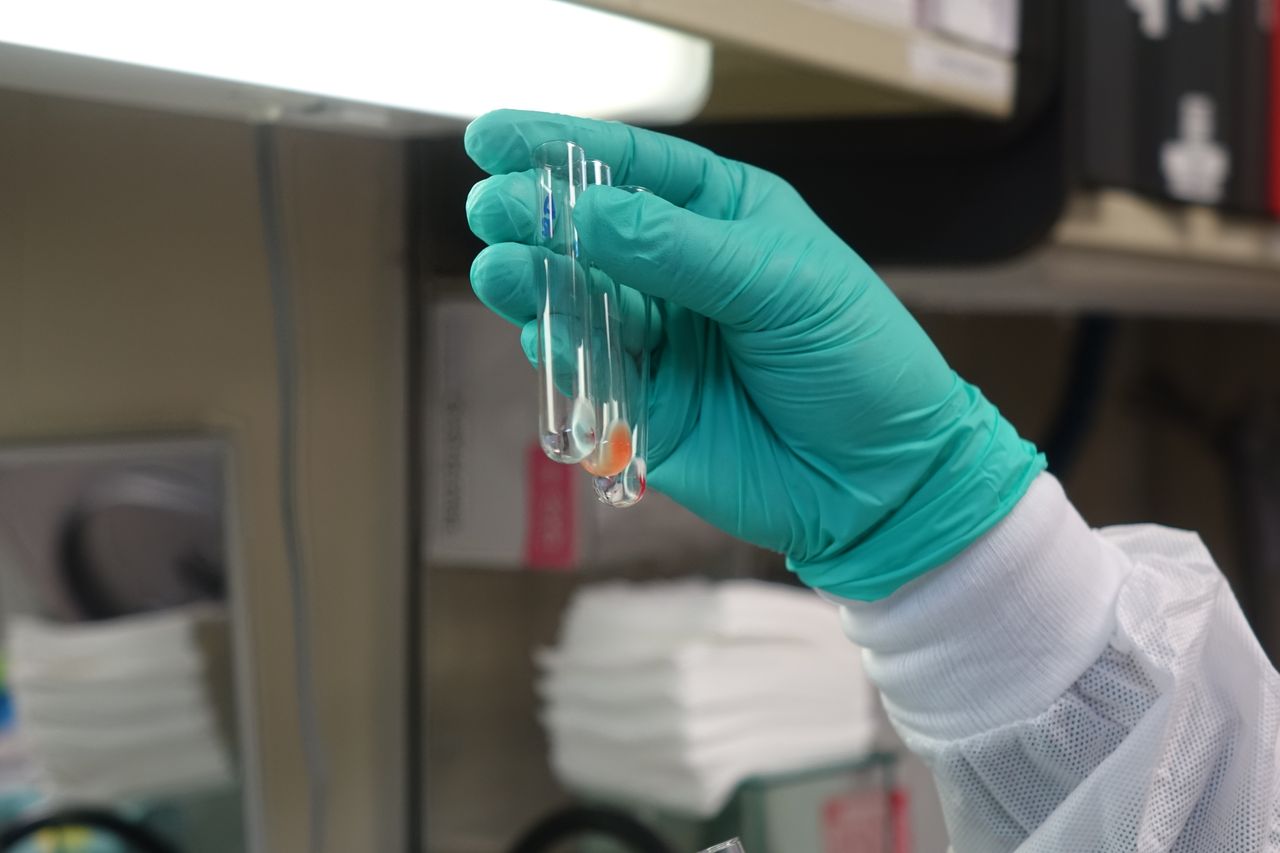 | | April Joy Castañeto, a medical technician from the Phillippines, tests blood samples at Iredell Health System in Statesville, North Carolina. The hospital relies on foreign-born doctors, nurses and medical technicians because it cannot find enough homegrown healthcare workers. (David Ovalle/FTWP) | | | |  | The Lead Brief | Nearly three months ago, President Donald Trump signed a proclamation slapping a $100,000 fee on new visas for highly skilled workers, known as H-1B visas. It’s already causing uncertainty among providers trying to hire amid chronic understaffing issues — particularly in rural and underserved areas, my colleague David Ovalle in The Washington Post newsroom reported from North Carolina. Why it matters: Before the change, H-1B visa application fees for nonprofit health facilities have generally ranged from about $460 to $1,000, David reports — making the jump particularly jarring for organizations already operating on razor-thin margins. The Trump administration has also moved forward with other policies that complicate legal immigration, which all combine to threaten patent care and access by making hiring more difficult. → The crackdown comes as rural hospitals are bracing for massive cuts to Medicaid, the anticipated impact from Republicans’ domestic policy law enacted earlier this year. Most of the provisions don’t go into effect until 2027, but states are already retooling their budgets. Key stats: Iowa, North Dakota and West Virginia — red states that overwhelmingly voted for Trump — lead the nation in the highest percentage of H-1B physicians, according to a study published earlier this year. The percentage of H-1B-sponsored doctors in rural counties was nearly twice as in urban counties, according to research published in JAMA. Overall, roughly 83 million Americans live in areas that don’t have sufficient access to a primary care physician, according to the American Medical Association. The Trump administration has said that the move is to prevent U.S. employers from bringing on foreign workers at lower salaries rather than hiring Americans, arguing that employers have abused the system. However, health care facilities are advertising and having issues finding U.S.-born applicants. → In his story, David spotlights one provider specializing in kidney care in Shelby, North Carolina — about an hour’s drive from Charlotte — that is struggling to hire doctors as its current staff is overworked, with the new visa policy actively throwing up more hurdles. However, he also explores how other facilities and regions around the country are grappling with the changes. — Alfred Sams, president of Rough Riders Network, an association of 22 independent rural hospitals in North Dakota, said that so-called frontier areas don’t attract U.S.-born candidates. Frontier areas are sparsely populated, geographically remote regions. In certain places here, the nearest stoplight can be 80 miles away, and the temperature can drop to 30 degrees below zero. | | | |  | From our notebook | Trump’s proclamation allows for the Department of Homeland Security to grant exemptions to individuals, companies or industries from the new policy if hiring those foreign workers “is in the national interest and does not pose a threat to the security or welfare of the United States.” However, the department did not answer questions about whether they would be granting — or have granted — any exemptions to medical workers or organizations. → From David’s notebook: One immigration lawyer David interviewed said that it took about a month for USCIS, an immigration agency within DHS, to respond to their request for a so-called national interest exemption for the North Carolina provider, to simply acknowledge receipt of their request. A decision has not yet been made. I asked the agency whether this is the typical timeline but haven’t heard back. | | | | | | Health on the Hill | The compromise version of Congress’s blueprint for Pentagon policies contains a much-anticipated provision that aims to stop Chinese life sciences companies from operating in the U.S. — specifically barring any entities that work with biotech “companies of concern” from contracting with the federal government. Many pharmaceutical companies work with Chinese-owned companies known as contact research and manufacturing organizations, or CDMOs, to help make their products. However, the partnerships have been more difficult to pin down over the last year as lawmakers ramped up scrutiny of the companies. Congress has been trying for two years to enact the measure, known as the BIOSECURE Act, which has been complicated by pushback from the pharmaceutical industry and some lawmakers. The version in the newly negotiated National Defense Authorization Act, released yesterday, reflects changes that may lessen some of its impacts. For example, the text no longer lists specific companies. Instead, it leans on the Pentagon’s 1260H list, a list the Defense Department updates each year, listing entities it says aid the Chinese military. It also allows companies with such contracts an off-ramp to get out of them — in addition to setting up ways to get a waiver and exemptions from the prohibitions. Why it matters: The move is one of the ways the U.S. government has been trying to counter Beijing's influence on the biopharmaceutical industry. The updated BIOSECURE Act — which many expect to pass as part of the NDAA — may not have sweeping impacts on the industry due to the changes, but risks for companies still remain. “There are many opportunities to negate the potential most negative impacts through the discretion given to the executive branch,” Raymond James analysts wrote in a client memo on Monday. Still, “partnerships with Chinese companies will become a greater risk for biotechnology companies moving forward.” → A survey from industry group Biotechnology Innovation Organization last year showed that 79 percent of 124 biopharma companies had at least one contract with a China-owned or -based CDMO. WuXi AppTec, a China-based CDMO, had been named in the original legislation, and has been used by biotech companies of all sizes. The updated legislation “gives the government a lot of tools to be very thoughtful in sculpting and controlling the relationship between suppliers of capacities in China and what’s happening in the United States,” Drew Endy, a science and senior fellow at the Hoover Institution, tells me. “There were some unintended consequences with the original version, whereas this version … really gives the government a whole set of options that can be turned on and off.” → Bloomberg reported that the Defense Department told lawmakers in a letter it wanted to add WuXi AppTec to the 1260H list. It doesn’t mean that the company — which has denied it has any involvement with the Chinese military — will be added. The House Armed Services Committee did not respond to a request to confirm the letter. In its third quarter earnings report, WuXi AppTec disclosed that business within the U.S. makes up nearly 68 percent of its overall revenue — earning more than $3 billion from its U.S. work in the first nine months of 2025, a 32 percent increase over the same period last year. | | | | | | Immunization Update | Many medical groups and public health experts were horrified. Make America Healthy Again advocates cheered. Such is the dynamic in a world in which Robert F. Kennedy Jr., the Trump administration’s top health official, oversees vaccine policy. Last week, a panel of federal vaccine advisers — all handpicked by Kennedy, a longtime vaccine skeptic — voted to nix a decades-long recommendation that all babies receive their first hepatitis B shot hours after birth. Studies have credited the universal birth dose with nearly eradicating the virus — which attacks the kidneys and can lead to cancer and death — in children. It can be passed to babies from their mothers at birth, but also unintentionally from other adults who may not know they have it. My colleagues in The Washington Post newsroom — Lena H. Sun, David Ovalle and Paige Winfield Cunningham — explore this dichotomy in a postmortem following the Advisory Committee on Immunization Practices’ two-day meeting that culminated in the panel’s recommended changes to hepatitis B shots in the childhood vaccination schedule. It’s a must-read to get a sense of the overall debate playing out on the federal level. → There is a chart in their story, “Under RFK Jr., the CDC provides a megaphone to the anti-vaccine movement” that briefly summarizes the status of vaccine policy changes enacted and under review: | 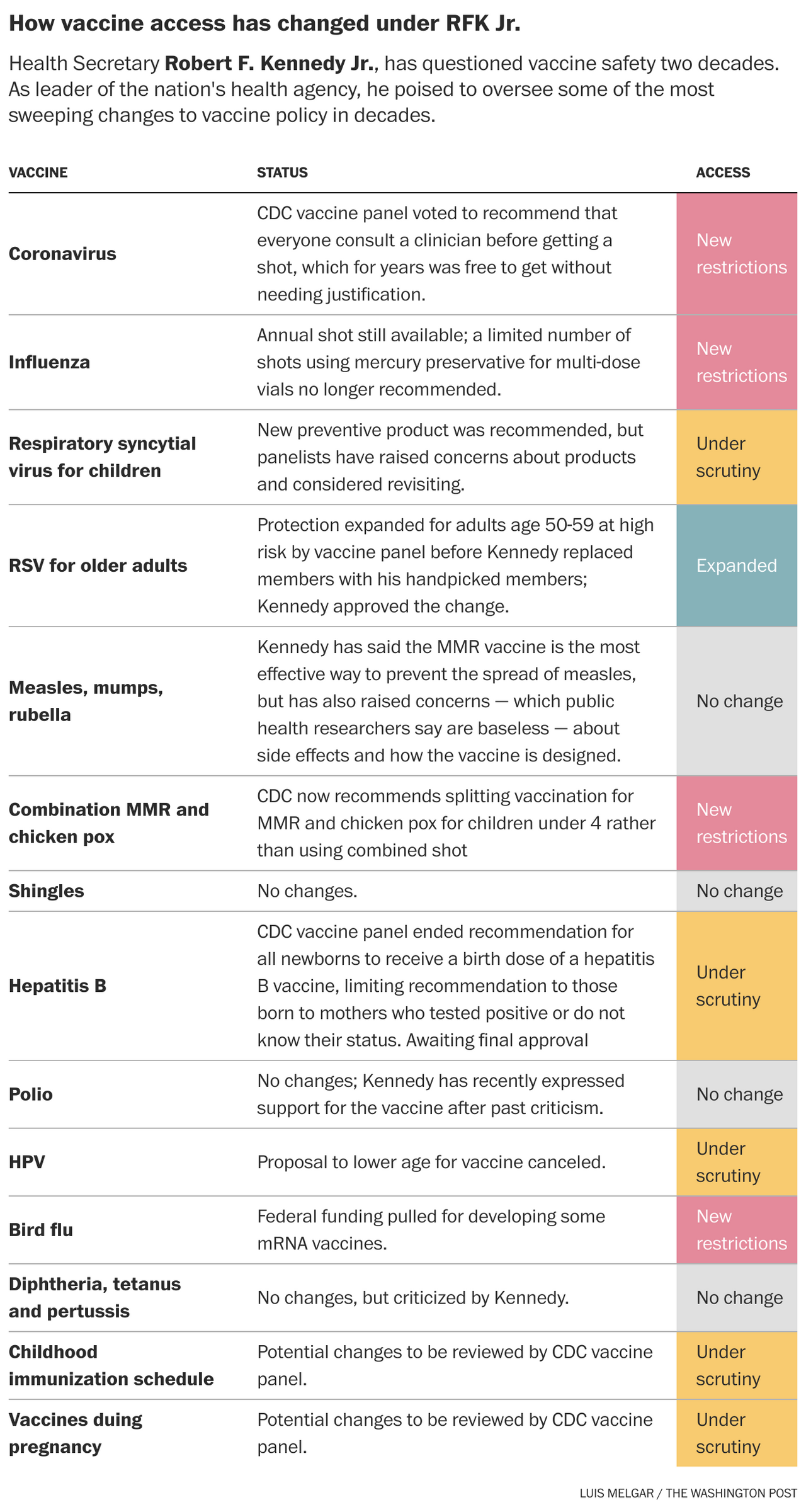 | | What to watch: The Centers for Disease Control and Prevention still needs to officially accept the hepatitis B recommendations for them to become official policy guidance. Acting CDC Director Jim O’Neill responded to Trump’s social media post calling for the agency to review the shots that children in the U.S. get compared to other countries: “Yes, sir. We will do a speedy and thorough review,” O’Neill posted on social media. READ MORE FROM WAPO: “Trump orders review of childhood vaccine schedule, calls U.S. an ‘outlier.’” The Trump administration had already announced efforts to review the entire childhood immunization schedule — including whether the ingredients in vaccines or spacing of them cause health issues. In October, O’Neill called on vaccine manufacturers to separate the measles, mumps and rubella combination vaccine into three separate shots. I wrote about how difficult this overhaul would be, and how the Food and Drug Administration would have to be on board. | | | | | | Quote snack | WaPo’s Dan Diamond was on the red carpet for the Kennedy Center Honors Sunday and was able to catch up with Mehmet Oz, leader of the Centers for Medicare and Medicaid Services. There’s a “batch” of new drug pricing deals set to be announced at the White House this month, Oz told him — part of Trump’s most-favored-nation, or MFN, pricing push. → As a reminder, five companies — Pfizer, AstraZeneca, EMD Serono, Eli Lilly and Novo Nordisk — have announced MFN deals in the Oval Office since the end of September. We’re still waiting to see whether about a dozen more have come to the table, as Trump had sent letters to 17 large drugmakers with drug pricing demands. | | | | |


_tstmp_1756933376-1920-1080.png)