|
 |



Your paid subscription makes Civil Discourse possible—independent, informed analysis in a moment when noise can drown out reason. Join a community that refuses to give up on democracy—or on understanding it.
Donald Trump fired Federal Trade Commission (FTC) Commissioner Rebecca Slaughter earlier this year. She sued.
In a landmark 1935 decision, Humphrey’s Executor, the Supreme Court held that Congress could put limits on the president’s authority to remove certain executive branch officials. That longstanding precedent has been on a collision course with Donald Trump’s quest for maximal power for as long as he’s been in office. Today, a Court that has been very sympathetic to Trump heard argument in Slaughter’s case.
The type of executive branch positions at stake are appointments to high-ranking positions in quasi-independent federal agencies like the FTC and others, including the Federal Reserve. The top line question is whether presidents can fire them in the absence of misconduct. We discussed the backstory to Humphrey’s Executor here, back in March. President Franklin Delano Roosevelt fired an FTC Commissioner, writing to him that “your mind and my mind [don’t] go along together on either the policies or the administering of the Federal Trade Commission.” The Court held that Congress intended to restrict a president’s power of removal to cases involving inefficiency, neglect of duty, or malfeasance in office, and that Roosevelt couldn’t dismiss Humphrey simply because they were of different minds on policy.
That precedent is about as on-point as they come. It suggests that Slaughter, who had done nothing wrong, should win her case. She was advised of her termination in an email that said her “continued service on the FTC is inconsistent with [the Trump] Administration’s priorities.”
But our tea leaf reading at the start of the term, which concluded that the Court would weigh in for Trump, appears to have been on target. We based that analysis on the fact that the Court declined to stay Slaughter’s dismissal from the FTC until it could hear the case. If there had been a majority, or something close to it, inclined to follow Humphrey’s Executor and rein Trump in, the Court would have prevented the firing from taking effect until it could hear the case. The fact that they allowed her dismissal to take effect implied the Court was prepared to undo the precedent that would have prohibited it. Oral argument bore out that conclusion.
Justice Kagan went straight to the heart of the matter when Solicitor General John Sauer argued the government’s case. She pointed out that “the central proposition of your brief” was that the Vesting Clause of the Constitution gives all of the executive power to the president. “Once you’re down this road, it’s a little difficult to see how you stop,” Justice Kagan said. Sauer talked over her and around her, but never disagreed. The government’s position, even though it didn’t go this far today, is that everything that happens in the executive branch is at the president’s pleasure. Everything. That could include matters like who DOJ indicts, what businesses the EPA regulates, and all sorts of individualized decisions that are currently made by people with expertise, guided by long-standing practices and ethical constraints.
To that point, when Justice Kagan asked whether a decision against Slaughter would apply to other similarly situated agencies, Sauer ducked. He told her the Court could just “reserve” making a decision on other agencies because those cases were not in front of the Court today. Justice Kagan responded that “logic has consequences,” and that even if the Court dropped a footnote saying it wasn’t deciding other cases as Sauer suggested, it would just be a dodge; it wouldn’t mean anything for future cases, where the government would be free to argue for an unprecedented level of control in the hands of the president, using Slaughter as support, if the Court decides it in the manner the government requested.
Justice Sotomayor said to Sauer, “You’re asking us to destroy the structure of government and to take away from Congress its ability to protect its idea that the government is better structured with some agencies that are independent.” Justice Alito invited Sauer to respond. “The sky will not fall,” he said, adding, “The entire government will move toward accountability to the people.” Justice Sotomayor ultimately responded, “What you’re saying is the president can do more than the law permits.” There was silence for a moment. Then Sauer hurriedly repeated a few of his earlier points and concluded that Humphrey should be reversed.
We don’t know precisely how the Court will rule, but the Chief Justice tipped his hand a bit, saying “the precedent” had “nothing to do with what the FTC looks like today,” and claiming that the FTC back then was different, and “had very little, if any executive power,” suggesting different rules might apply today for an agency that had become more powerful. It’s the sophistic kind of reasoning we have seen before when the Roberts Court twists itself into pretzel logic so that it can reverse longstanding precedent—while pretending it is doing nothing of the sort.
A decision in this case is likely to come at the end of the term, late next June or the first week in July, although it could come at any time. It is likely to be one of the most consequential of this term.
A lot more happened today that is worthy of our attention. But because there is so much of it, instead of trying to cover it all, I’ll flag some of the most important developments here, and you can read further on any of them that interest you. We will take them up in more detail as they develop.
ProPublica, widely regarded as a highly credible source of independent investigative journalism (they broke the story on Clarence Thomas and Samuel Alito accepting vacation travels and other favors from conservative power players) reported today that some of Trump’s mortgages match his description of mortgage fraud, according to records they reviewed. While living in New York, he claimed two 1993 real estate purchases made within two months of each other in Florida would both become his principal residence. The report says: “The Trump administration has argued that Fed board member Lisa Cook may have committed mortgage fraud by declaring more than one primary residence on her loans. We found Trump once did the very thing he called ‘deceitful and potentially criminal.’” Trump has accused multiple political adversaries of mortgage fraud for claiming more than one primary residence, and that appears to be the rationale behind federal criminal investigations into New York Attorney General Letitia James, California Senator Adam Schiff, and California Representative Eric Swalwell, and others, although there are at best flimsy facts to support the allegations.
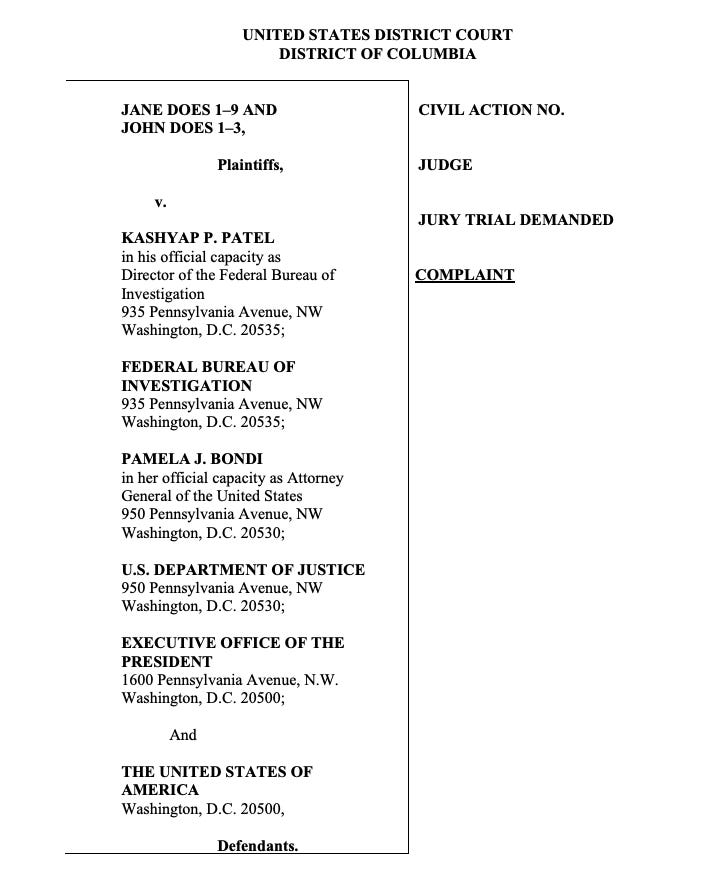
Twelve former FBI agents sued Attorney General Pam Bondi and FBI Director Kash Patel, along with others, alleging “unlawful retaliation” because they were fired for kneeling in response to protests in Washington, D.C., after George Floyd's murder. The lawsuit is based on First Amendment violations and also points out the wisdom of the plaintiffs’ decision to kneel with the crowd: “As a result of their tactical decision to kneel, the mass of people moved on without escalating to violence.”
 |
Alina Habba is no longer the U.S. Attorney in New Jersey. New Jersey does not currently have, and based on a memo issued by DOJ today, it appears may not be getting, a new U.S. Attorney any time soon. Instead the office will be staffed with people appointed to, in effect, exercise the powers of the position without the title or the scrutiny of a Senate confirmation process. This will not be the last word on the issue—expect litigation.
The Wall Street Journal reports that the Bureau of Labor Statistics will continue to “skip publication of its delayed report on wholesale-price inflation, and will instead roll those figures into a postponed November report to be published on Jan. 14.” The administration wouldn’t keep this news from us if it were good.
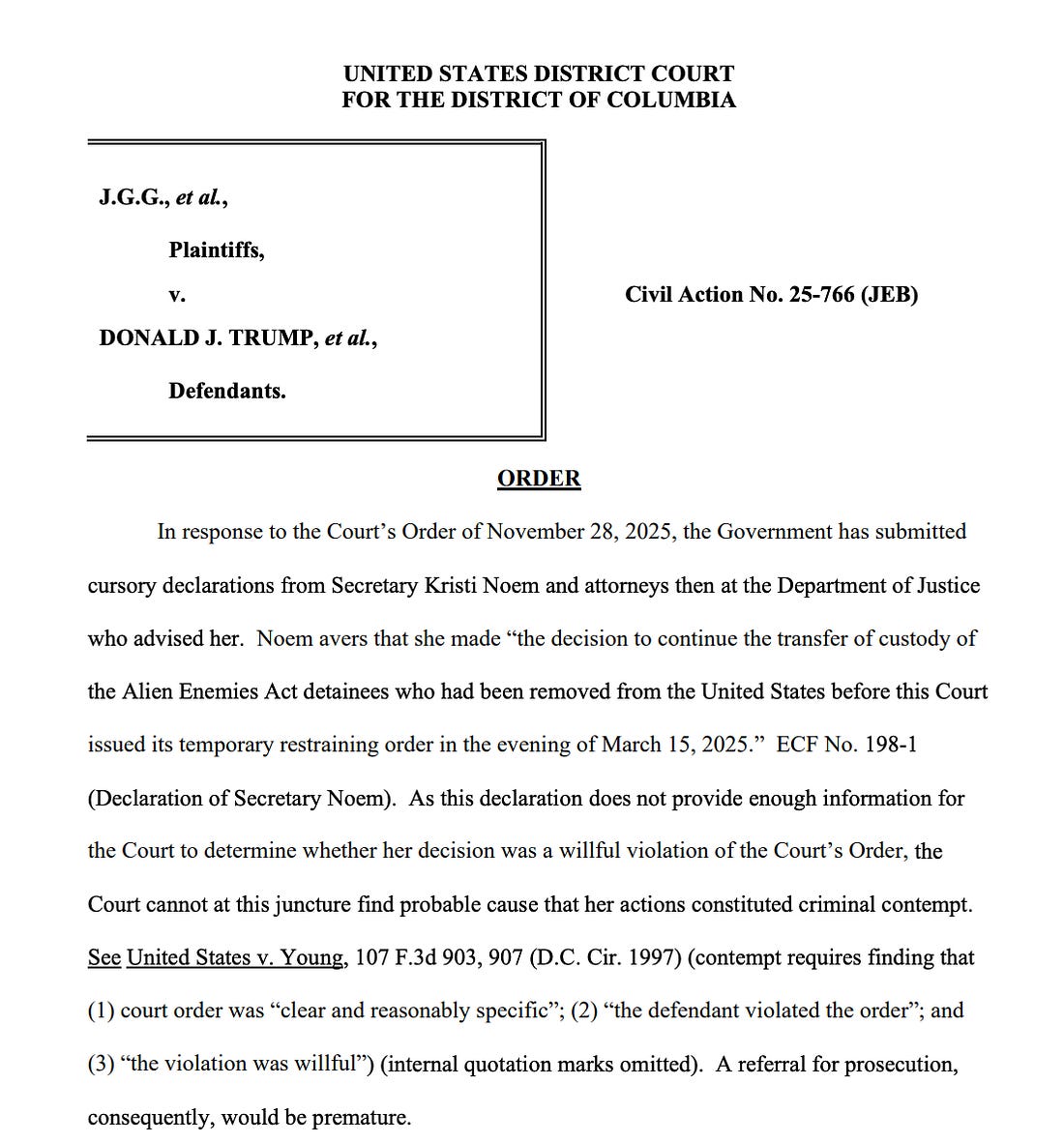
Judge Boasberg has ordered two witnesses to testify in contempt proceedings he is conducting. Former DOJ attorney Erez Reuveni and Drew Ensign, currently a Deputy Assistant Attorney General in the Civil Division (and the lawyer who was in court relaying Judge Boasberg’s orders to the government as planes full of Venezuelans headed toward El Salvador) are to testify next week. In his order, the Judge explains he has read DHS Secretary Kristi Noem’s declaration that she issued the order to turn the men over to El Salvador’s custody, but he cannot determine from what he calls her “cursory declarations” whether she willfully violated the court’s order in doing so. No word on whether Emil Bove, who was working for DOJ when he allegedly said “DOJ would need to consider telling the courts ‘f--- you’ and ignore an order barring the migrants’ removal,” (he denies it) but is now a Third Circuit Court of Appeals judge, will also be ordered to testify. He has provided a written declaration to the court indicating he “contributed to privileged legal advice” that was given to Noem before she made her decision.
 |
The Ninth Circuit’s order agreeing to take the National Guard matter en banc, was amended today to include an opinion by Senior Judge Jay Bybee, who was appointed by George W. Bush. He wrote an opinion in support of the en banc