|
 |
👋 Hi, this is Gergely with a subscriber-only issue of the Pragmatic Engineer Newsletter. In every issue, I cover challenges at Big Tech and startups through the lens of engineering managers and senior engineers. If you’ve been forwarded this email, you can subscribe here.
Building MCP servers in the real world
How engineers and teams use MCP servers: from debugging to working with legacy systems, & giving non-devs more access. Details from 40+ devs – with some surprises
|

| |||||||||||||||


The Model Context Protocol (MCP) was released almost exactly a year ago by Anthropic, and today, MCP is enjoying quite a moment, with strong growth in the numbers of devs building MCP servers. That might be related to MCP servers being a great way to give agents like Claude Code, Cursor Agent, and other LLMs new capabilities to use services, query documentation, and be more efficient. Adoption is widespread and diverse, across cutting-edge startups and regulated industries like aerospace alike.
One year on, how are engineering teams using this technology, and what does that teach us? To find out, we collected input from 46 software engineers who build and use MCP servers at work, and talked with Jeremiah Lowin, CEO of Prefect and creator of FastMCP, the leading MCP framework for Python, and Den Delimarsky, core MCP maintainer and Principal Engineer at Microsoft.
Thanks to everyone who shared their experience of building with MCP.
Today, we cover:
MCP fundamentals. Brief recap of the protocol.
Usage realities. Internal MCP server usage outpaces its public usage, business stakeholders are heavy MCP users, and other details.
How teams use MCP. Based on a dozen use cases, there are varied ways of using it.
Popular public MCP servers. Stats from widely-used public MCP servers operated by Sentry and Linear, plus an odd conjunction of thousands of DAUs and millions of daily sessions.
Security considerations. Security’s still the Achilles heel of MCPs and LLMs. There are some sensible security practices for treading carefully in the space.
Learnings from building MCPs. Start small and local, choose the development language carefully, design primitives for agents and not humans – & more.
Useful tools for building MCP servers. FastMCP, MCP Inspector, and Cloudflare’s remote MCP guide among the top mentions.
Our look into MCP usage suggests that using, building, and maintaining MCP servers are on the way to becoming part of the software engineering toolset; perhaps they already are. Meantime, best practices are still taking shape. Let’s get into it:
The bottom of this article could be cut off in some email clients. Read the full article uninterrupted, online.
1. MCP fundamentals
The MCP protocol was released in November 2024 and was developed by two software engineers at Anthropic, David Soria Parra, and Justin Spahr-Summers, who started work on it that July.
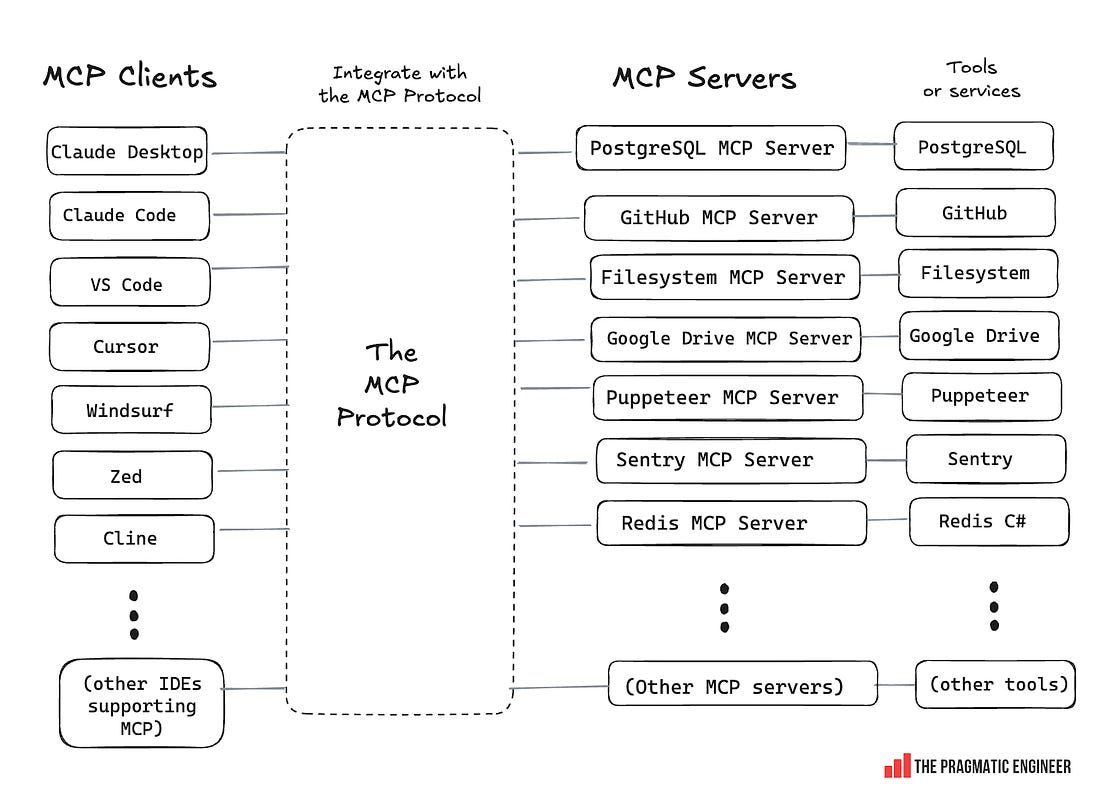
The protocol aims to be the “USB-C” layer for AI applications. It’s a standardized protocol to connect Clients (chatbots, IDEs, AI applications) to Servers (data, files, and tools). Here’s how the protocol works, at a high level:
 |
With MCP, you can do handy things like:
Implement a ticket. Tell the agent inside Cursor to implement TICKET-123 in Linear.
Interactive debugging. Tell Claude Code to verify that the feature implemented in TICKET-123 in tools like Linear/JIRA works as expected, or by inspecting logs inside Sentry, Statsig, and other production systems.
Query databases. Ask your agent running in the IDE: “How many new signups were there last week?” With a database MCP connector, the agent goes and writes the right query and returns the result.
For devs, a very practical use case is to add MCP servers for preferred agents, then instruct the agent to do more complicated workflows involving one of the added tools. Thanks to having access to tools via MCP – boom! – the agent becomes a lot more capable!
We cover the origin of MCP and how it works in depth, in the deepdive MCP Protocol: a new AI dev tools building block.
2. Usage realities
When it comes to MCP adoption, there’s a view that there are many times more MCP servers than users, as per a popular meme in the space: