|
The Copilot Paradox: Rethinking Productivity in the Age of AI-Driven Development
GitHub Copilot promises faster software delivery, but at what cost? Explore the hidden trade-offs and leadership strategies to harness AI wisely.
|

| |||||||||||||||


This app that might actually make you love meetings. (Sponsor)
Meetings aren’t the problem. The challenge is everything that comes after them.
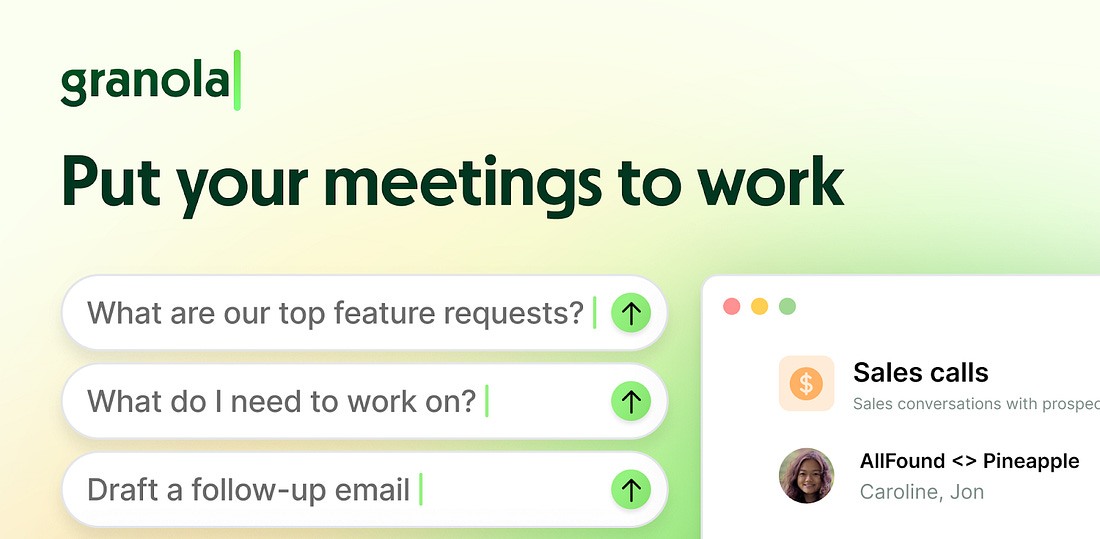
With Granola, the AI Notepad for people with back-to-back meetings, you can avoid context switching, the cognitive load of remembering what you promised … and the stress of knowing something important slipped through.
Meetings are no longer about scrambling to keep up. With Granola, they are about connection. They lead somewhere.
Take notes the way you always have. Granola works in the background, turning conversations into clear summaries, action items, and next steps.
Before, during, or after a meeting, you can chat with your notes to quickly understand what needs to happen, write follow-ups, or share context with others.
Generative AI is transforming software development. GitHub Copilot and similar tools are now embedded in daily workflows across engineering teams worldwide. Developers are shipping features faster, prototypes are emerging overnight, and leaders are touting dramatic gains in engineering velocity.
But the reality is more complex. While AI-assisted coding accelerates output, it also introduces a new layer of debugging debt, architectural fragility, and governance risk. What looks like progress on the surface can mask systemic vulnerabilities underneath.
This is the Copilot Paradox: the appearance of productivity without guaranteed value.
The Dual Nature of Copilot
The promise of AI coding assistants is real:
Acceleration → Routine scaffolding, test generation, and syntax are handled in seconds.
Accessibility → Junior developers and cross-functional contributors (e.g., designers prototyping) can contribute more effectively.
Experimentation → Teams can spin up prototypes rapidly and validate ideas earlier in the product cycle.
Morale → By reducing repetitive work, engineers spend more time on creative problem-solving.
Yet, for every strength, there’s a corresponding liability:
Error Propagation → Plausible but incorrect code compiles cleanly and fails silently.
Hidden Complexity → AI-generated shortcuts often ignore scalability, performance, and maintainability.
Erosion of Craft → Over-reliance risks atrophying engineers’ problem-solving instincts.
Uncertain IP → Training data origins remain opaque, raising compliance questions for enterprises.
The paradox is not whether AI helps, but whether organizations can capture net value after accounting for these trade-offs.
Implications for Leaders
1. Redefining Productivity Metrics
Traditional engineering metrics — commits, velocity, story points — no longer capture true productivity. AI can inflate these signals artificially. Leaders must pivot to outcome-based metrics:
Time-to-stable-release, not time-to-merge.
Defect density per release, not raw commit count.
Customer-impact velocity → how quickly usable, reliable features reach users.
Without this recalibration, organizations risk optimizing for motion instead of progress.
2. Governance as a Strategic Imperative
AI-generated code introduces new classes of risk:
Compliance risk (license violations, IP uncertainty).
Security risk (injected vulnerabilities, unsafe defaults).
Operational risk (unstable releases, maintenance debt).
Forward-looking organizations are already creating AI coding policies — defining what AI can be used for (scaffolding, testing), and where human expertise must remain central (critical algorithms, security-sensitive code).
This isn’t just an engineering issue; it’s a board-level concern. Just as DevOps demanded cultural and organizational change a decade ago, AI development demands executive oversight today.
3. The Cultural Shift in Engineering
The role of engineers is evolving from creators of code to curators of machine-generated output. This transition requires:
New skills → debugging AI output, auditing reliability, orchestrating multiple AI systems.
Psychological adaptation → engineers must trust but verify, shifting from maker to reviewer.