Thanks for reading The Briefing, our nightly column where we break down the day’s news. If you like what you see, I encourage you to subscribe to our reporting here.
Greetings!
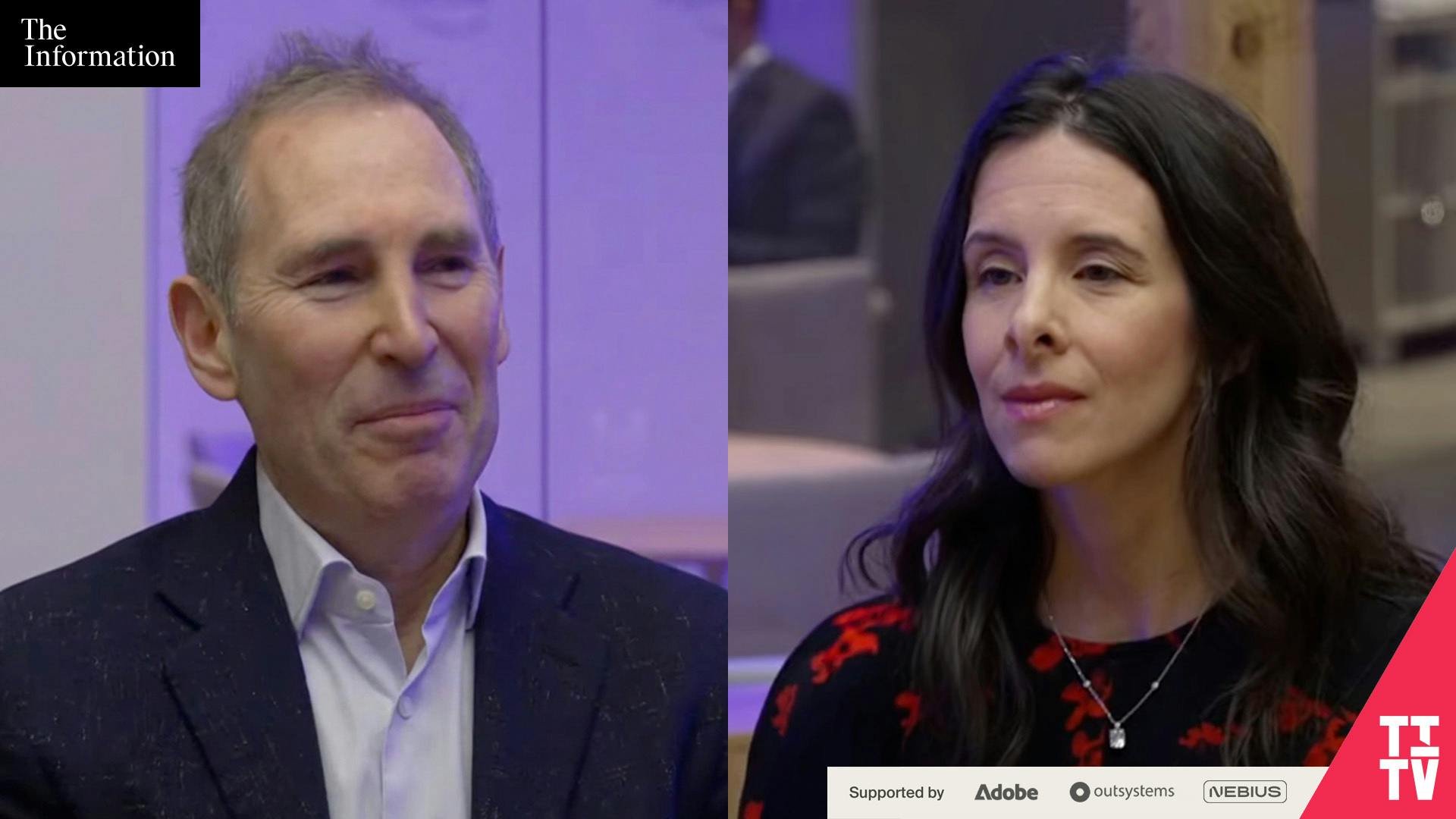
My second day in Davos began way too early—in a sit-down with Amazon CEO Andy Jassy for The Information’s TITV.
It has been two years and three months since I last sat down with Jassy in Seattle. While he’s always calm and measured—and, for what it is worth, he’s one of the nicest people to interview—one could sense a little defensiveness back then when he was describing Amazon’s position in AI.
Without a leading AI model, and with Amazon’s rivals in the cloud, Microsoft and Google, growing quickly, some investors and customers were skeptical. And so in our last interview, Jassy went on about all the advantages Amazon had by focusing on three “layers of the stack”: models, applications and chips. It was interesting but a little generic. I almost felt like he was trying out his strategic framework on me.
This time Jassy—though still nice—was a little more confident.
On chips, he pressed the case for Amazon’s Nvidia competitor, Trainium, while saying Amazon Web Services won’t force customers to use it. He spoke more about the advantages Trainium brings to Amazon and its profit margins.
Jassy also had much more to say about Amazon’s relationship with OpenAI this round. Two years ago, there wasn’t a relationship to speak of. Now, after a modest cloud deal and reporting from our reporters Anissa Gardizy, Sri Muppidi, Cory Weinberg and Amir Efrati about talks over a funding round, he’s clearly looking for more. “I hope that we have a chance to deepen the relationship over time.”
I wouldn’t dismiss that as a throwaway line—it’s a big shift from how Jassy spoke about any potential relationship in the past.
OpenAI also yielded one of the more interesting moments in the interview— and just a hint of Jassy’s notoriously sharp negotiating ways. When I asked him if he is worried about the success chatbots like OpenAI might have in shopping and ads, he didn’t mince his words.
“It is not simple to do that well,” he said.
Stay tuned for more from Davos tomorrow as I interview Peng Xiao, CEO of G42; Rob Goldstein, chief operating officer of BlackRock; Michael Intrator, CEO of CoreWeave; and Sarah Friar, chief financial officer of OpenAI.
Netflix’s Mixed Picture
Netflix had some good and bad news with its fourth-quarter numbers, released Tuesday. It did better in the quarter than projected, and it finally told us how much money it’s generating from ads ($1.5 billion last year). On the other hand, the company projected a slowdown in top-line growth in 2026 to between 12% and 14%, compared with 16% in 2025. That was enough for investors to sell the stock down nearly 5% in after-hours trading.
Netflix stock is now trading at its lowest point in 12 months, having been battered over the past few weeks since the company announced a $82.7 billion acquisition of Warner Bros. Discovery’s film studio and streaming operations. The growth slowdown perhaps explains why Netflix management decided to pursue the WBD deal.
Now that Netflix has disclosed the size of its ad business, it’s clear how much growth is coming from advertising. Netflix projected advertising revenue would double in 2026 to an implied $3 billion. Excluding ad revenue from both the 2025 and 2026 projected numbers implies growth for the core of the business of just 10%. And Netflix can’t assume advertising will continue to double, given the insanely competitive nature of the ad market (which will become even more so, with ChatGPT jumping in).
Buying a big operation like WBD will reset Netflix’s business for the next few years. If you believe Netflix management, the purchase could act as a catalyst to its existing operations. Netflix shareholders have to hope they’re right, given the scale of the purchase.—Martin Peers
Today on The Information’s TITV
Check out our latest episode of TITV in which Jessica Lessin sits down with Amazon CEO Andy Jassy to talk agentic commerce, OpenAI, layoffs and energy in the era of AI.
In Other News
• Elon Musk and Sam Altman traded barbs on X over media reports of deaths linked to OpenAI’s ChatGPT and other AI-related safety issues (more here).
• Pinterest named former Spotify ads chief Lee Brown as its first chief business officer, overseeing sales, content, “ad product marketing” and “customer-facing operations.” The appointment comes days after Brown quit DoorDash after just a few months there. At the same time, Pinterest said Chief Revenue Officer Bill Watkins has decided to leave the company.
• The Federal Trade Commission said it would appeal a court’s ruling against its Meta Platforms antitrust lawsuit last November.
Recommended Newsletter
Start your day with Applied AI, the newsletter from The Information that uncovers how leading businesses are leveraging AI to automate tasks across the board. Subscribe now for free to get it delivered straight to your inbox twice a week.