| | In today’s edition: UAE president joins Trump’s Board of Peace, Saudi lessens its dependence on oil,͏ ͏ ͏ ͏ ͏ ͏ |
| |  | Gulf |  |
| |
|
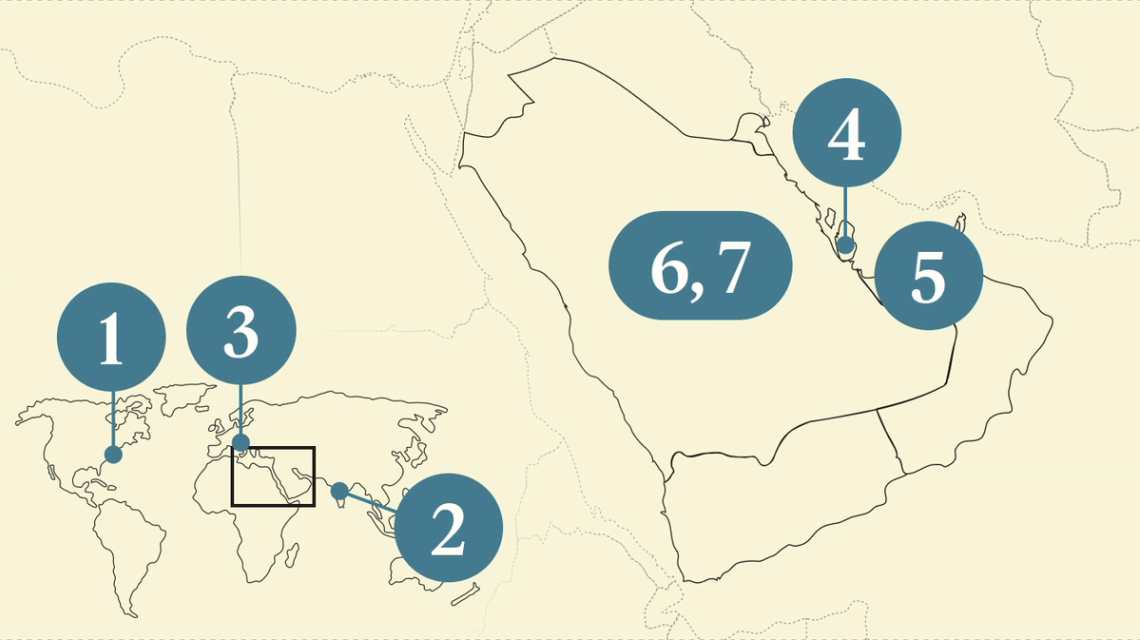 - UAE joins Trump’s board
- India-UAE deepen ties
- Saudi’s loss leaders
- Qatar invests with Goldman
- G42’s digital embassies
- IMF boosts Saudi outlook
- Saudi hospital bed shortage
 An assassination anniversary marks a changed region. |
|
UAE joins Trump’s Board of Peace |
 Yoan Valat/Pool via Reuters Yoan Valat/Pool via ReutersUAE President Sheikh Mohamed bin Zayed and Bahrain’s King Hamad Al Khalifa will join President Donald Trump’s Board of Peace, the US-led body formed to oversee reconstruction and governance in Gaza but which appears to have broader global ambitions. A draft charter reportedly shows countries must commit $1 billion for a permanent seat, with Trump as lifetime chairman. More details are expected to be revealed at the World Economic Forum in Davos, with many observers saying the board appears to be set up as a rival to the United Nations. Argentina, Belarus, Hungary, Israel, Kazakhstan, Morocco, and Vietnam have also agreed to join. Many other countries have received invitations, but most Western leaders appear reluctant to get involved at a time when Trump is demanding control of Greenland. Abu Dhabi previously backed Trump’s 20-point Gaza peace plan and was the top donor to Gaza during the two-year war that followed Hamas’ Oct. 7, 2023, attack on Israel; it maintained ties with Israel throughout the conflict. UAE-based Bulgarian diplomat Nickolay Mladenov — currently director general of the Anwar Gargash Diplomatic Academy — was named director general of the Gaza Board of Peace and is tasked with implementing Trump’s plan for the enclave. |
|
 UAE President Sheikh Mohamed bin Zayed and India’s PM Narendra Modi. Courtesy of Emirates News Agency-WAM. UAE President Sheikh Mohamed bin Zayed and India’s PM Narendra Modi. Courtesy of Emirates News Agency-WAM.UAE President Mohamed bin Zayed had a brief — but productive — three-hour visit to New Delhi this week. ADNOC signed a $3 billion deal on Monday to supply liquefied natural gas to India, making it the UAE’s top customer for LNG, as MBZ held talks with Indian Prime Minister Narendra Modi to deepen trade and defense ties. The two sides pledged to double bilateral trade to $200 billion by 2032 and to form a strategic defense pact. The UAE is India’s third-largest trading partner (Saudi Arabia is the fifth), and Indians make up the largest expat group in the Emirates, accounting for more than a third of the population. Abu Dhabi’s burgeoning and increasingly open rivalry with Riyadh is also playing out in the region: India’s nemesis Pakistan last week said it was drafting a three-way defense agreement with Saudi Arabia and Türkiye, Reuters reported, amid an ongoing rift between the kingdom and the UAE over a host of foreign policy issues. — Kelsey Warner |
|
Saudi reduces oil reliance |
 Yves Herman/Reuters Yves Herman/ReutersSaudi Arabia’s economy has reached new levels of independence from oil and is letting the private sector take on a bigger role after the government was initially willing to fund some “loss-leaders,” Minister of Economy and Planning Faisal Alibrahim told Semafor at Davos. The shift — non-oil activities now make up around 55% of GDP, Alibrahim said — validates a decade-long effort to diversify the country’s economy under Crown Prince Mohammed bin Salman, investing in everything from renewable power to tourism to auto manufacturing. The state is also adjusting its spending strategy after five years of going “full throttle,” to focusing more on efficiency, he added. “It was all about catch-up” and “delivery at any cost,” Alibrahim said. “Now it’s about achieving results at the right cost.” — Matthew Martin |
|
Goldman strikes Doha investment deal |
 Andrew Kelly/Reuters Andrew Kelly/ReutersQatar’s sovereign wealth fund could invest up to $25 billion with Goldman Sachs’ asset management arm as part of an agreement that will also see the US bank expand its Doha presence. The deal will give the $580 billion Qatar Investment Authority “premium deal flow in sectors critical to our investment strategy, including AI, fintech, digital infrastructure, and private credit,” QIA Chief Executive Mohammed Al Sowaidi said in a statement. Goldman said its Doha office will become its “largest regional office for asset management,” and it will also advise on the “development of Qatar’s economy and capital markets.” The deal is the latest sign of how Gulf sovereign funds are using their financial heft to encourage partners to create jobs in the region and attract investment. The QIA is expected to ramp up investment activity as Qatar’s expanding gas exports lead to a cash windfall. During US President Donald Trump’s visit to the Gulf last year, the fund said it would invest about $500 billion in the US over the next decade. — Matthew Martin |
|
G42 advances digital embassy plan |
 Noah Berger for AWS/Reuters Noah Berger for AWS/ReutersG42 wants to persuade foreign governments to house their data in “digital embassies,” as the Abu Dhabi AI conglomerate’s commercial aspirations for massive data centers take shape. A data embassy would store information beyond a country’s physical borders but under its laws: The plan is part of an effort to pitch governments to use G42’s infrastructure and software as a hedge against natural disasters, cyber crime, and as a lower-cost alternative for countries where energy and land are more expensive, Semafor previously reported. The move is similar to plans in Saudi Arabia. Last year, the kingdom drafted a law (not yet enacted) setting out parameters for data embassies, ranging from the guest country retaining full autonomy to hybrid legal systems in which Saudi courts could assist foreign judicial systems, CNBC reported. The concept is not new — Estonia and Monaco have digital embassies in Luxembourg — but has yet to be widely adopted. — Kelsey Warner |
|
IMF raises outlook for Saudi economy |
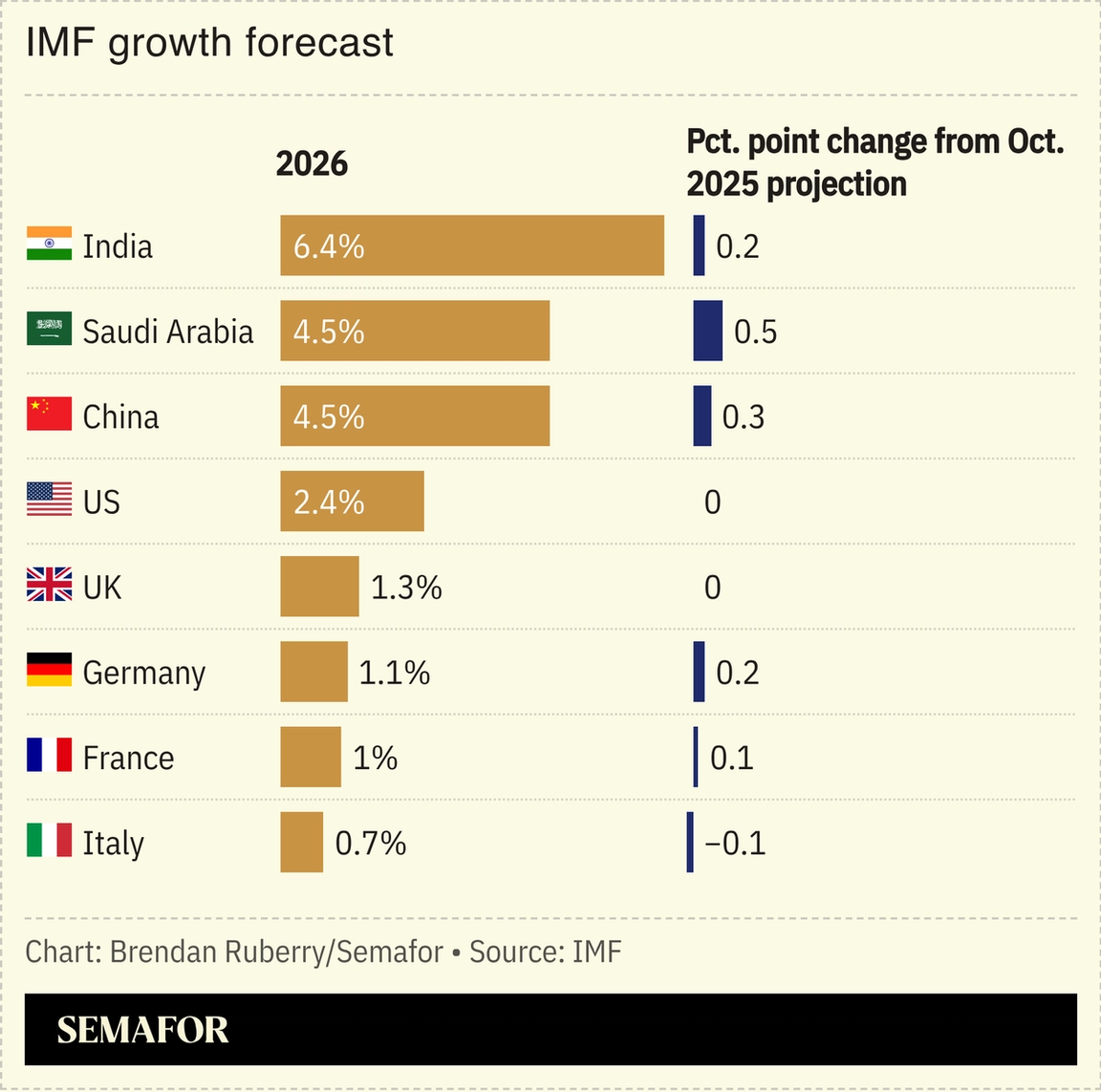 The IMF raised its estimates for economic growth this year in the Middle East and for Saudi Arabia in particular, citing higher oil output, strong domestic demand, and ongoing reform programs. The organization’s prediction comes amid the unwinding of OPEC production limits and a strengthening non-oil sector in the kingdom. Growth across the wider region is projected to hit 3.9% this year. The backdrop is a fairly resilient global economy, which the IMF expects to grow by 3.3% this year — boosted by heavy investment in artificial intelligence, falling inflation, and a private sector that has proven adept at handling the volatile trade environment caused by Trump’s regular use of tariffs as a foreign policy tool. |
|
Saudi hospitals brace for aging population |
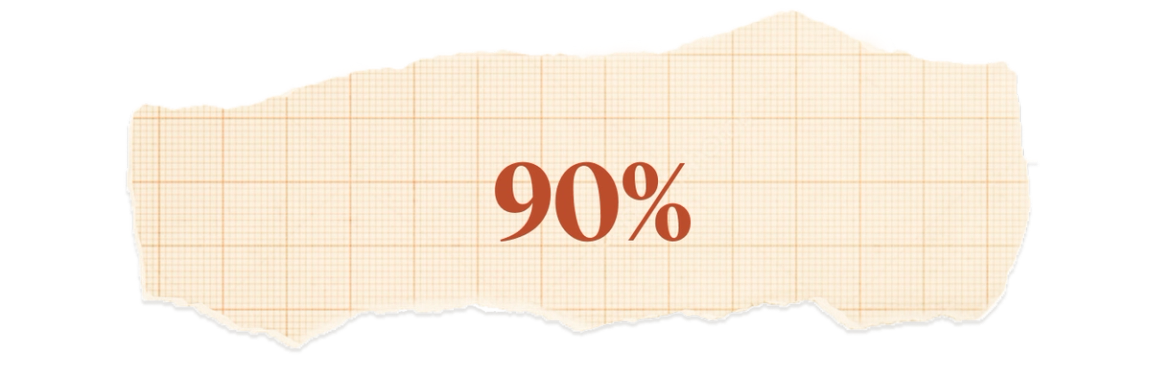 The occupancy rate of Saudi hospital beds meant for long-term care, a sign the kingdom is short on facilities for patients who need extended stays. The lack of spare capacity means patients are taking up other precious resources — real estate consultancy Knight Frank found that 15% to 20% of acute-care beds are currently occupied by long-term care patients. The Ministry of Investment has identified long-term care as a national investment priority, while the state-owned Health Holding Company plans to convert some smaller hospitals into specialized long-term care facilities. But Knight Frank flagged health care infrastructure as a growing opportunity for investors and developers too, as Saudi’s population ages and demand rises: In Riyadh alone, it estimates a shortfall of 15,300 hospital beds by 2040. — Manal Albarakati |
|
In 2026, the World Governments Summit will convene under the theme “Shaping Future Governments.” This summit will bring together governments, international organizations, thought leaders, and private sector leaders from around the globe to foster international cooperation and identify innovative solutions for future challenges, ultimately inspiring and empowering the next generation of governments. Learn more here. |
|
Heard at Semafor Haus in Davos: 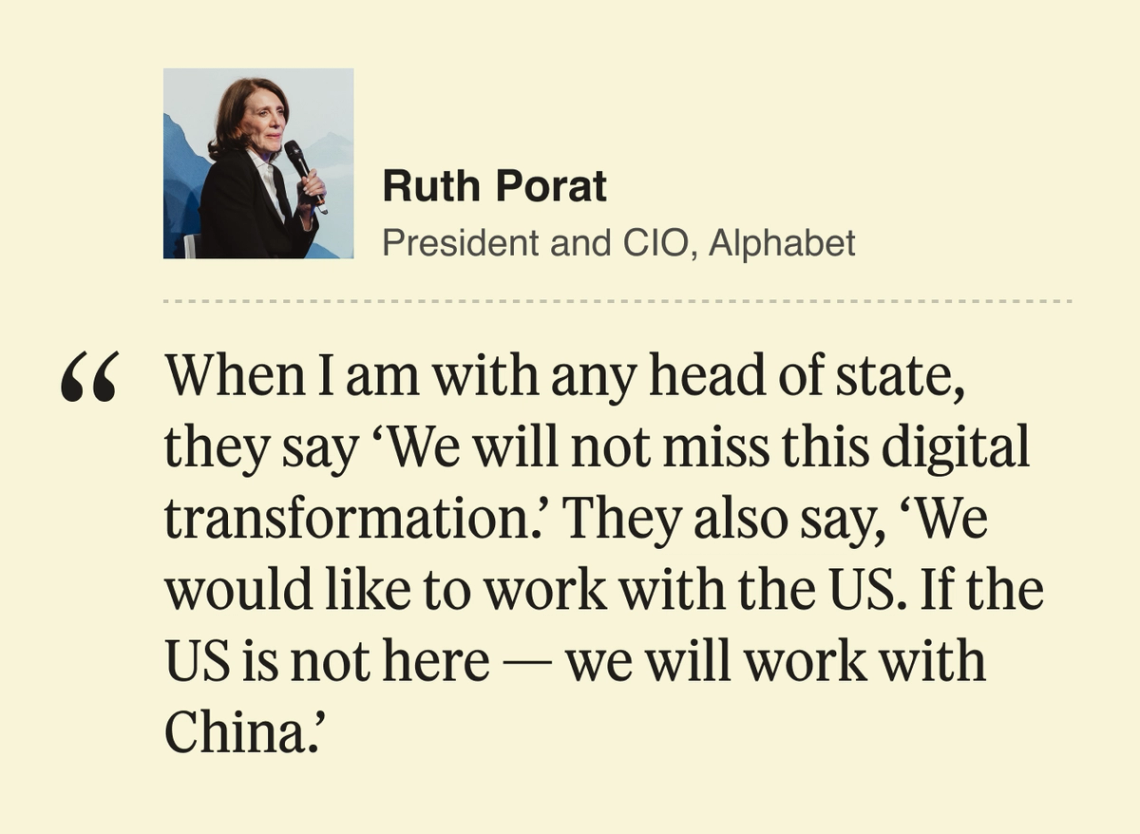 |
|
 Defense- UAE-based defense company EDGE Group and Qatar’s Barzan Holdings have formed a joint venture to develop advanced defense technologies. EDGE and Anduril agreed in November to work on developing autonomous systems.
Diplomacy |
|
|


