|
|
|
|
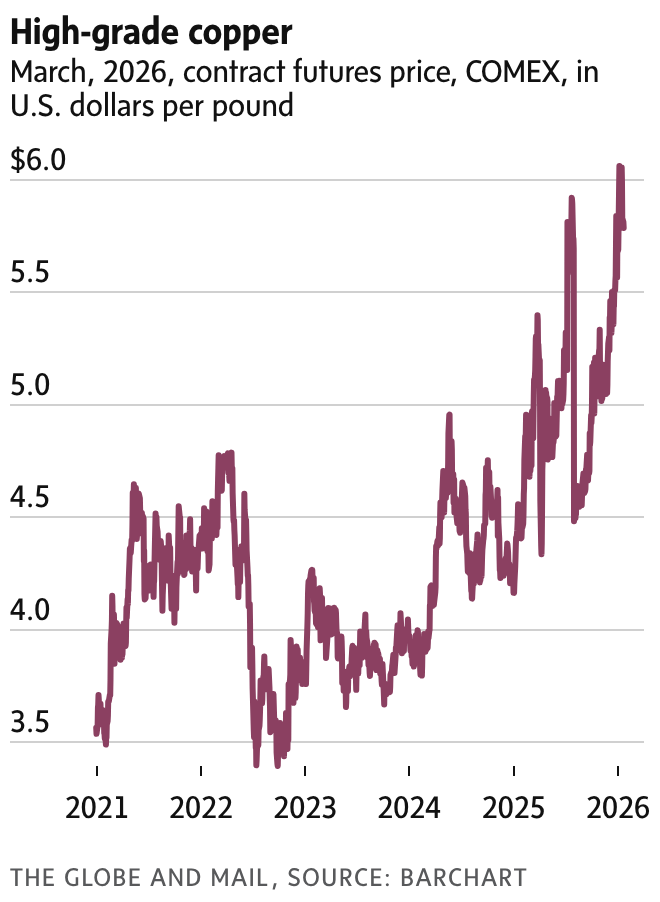
Good morning to you. Today caps what has been, to put it mildly, an eventful week. The events in Davos – a frightening new world order and a Greenland U-turn – revealed something profound about how our world is changing. The result is a time that is both frightening and exciting. That’s in focus today, along with the true price of copper in Zambia. |
|
|
|
|
|
|
|
|
|
|
|
|
|
|
|
|
|
|
|
|
|
|
|
|
|
|
|
|
Auto: Chinese car maker Chery eyes expansion into the Canadian EV market |
|
|
|
|
Rewind: Why was BYD’s first manufacturing foothold in Canada a bust? Let’s go back to 2019 |
|
|
|
|
|
|
|
|
|
|
|
|
|
|
|
Prime Minister Mark Carney appears on a screen as he speaks during the World Economic Forum in Davos, Switzerland this week. Denis Balibouse/Reuters
|
|
|
|
|
|
|
|
|
|
|
Zooming further out from Davos |
|
|
|
|
Hi, I’m John Rapley. After decades working in academia and the policy sector, a few years ago I took up the writing life. Among my other work, I now contribute a weekly economics column for The Globe and Mail. Given the drama unfolding in Davos and the squabble over Greenland, my editor Ethan Lou asked me to write an essay trying to make sense of what just happened. |
|
|
|
|
U.S. President Donald Trump, with his lust for Greenland and hectoring of Europe, thinks the world is at his mercy, and that the U.S. is invincible. He’s right on the first point. But he discovered this week that he’s wrong about the second one. In Davos at the World Economic Forum, Trump climbed down on his Greenland threats after his actions caused chaos in the markets. |
|
|
|
|
|
|
|
|
Admittedly, trying to make sense of anything involving Trump can be a tall order. His speech at Davos
was alarming less for its content, but for its lack thereof: the fact that he rambled incoherently for an hour is being taken by many observers as a President whose faculties may be declining. This seems to be becoming an American stock-in-trade. |
|
|
|
|
In fact, the most talked-about speech
at the World Economic Forum was delivered not by the U.S. President but by our own Prime Minister, Mark Carney. It would not be much of an exaggeration to say that as the week progressed, the whole world was talking about it. What impressed listeners was not just Carney’s astute diagnosis of the fact that the old world has died, but his prescription of where we go from here. |
|
|
|
|
The old regime that Carney declared dead is what was called the U.S.-led rules-based international order.
Having emerged after the Second World War, it reached its apogee in the decades that followed the end of the Cold War, when the U.S. stood alone as a somewhat enlightened global hegemon. However, with the rise of China and the U.S.’s inward turn, the old order sank into crisis; Trump’s assertion of a new form of imperialism has finally buried it. |
|
|
|
|
The story won’t end there, though. This was merely the start to what will be a long and bumpy course ahead, because it’s just one of the plotlines in an even bigger story: the relative decline of the West. |
|
|
|
|
And it’s not just this week. The past year has been humbling for Western countries, including Canada. |
|
|
|
|
As I argued in my last book, this process began around the turn of the millennium, as the former global periphery began to rise faster than the Western economies, and then gained speed after the 2008 global financial crisis. To then maintain their public services amid slowing economic growth, Western governments resorted to borrowing, using the creditworthiness they’d built over two centuries of global dominance. |
|
|
|
|
Such debt is dangerous. It piles, and then, as the events of this week showed, you become beholden to it. Trump was forced to climb down on Greenland partly because investors dumped U.S. bonds, making it more expensive for the U.S. to service its debt – a prospect that threatens the stability of the country if it escalates. |
|
|
|
|
In the words of a former adviser to president Bill Clinton on reincarnation: “I would like to come back as the bond market. You can intimidate everybody.” |
|
|
|
|
So, where to now, in this new world order? |
|
|
|
|
The good news is that Carney has given us a good map. The bad news is that we have to do the difficult job of trying to follow it. On that, watch for columnist Tony Keller’s essay in our Saturday newspaper. |
|
|
|
|
|
|
|
|
|
|
|
|
|
|
|
|
A boom with a toxic price |
|
|
|
|
|
|
Zambia is one of the world’s most mining-dependent countries, and copper generates more than 70 per cent of its export revenue. But it comes at a cost: toxic pollution and spills are spoiling crops and development is forcing people to move, while international miners continue flocking to the country – and the Canadian-owned mines leave challenges for the future, too. |
|
|
|
|
|
|
|
|
|
|
|
|