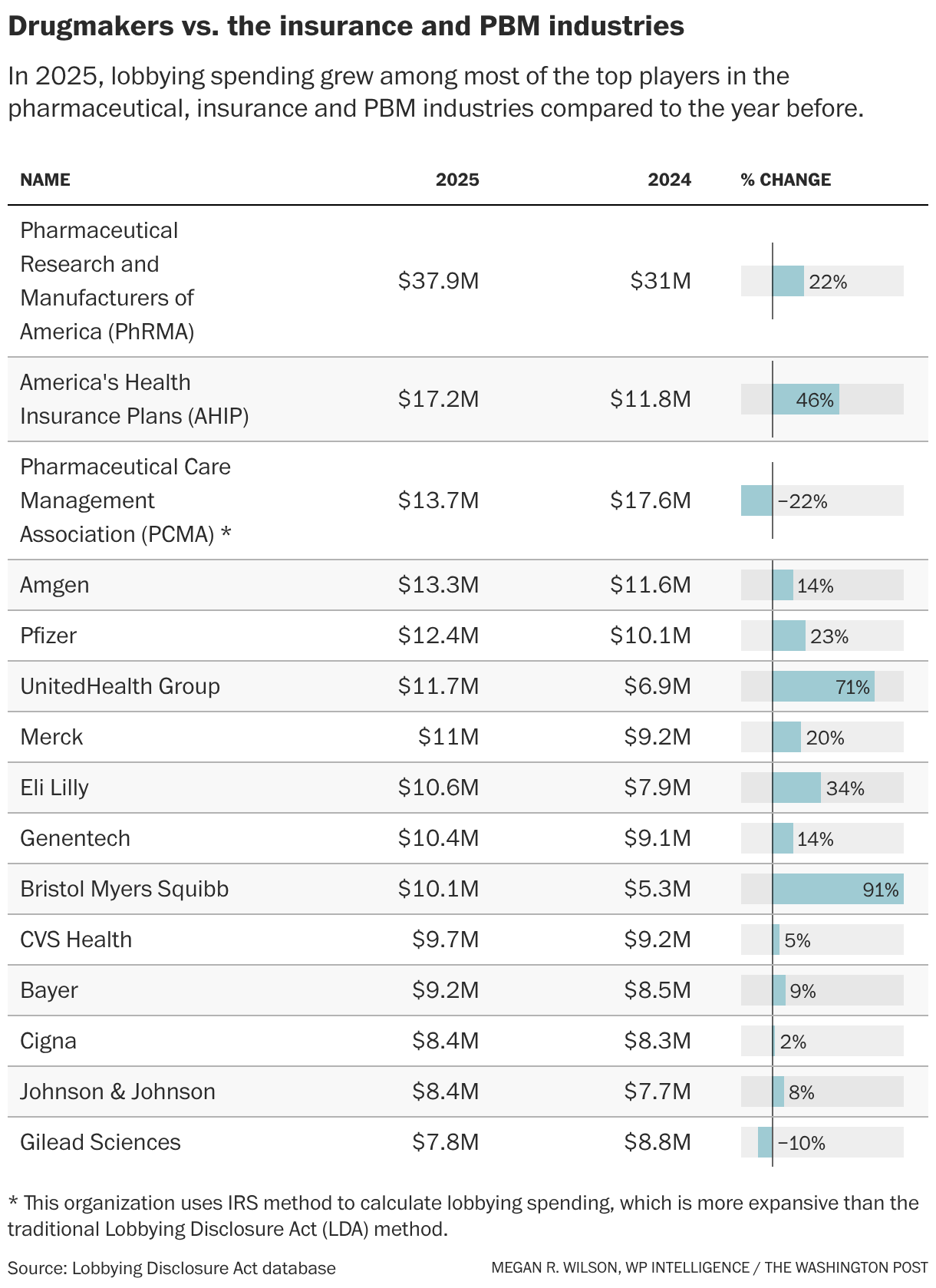
| → Only the U.S. Chamber of Commerce and the National Association of Realtors — which each represent millions of members — spent more on lobbying over the last two years. PhRMA, which represents 34 member companies, is laser-focused on a small portfolio of issues at the federal level, directing much of its firepower at PBMs in recent years. Some of PhRMA’s policy asks — including a provision to separate a PBM’s revenue from the price of medicines it selects for Medicare Part D plans to cover — are in the House-passed government funding legislation. Critics have argued that PBMs have an incentive to choose higher-priced drugs so they can exact larger discounts from pharmaceutical companies and pocket the difference, a claim the industry has denied. Instead, the legislation would allow PBMs to collect a “bona fide” fee for the service they provide. The Senate is expected to approve the bill next week. → Although other groups — including ones representing pharmacies and employers — helped push the PBM reform issue along, none could match drugmakers’ advocacy war chest and wide-ranging advertising campaigns that blanketed podcasts, television networks and the internet. The ads blamed PBMs for high drug prices and argued the industry — which negotiates discounts on drugs and selects which medications an insurance plan will cover — had become too consolidated. The largest PBMs are owned by insurance companies — Cigna owns Express Scripts, CVS Health owns CVS Caremark, and UnitedHealth Group owns Optum Rx — and many have their own affiliated pharmacies. Meanwhile, the industry group representing PBMs, called the Pharmaceutical Care Management Association (PCMA), launched its own seven-figure ad buys to push back, arguing that the rebates they negotiate with drugmakers help keep costs down. However, momentum behind reform proposals continued gaining on Capitol Hill. → Now PCMA says the PBM policies in the government-funding legislation will “make health care more expensive.” The House “has sided with Big Pharma over American families facing a painful affordability challenge,” said new PCMA President and CEO David Marin, who started earlier this week. Marin urged the Senate to reject the bill, though doing so is unlikely to happen, in part because it would likely trigger a government shutdown. “This policy is a gift to the pharmaceutical industry, which has long sought to tie the hands of PBMs. That’s because PBMs exist to fight back against drugmakers’ egregiously high prices,” Marin said, arguing that lawmakers should keep the focus on the pharmaceutical industry itself. “If the Senate does not reject this policy, lawmakers will come to regret these costly mandates.” WHAT’S NEXT Congress could theoretically go further on PBMs in the future, but the industry would likely engage in even stronger pushback that could complicate any future efforts. Lawmakers, drugmakers and other industry players that have long pushed for reforms are likely to consider these changes, if enacted, as a major victory. → So, what does that mean for PhRMA’s advocacy agenda? The group won’t show its cards. But it’s likely to turn more of its efforts on hospitals as it lobbies policymakers to curtail the 340B discount drug program that compels pharmaceutical manufacturers to give hospitals that serve low-income and uninsured patients massive markdowns on medications. As talk of affordability grows in Washington, PhRMA may also need to double down on defense. In President Donald Trump’s “Great Healthcare Plan,” he calls on Congress to codify the most-favored nation (MFN) drug pricing deals the administration made with 16 drug companies. The deals, which are confidential, involve lowering prices on medicines in the U.S. to match prices in other wealthy nations. → Fifteen of PhRMA’s members have cut deals with the Trump administration — with most proudly announcing them in flashy White House press conferences — but the industry broadly is worried about pushing MFN policies further. Following the plan’s release, Alex Schriver, a spokesperson for PhRMA, cautioned against price controls for the pharmaceutical industry. “Imposing broad-based price controls does nothing to address insurance barriers and would instead threaten access to breakthrough treatments and undermine critical investments that strengthen the U.S. economy,” Schriver said. | 

_tstmp_1756933376-1920-1080.png)





_tstmp_1769210240-1280-0.png)