| | Oil prices held above $100 a barrel on Thursday as peace talks between the US and Iran collapsed bef͏ ͏ ͏ ͏ ͏ ͏ |
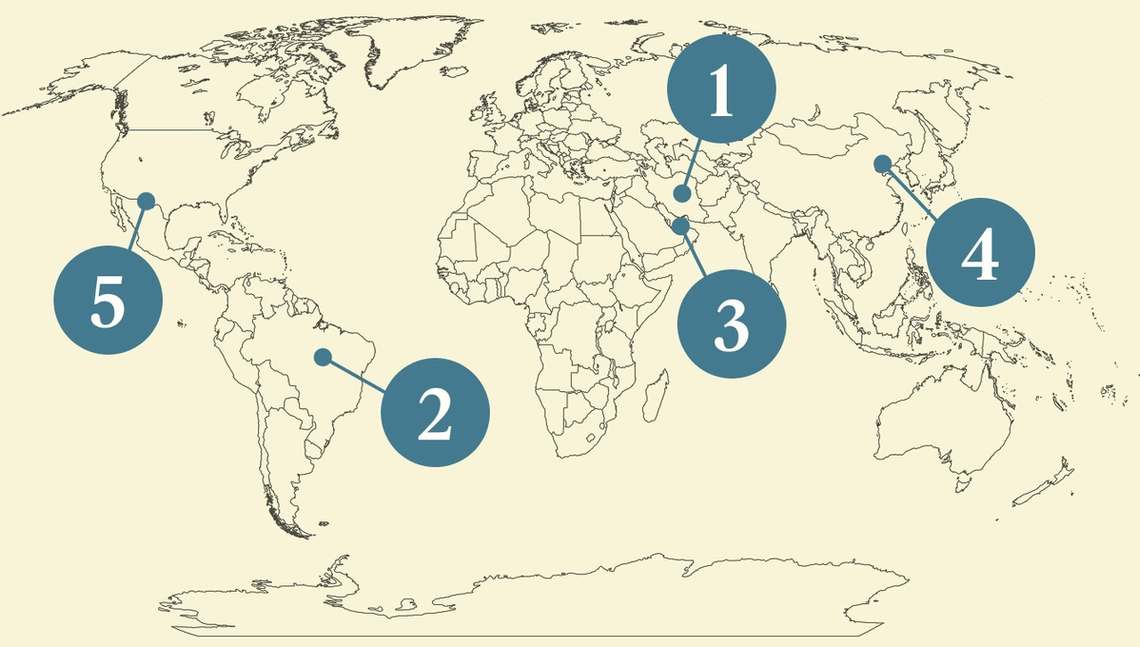
| |  Brasília Brasília |  Abu Dhabi Abu Dhabi | Beijing |
 | Energy |  |
| |
|
 - Blockade dispute
- Biofuels bounce back
- Fertilizer set to jump
- Record solar exports
- Data center kerfuffle
 The US gets a new leader for local climate action, while the EU reconsiders Arctic drilling. |
|
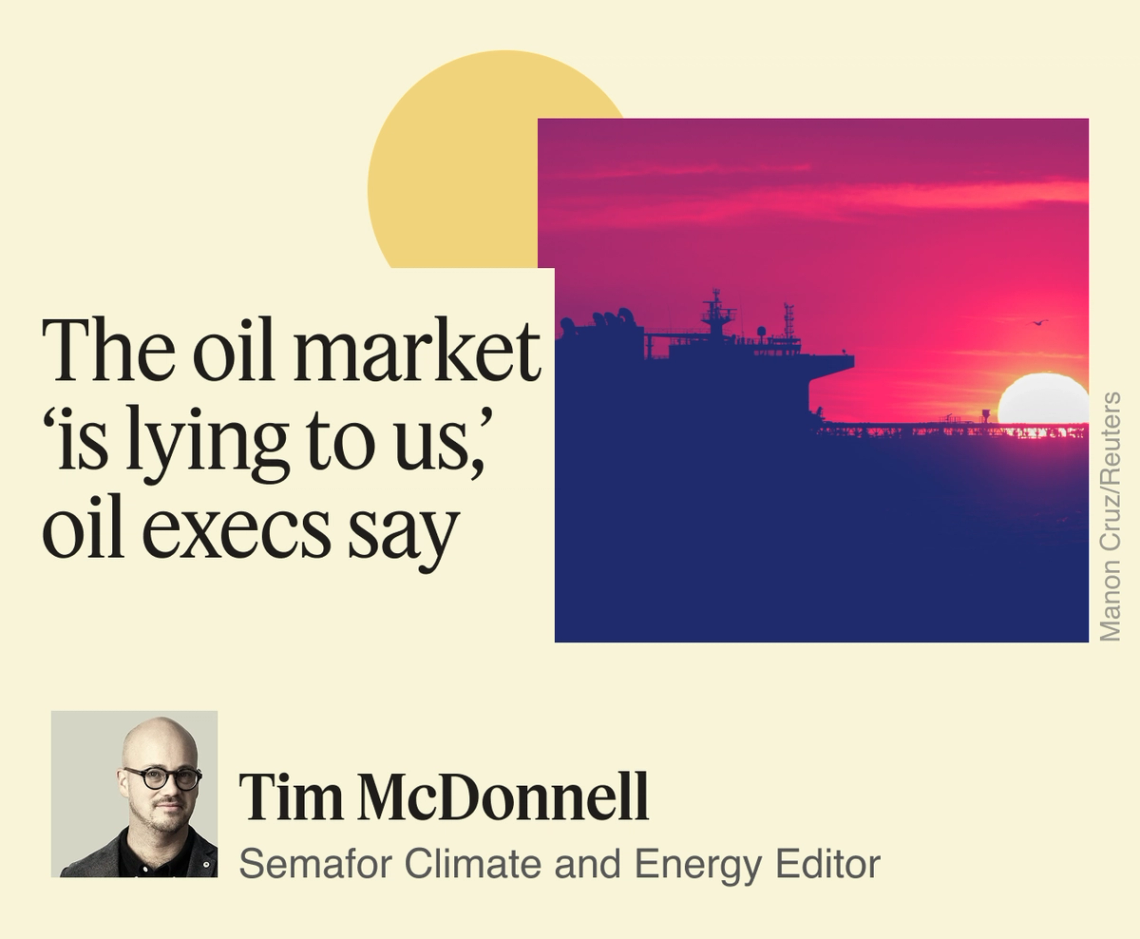 Big Oil is making money but losing sleep. Sure, high oil prices are nice; we’ll find out next week exactly how nice when the majors report first-quarter earnings. But what goes up must eventually come down. And even though US oil executives and insiders are worried that energy market disruption stemming from the war in Iran is poised to get significantly worse, they’re not ready to ramp up drilling to counteract it. “The real problem is the back end of the curve is lying to us,” Kaes Van’t Hof, CEO of Texas independent producer Diamondback Energy, said during an energy summit at Columbia University this week. He was referring to the widening gap between the high price for oil delivered today, and the significantly lower price for oil futures contracts, a gap that reflects Wall Street’s sanguine view that the Strait of Hormuz will be reopened soon. The low future price signal is both misleading — because it severely underplays the likelihood of forthcoming major disruptions to airlines, food systems, and other energy users — and a deterrent to drilling investment, Van’t Hof said: “I do think you’ll see US production respond slightly, but it’s nothing compared to the size of the issue, like putting a garden hose into an emptied Olympic-sized swimming pool.” Backstage at the Columbia event, other energy executives and observers expressed frustration about what they see as mixed signals from the Trump administration — which says publicly the crisis is almost over but privately is still urging companies to drill more — and trepidation about the possibility that increasing US oil exports, a development Trump has celebrated, could backfire by driving up domestic prices and fueling political momentum for a crude oil export embargo, a move that would be disastrous for the industry. Throughout the conflict, execs and observers told me, the administration ignored or downplayed well-known red flags about risks to the strait, waited too long to try to rally the industry, and failed to take preparatory measures that could have given the energy market a bit more flexibility and bought Trump’s negotiators more time. Traders and US officials also got too comfortable over the past few years with the idea that massive US production could buffer any geopolitical shock, Bob McNally, president of the consulting firm Rapidan Energy Group and former energy adviser to President George W. Bush, told me. Now they’re being Pollyannaish. “All the barrel-counters agree the Hormuz disruption is going to cause a severe crisis due to shortages and price spikes, but so far the broader community of macro investors and traders seems to have a rosier view,” he said. “It’s extremely rare — if not unprecedented — for all barrel-counters to agree, so someone’s really wrong.” I’ll be on vacation next week, though this briefing’s schedule won’t change. You’ll still get Semafor Energy on Tuesday and Thursday, and I’ll be back on May 5. |
|
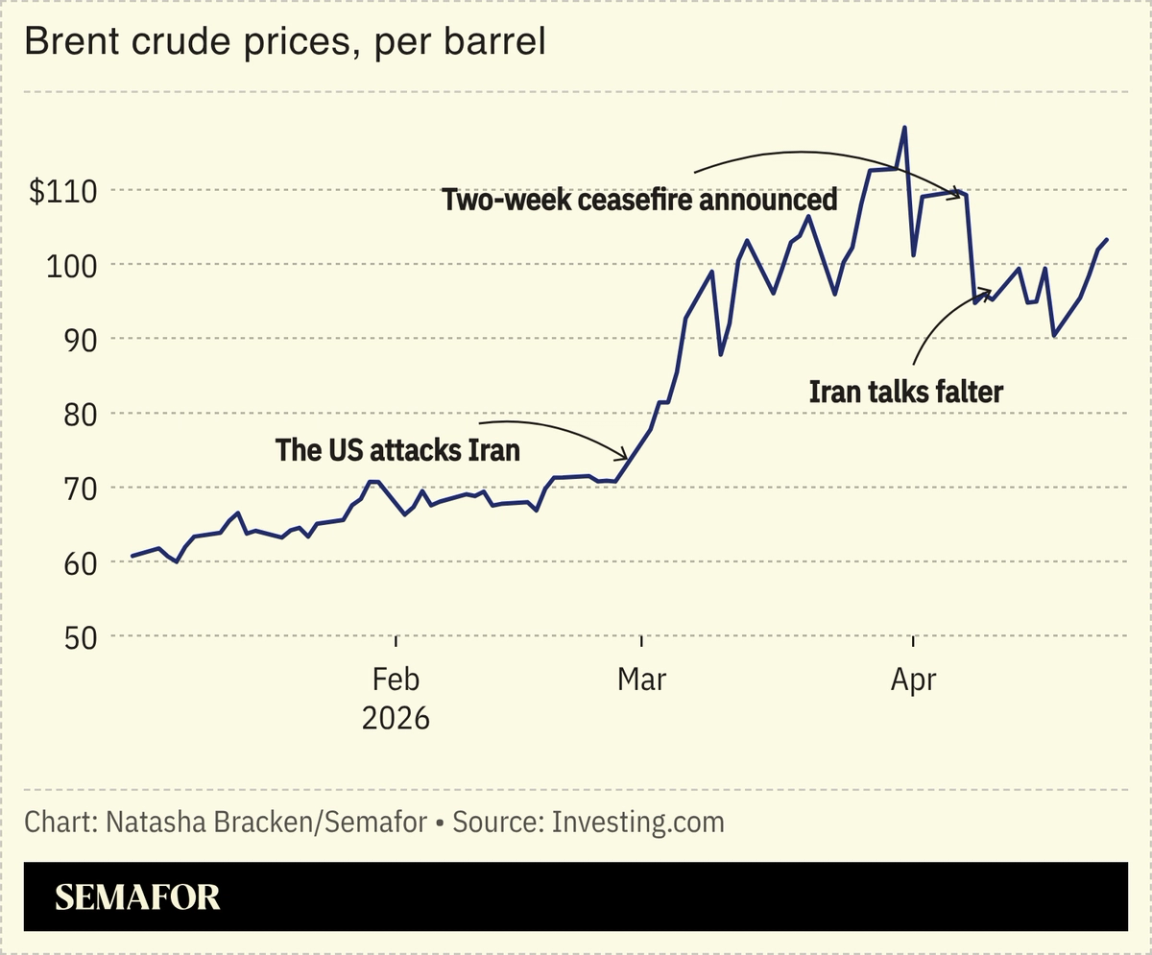 Oil prices held above $100 a barrel on Thursday as peace talks between the US and Iran collapsed before a second round could take place, while Washington and Tehran both sought to assert control over the Strait of Hormuz. US President Donald Trump indefinitely extended a ceasefire with Iran, but vowed to maintain a blockade on Iranian ports. Tehran, meanwhile, said it would not engage in diplomacy so long as Washington’s blockade remained in place. Tensions in the strait have since deepened: Iran said it had seized two container ships seeking to exit the Gulf through the strait on Wednesday, while the US military intercepted at least three Iranian-flagged tankers in Asian waters, redirecting them from positions near India, Malaysia, and Sri Lanka, Reuters reported. Beyond the disruption the conflict with Iran is causing to global energy supplies — from which the US is not insulated, with gasoline prices rising to the highest level in almost four years — satellite imagery suggests oil spills from the war may soon trigger an ecological catastrophe. Spills in the Persian Gulf are now visible from space after air strikes by all parties hit oil facilities and tankers across the region, threatening marine life and the filtration systems of desalination plants. |
|
| |  | Nithin Coca |
| |
 Diego Vara/File Photo/Reuters Diego Vara/File Photo/ReutersThe outlook for biofuels may finally be brightening: With the de facto closure of the Strait of Hormuz choking off oil and gas deliveries to much of the world, prices for biofuels are increasing just as many countries look to up their investments in a bid to head off an energy catastrophe while not straying too far from emission-cutting commitments. But analysts say the pivot is rife with problems. Biofuels’ energy security benefits are limited, and their climate credentials are contested. Ultimately, officials betting on biofuels may not achieve the outcome they were hoping for. Most biofuels consumed globally come from food crops such as corn, palm oil, rapeseed, and sugar. These food-based biofuels boomed after the Kyoto Protocol, alongside a push in Europe and the US to expand their use in transportation. But their growth has stalled over the past 15 years, mainly because of high costs and growing questions over their climate impact, and amid a boom in EVs and renewable energy. |
|
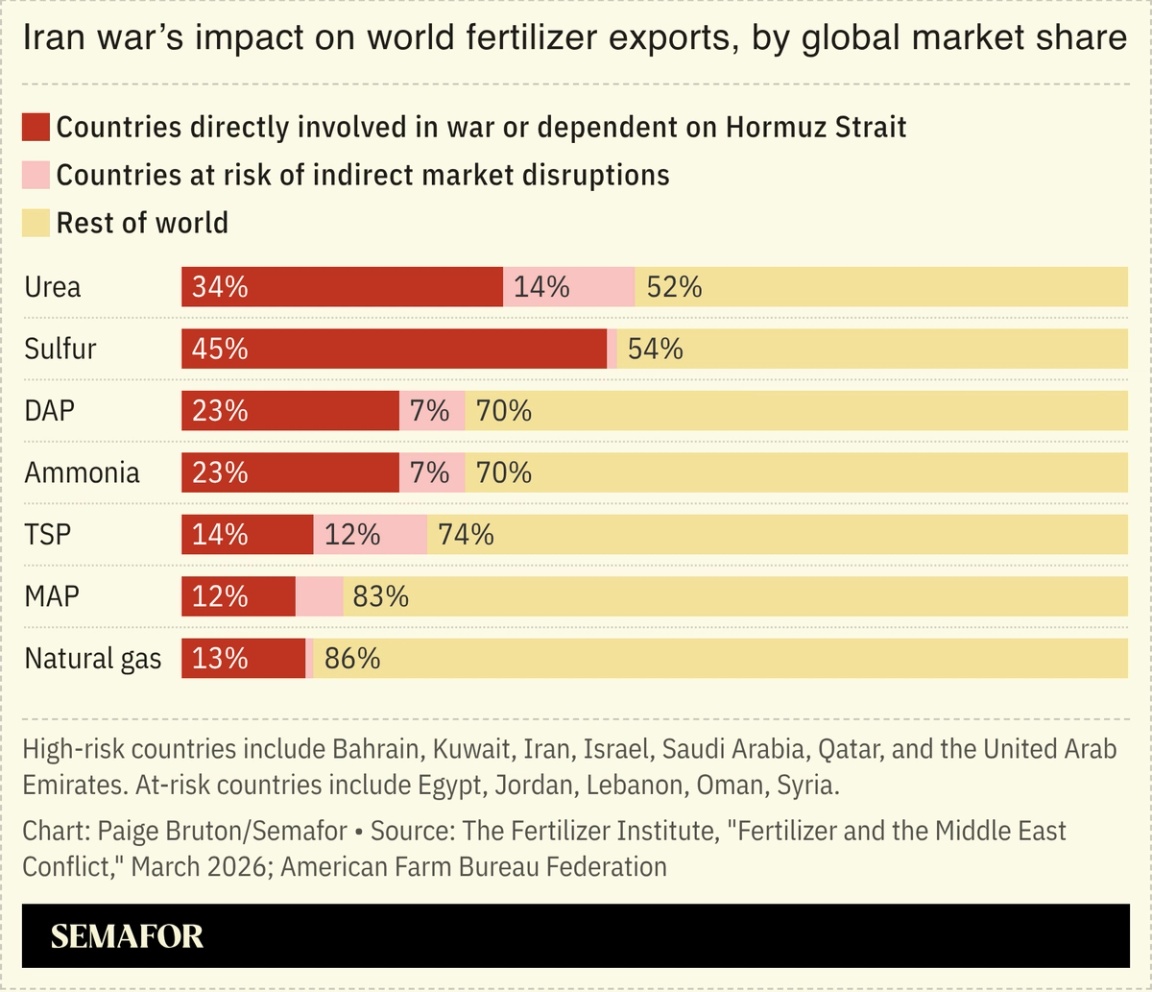 Fertilizer prices are poised to surge even higher, and could take “months and months” to normalize after the Strait of Hormuz reopens, the CEO of a top global producer told Semafor. The price of nitrogen-based fertilizers has more than doubled as the strait closure chokes off one-third of global urea exports and one-fifth of ammonia, the fertilizer’s key ingredients. Yet with tropical countries approaching the year’s first planting season, prices for key commodity crops haven’t yet budged, putting farmers in a bind. Many will likely choose not to use fertilizer this year, said Ahmed El-Hoshy, chief executive of Abu Dhabi-based Fertiglobe, which will mean food shortages and inflation in the months ahead. When a durable peace is reached, allowing ships to once again traverse the strait, fertilizer companies will still have to wait for natural gas production in the Gulf to ramp up to regain their feedstock supply, which will take months or even years. And, there’s still no alternative fertilizer “that is economically viable at scale,” El-Hoshy said. Meanwhile, climate change continues to put pressure on the food system; a UN report this week warned that extreme heat is pushing farmers “to the brink.” |
|
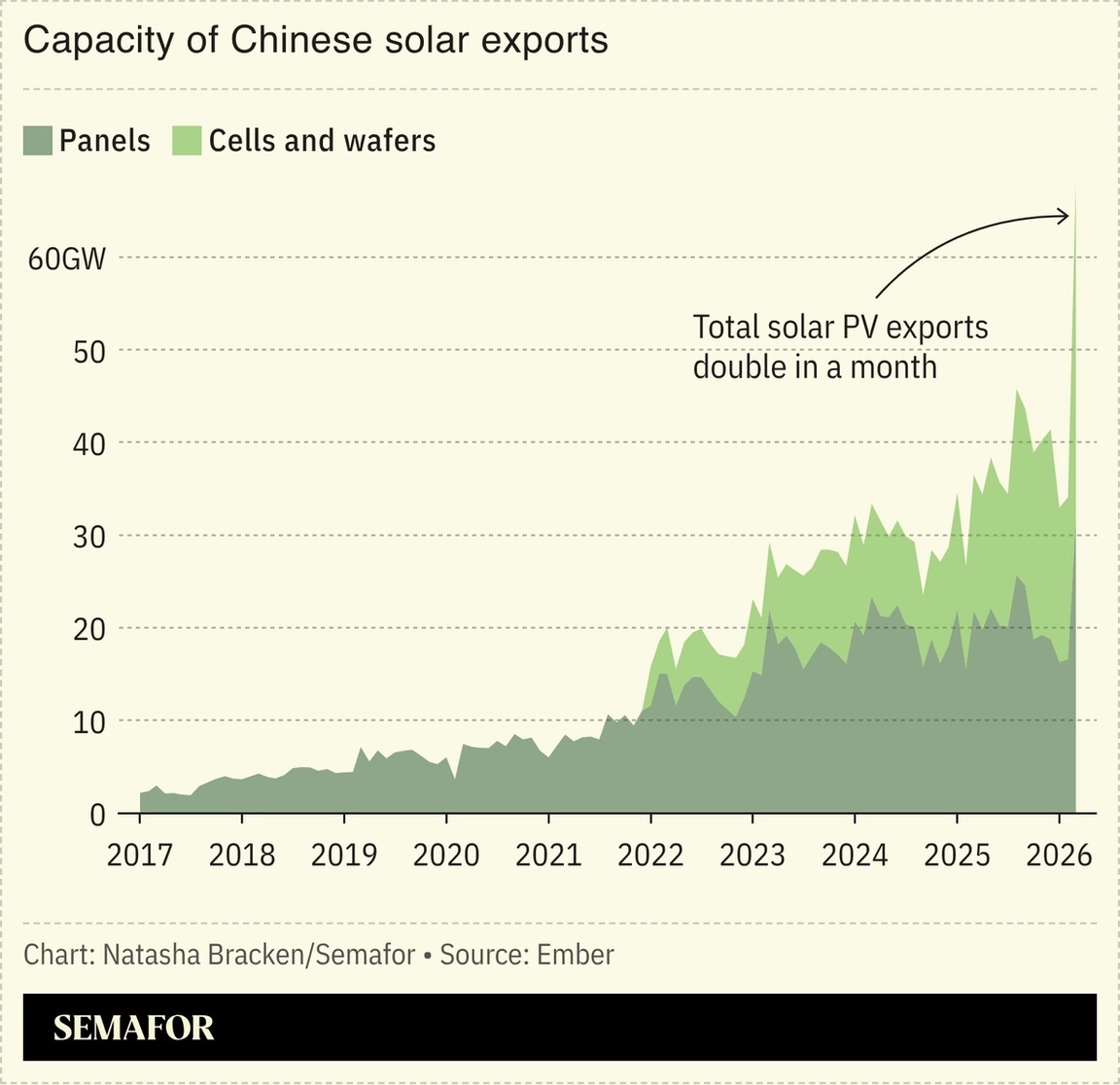 China’s solar exports hit an all-time high in March, as countries stockpiled ahead of an expected price increase and those most exposed to the effective closure of the Strait of Hormuz scrambled to find alternative energy sources. Chinese solar exports doubled from the previous month to reach 68GW in March — equivalent to Spain’s entire solar capacity — according to the think tank Ember. Africa and Asia, both heavily dependent on fossil fuel imports from the Middle East, together accounted for three-quarters of the increase. Both regions are also investing more in domestic manufacturing and assembly: Chinese exports of cells and wafers overtook panel exports in October 2025, Ember said. Clean technology is, in other words, increasingly acting as a reliable substitute to fossil fuels in times of energy crisis. Ember’s latest electricity report found that record solar generation growth in 2025 was enough to displace gas-fired electricity equivalent to all LNG exports through the Strait of Hormuz last year, while the global EV fleet displaced 1.8 million barrels per day of oil demand, roughly 13% of US crude oil production. |
|
 Leah Millis/Reuters Leah Millis/ReutersTurmoil at the Texas data center company Fermi is a cautionary tale about what happens when a startup jumps too quickly into the AI development boom. Fermi was an early mover in the “powered land” business model, with a plan to lease space to tech companies on an enormous tract it was equipping with 17 gigawatts of sparkling new gas turbines and nuclear reactors. It had some big advantages, especially political backing from the Trump administration — the president’s former Energy Secretary Rick Perry is a cofounder — that allowed it to secure rare gas turbines from Siemens. But six months after a high-profile IPO, the company’s share price has crashed, and its CEO and CFO both left their posts this weekend, reportedly over disagreements about whether to sell the firm (Fermi didn’t respond to a request for comment). The biggest problem — among others documented in a good feature this week by cleantech researcher Michael Thomas — was the company’s decision to go public before securing a primary tenant. Other startups pursuing similar projects are now moving much more cautiously, one Wall Street financier tracking the sector told me. “The project was marketed as AI-ready infrastructure before it’d secured anchor offtake, tenant-driven cooling, financing certainty, and credible delivery sequencing,” said Paresh Patel, founder of Equitable Energy Ventures, a Houston-based clean tech startup investor and adviser. “This was less an AI-demand bust than a bankability collapse inside an over-marketed megaproject that went public before the core pieces were truly locked. The real story isn’t that AI demand is fake or overstated. It’s that [in this case] the market got ahead of what was actually financeable and executable.” |
|
 New Energy- A US federal judge ruled in favor of renewable energy developers challenging the Trump administration’s actions against wind and solar projects, the latest in a string of courtroom defeats for the administration over its targeting of clean energy.
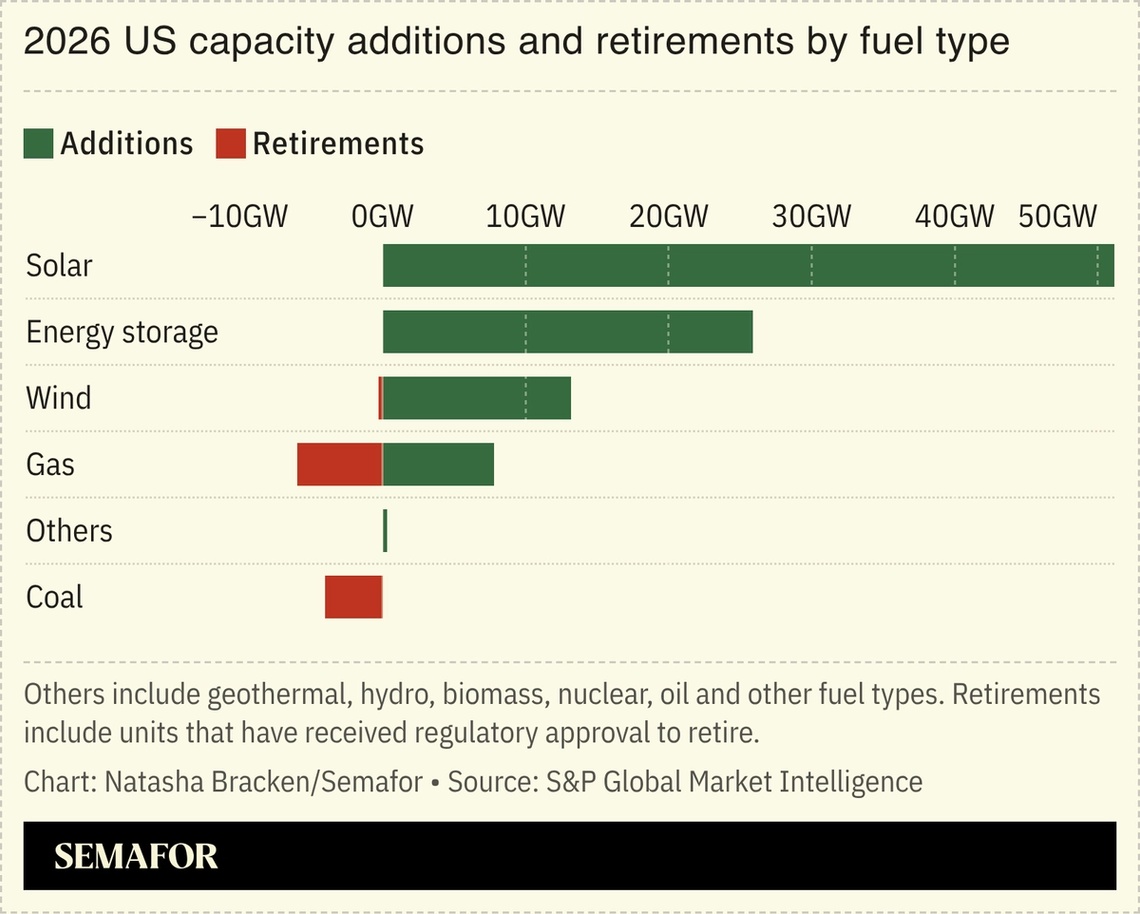
- And despite the Trump administration’s latest efforts to deploy fossil fuels en masse, developers across the US could add more than 90 gigawatts of clean energy and storage in 2026 alone, according to S&P Global Market Intelligence.
 Fossil Fuels- The average price for a long-haul airline ticket in Europe has risen by more than $100 since the outbreak of the Middle East war, according to an environmental advocacy group.
- Ukraine said it had completed repairs to the Druzhba oil pipeline, paving the way for the resumption of Russian oil flows to Europe as part of a controversial deal to secure a €90 billion EU loan to fund its military campaign against Moscow.
- A growing number of energy companies are listing Venezuela as a lobbying priority, according to Axios.
- The EU is weighing abandoning its proposal to ban new oil and gas drilling in the Arctic as it looks to increase its energy supplies amid the Iran war.
Finance- A Beijing-based space startup secured $8.4 billion in financing commitments from state-owned or -linked banks, part of China’s efforts to explore building orbital data centers.
Politics & Policy- The European Commission announced plans to cut electricity taxes and coordinate gas storage refills across member states this summer, but stopped short of capping gas prices or taxing energy companies’ windfall profits.
Minerals & Mining- US allies should pay more for critical minerals sourced from outside of China, the White House’s trade representative said, as Washington looks to break Beijing’s dominance in the sector.
|
|
|


