| | In today’s edition: Dubai greenlights $9 billion rail expansion, and Gulf residents embrace newly af͏ ͏ ͏ ͏ ͏ ͏ |
| |  | Gulf |  |
| |
|
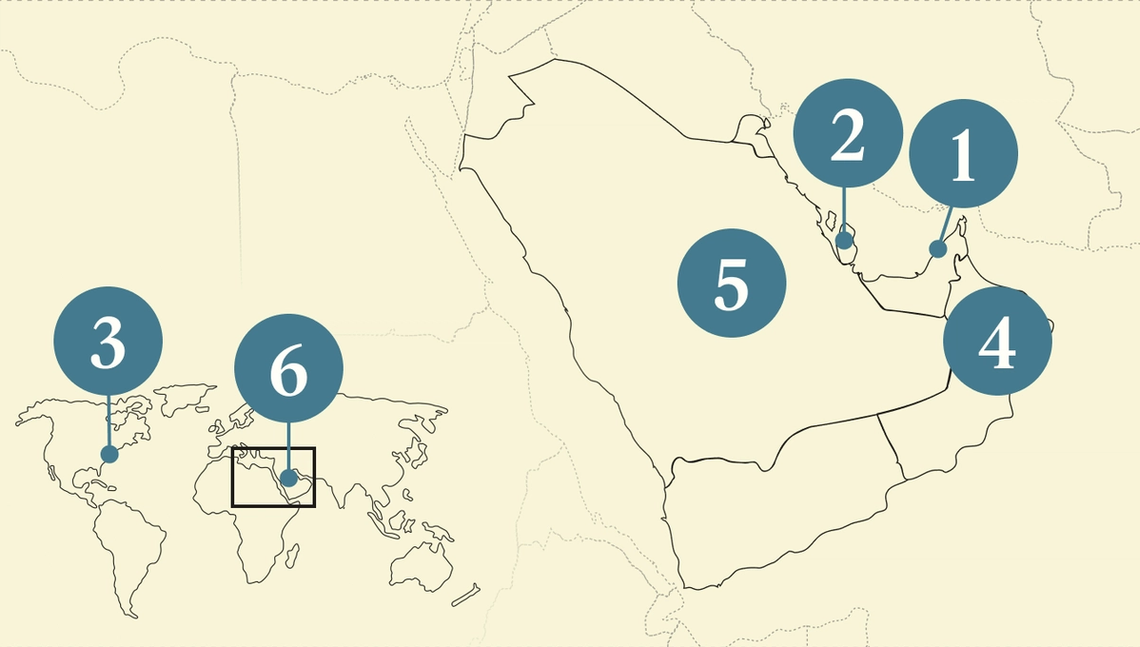 - Dubai commits to stimulus
- Rare Qatari trade deficit
- Big Oil’s fears
- War winners and losers
- Saudi house prices dip
- Staycation surge
 Saudi geopolitical hedging, the rise of killer robots, and other weekend reads. |
|
Dubai’s $9B metro stimulus |
 @HHShkMohd/X @HHShkMohd/XDubai plans to build a 42-kilometer (26-mile) metro line costing more than $9 billion, providing a major economic stimulus as the emirate tries to shake off the impact of the Iran war. The all-underground Gold Line is Dubai’s largest transport project to date and is scheduled to be completed by September 2032. Dubai is looking to shore up confidence in the emirate after it was repeatedly attacked by Iranian missiles and drones, shaking a perception of security fostered over decades. Tourist arrivals to the city have collapsed, hitting hotels and airlines, and property prices declined in March for the first time since the pandemic, according to data compiled by consulting services provider ValuStrat. As a result, Dubai’s leaders have increased their public interactions with the city’s business community during the war, projecting calm and vowing to come back stronger. “Our future endeavours will not stop; rather, they will accelerate,” Dubai Ruler Sheikh Mohammed bin Rashid said on Wednesday. — Matthew Martin |
|
Qatar’s trade balance heads into the red |
 Qatar’s projected trade deficit in March, its first in more than a decade, according to Dubai-based bank Emirates NBD. While the country’s National Planning Council has yet to release official figures for March, Emirates NBD has the metric swinging from a 12 billion riyal ($3.3 billion) surplus in February to a shortfall of 4.4 billion riyals in March, as the Iran war halted the gas-rich country’s energy exports. Qatar’s trade balance had been edging down in recent years as a result of lower energy prices, but that trend was due to be turned around by the coming expansion of its liquefied natural gas output. Those plans are now delayed and repairing the war damage to existing LNG plants at Ras Laffan could take as long as five years. Doha does at least have substantial financial resources to cushion the blow: It began the year with 261 billion riyals in reserves at the central bank and its sovereign wealth fund has assets worth $600 billion. — Dominic Dudley |
|
View: High prices but still worried |
| |  | Tim McDonnell |
| |
 Vincent West/File Photo/Reuters Vincent West/File Photo/ReutersBig Oil is making money but losing sleep, Semafor’s climate and energy editor wrote in a column today after speaking with industry executives and government officials. High oil prices are nice, he wrote, but what goes up must come down. US oil executives are worried that energy market disruption from the war in Iran is poised to get significantly worse, and they’re not ready to drill their way out of it. “The real problem is the back end of the curve is lying to us,” Diamondback Energy’s CEO said at a Columbia University energy summit this week — referring to the widening gap between today’s high spot price and significantly lower oil futures, which reflect Wall Street’s assumption that the Strait of Hormuz will reopen soon. That low future price is both misleading and a deterrent to new drilling, the CEO said. Backstage, executives vented about mixed signals from the Trump administration — publicly saying the crisis is nearly over while privately urging companies to drill more — and worried that rising US oil exports could fuel political momentum for a crude export embargo, which would be disastrous for the industry. |
|
Who wins with higher oil prices |
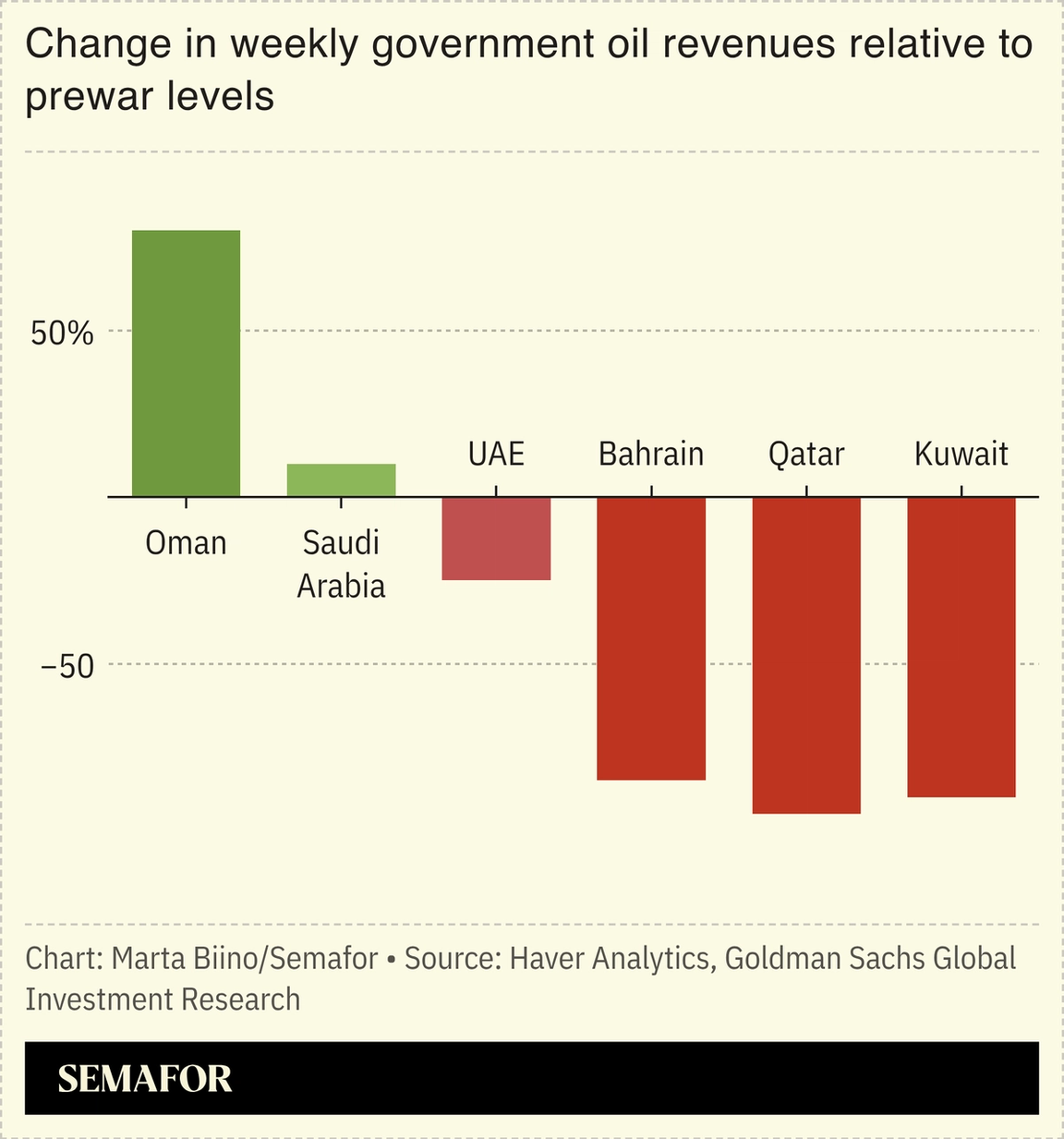 Oman and Saudi Arabia can expect a windfall from higher oil prices due to the Iran war, according to Goldman Sachs. Oil revenues for the two countries have risen as crude prices have surged due to the effective closure of the Strait of Hormuz; with all its ports outside the Gulf, Oman’s trade has been unaffected, while Saudi has been able to direct exports via its western ports. But revenues have dropped in Bahrain, Kuwait, Qatar, and the UAE, the bank said in a note to clients, in one of the most detailed estimates of the financial impact of the conflict. Weekly oil revenues have almost doubled for Oman and are up 10% for Saudi Arabia. With the region’s exports down, the six Gulf countries’ cumulative weekly borrowing requirements have doubled from $1.7 billion to $3.5 billion, the bank said. Still, Gulf states have ample financing options — including international and local currency bond markets, swap lines, and their own international reserves and sovereign wealth fund assets — to plug the gap. — Matthew Martin |
|
Saudi real estate feels war ripples |
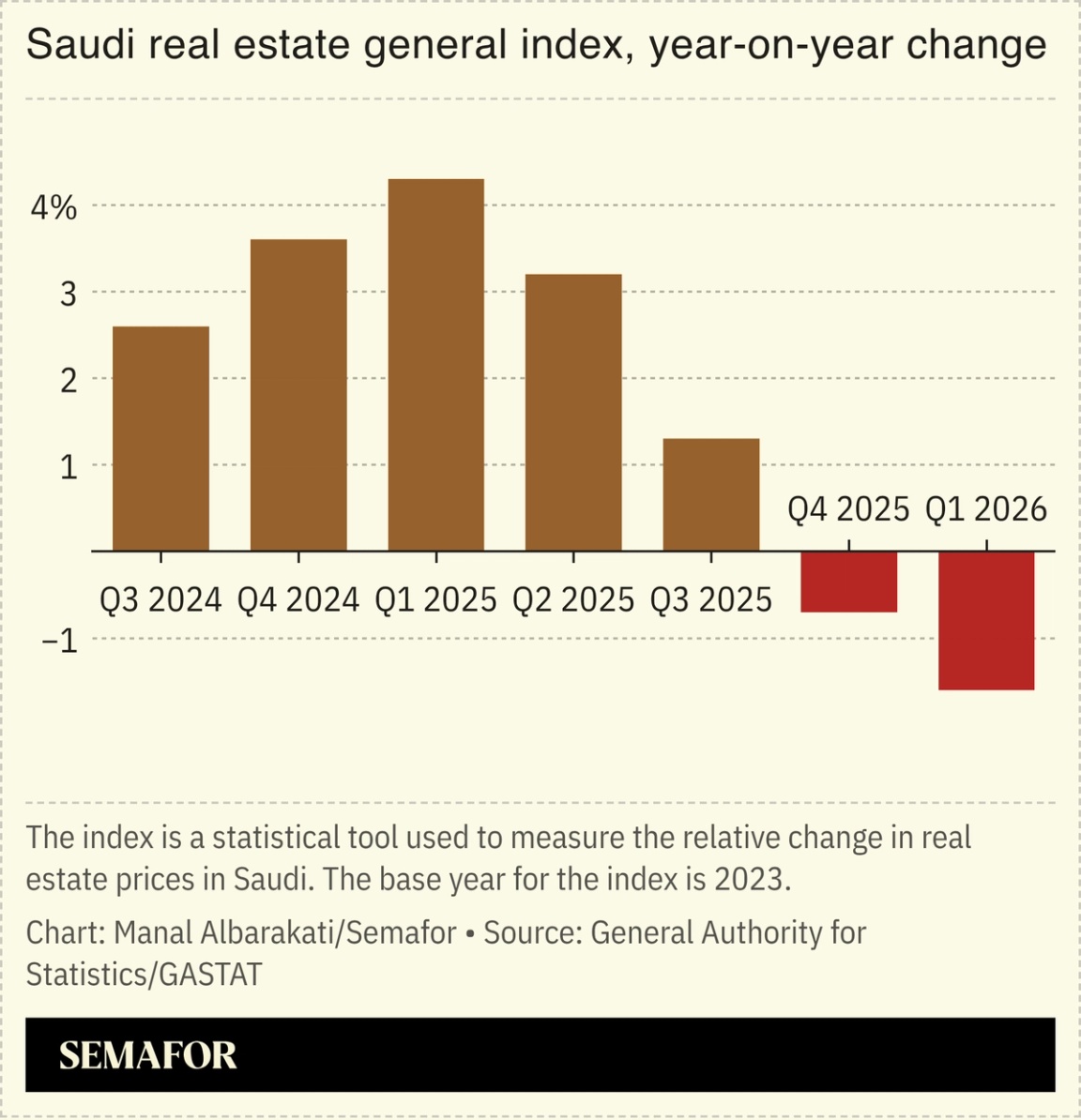 Saudi real estate prices fell 1.6% year-on-year in the first quarter of 2026, as a government crackdown on soaring housing costs and the disruption of the war combined to accelerate a decline that had begun in the previous quarter. The drop was driven primarily by a 3.6% fall in residential prices. In contrast, commercial prices rose 3.4%. Riyadh saw the steepest regional decline at 4.4%; prices had doubled in the capital between 2019 and 2025, AGBI reported. The government had been moving to cool the market before the conflict began: Crown Prince Mohammed bin Salman had described rising housing costs as “unacceptable,” and Riyadh has raised taxes on undeveloped land to encourage firms to launch more projects. |
|
War brings Gulf residents luxury access |
 A spa treatment at Shebara, Red Sea. @Shebara/Instagram. A spa treatment at Shebara, Red Sea. @Shebara/Instagram.For years, booking the Gulf’s most coveted hotels meant months of planning or very deep pockets. Prewar, a night at the St. Regis Saadiyat in Abu Dhabi over the weekend was more than $2,000. A villa at Shebara, the futuristic overwater resort on Saudi Arabia’s Red Sea coast, cost even more. That is changing. After the war began on Feb. 28, international tourism to the region plummeted. In Dubai, occupancy dipped to just 16%, while the softness was similar in Saudi Arabia, where postponed concerts, conferences, and sporting events were a drag on travel. How long the deals last depends on when the war ends. For now, Gulf residents are accessing some of the region’s most exclusive properties at a bargain: A night at the St. Regis Saadiyat was just $300 over Eid. — Manal Albarakati |
|
 Energy- QatarEnergy loaded cargo from the Golden Pass LNG facility in Texas, marking its first shipment of the super-chilled fuel since Iran closed the Strait of Hormuz. The state-owned company holds a 70% stake in Golden Pass, with the remainder owned by Exxon Mobil.
- Libya is emerging as one of the few beneficiaries of the Iran war. Oil production has hit its highest level in more than a decade, and the economy is expected to grow by 6.7% this year. Even more surprising, the country — long divided between rival factions — has agreed on a unified budget for the first time since 2013. — The National
Finance- US Treasury Secretary Scott Bessent said several countries in the Gulf and Asia have requested dollar swap lines as they deal with the economic impacts of the war. A swap line would “benefit the UAE and the US,” Bessent said of the request from Abu Dhabi. — Reuters
 @UAEEmbassyUS/X @UAEEmbassyUS/X- JPMorgan will add Saudi local currency government debt to its emerging market bond index from 29 January 2027. The move should help attract more investment into the kingdom’s local bond market as it seeks to diversify funding sources and plug budget deficits.
IPO- Saudi Arabian IT firm Dar Al Balad Business Solutions is pushing ahead with plans to sell shares on the kingdom’s stock exchange, testing investor appetite for new listings in the wake of the Iran conflict. — Bloomberg
- Advanced Inhalation Rituals, the maker of hookah tobacco known as AIR, is planning to list in the US on the Nasdaq exchange as early as next month. The firm is working on a listing through an acquisition by an entity backed by Cantor Fitzgerald. — AGBI
Mining- Saudi Arabia’s Manara Minerals is abandoning a plan to buy up international mining assets as a way to boost its ambitions to be a metals and minerals processing hub, and will refocus on building a trading operation to secure materials the kingdom needs. — Bloomberg
|
|
 - Saudi Arabia’s restraint during the six-week war between Iran, Israel, and the US is a reflection of its hedging strategy. But the war has raised questions about how it can balance relations with its long-standing security partner, the US, and its rival and neighbor, Iran, Maria Fantappie and Vali Nasr wrote in Foreign Affairs.
- Ukraine is shifting more combat to unmanned systems as it grapples with troop shortages and looks to limit casualties. The robots are transforming the battlefield while also helping Kyiv’s push to develop a domestic defense industry that will be at the core of future security ties with other countries, The New York Times reported.
- We have not yet seen the worst of the Iran crisis, columnist Gideon Rachman argued in the Financial Times, referring to the assumption that the conflict has peaked as complacency in “the fog of peace,” with the US underestimating Iran’s resilience.
|
|
|


