
|
I invite you to upgrade to a paid subscription. Paid subscribers have told me they have appreciated my thoughts & ideas in the past & would like to see more of them in the future. In addition, paid subscribers form their own community of folks investing in improving software design—theirs, their colleagues, & their profession.
 |
| ||




Genie Lessons from the Genie Sessions — every Friday I work on a real problem with an AI tool, live, for paid subscribers. Every Monday the lesson drops here, free.
Nobody wants agents. Nobody wants agent swarms. I have a system and I want it to change. That’s the whole thing.
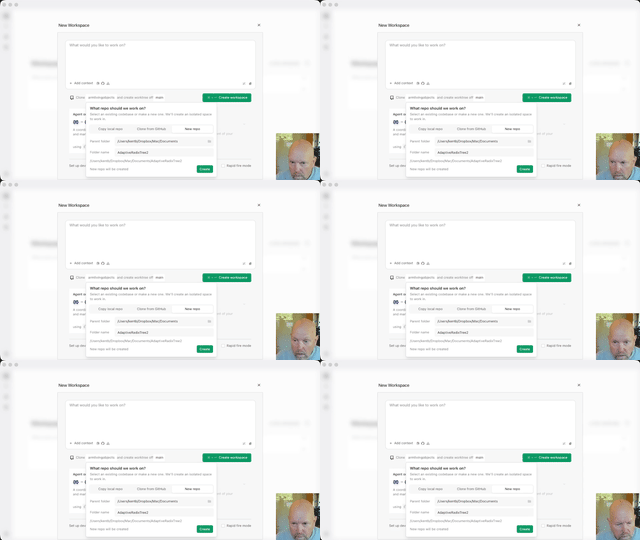
This session I was using Intent by Augment Code — multi-agent, coordinator plus implementer plus verifier. Working on an adaptive radix tree in Go, optimizing for human readability. The coordinator delegates, the implementer runs off and builds things, the verifier checks. I called it the Freudian architecture: id, superego, ego. The id rushes ahead. The superego folds its arms. The ego negotiates. It kind of works.
But watching the swarm spin up, I noticed something. I was managing it. Watching which agent was doing what. Wondering when to interrupt. Holding state in my head that the system should have been holding for me. I’d said I wanted readable code and instead I had a coordination problem.
The mismatch is this: when I was working on performance last week, what I actually wanted was — how much faster can we make this? How hard would it be? How much would it cost? Outcomes. I don’t want to prompt-engineer my way toward an answer. I want to describe the result I’m after and have the genie tell me if it’s achievable and what it would take. I’ve never been able to get two agents working on the same codebase at the same time without my head exploding. So I’m not convinced the swarm is the answer.
Multi-agent is a feature. Outcome-orientation is the thing the feature is supposed to deliver. We keep getting those confused.
The other frontier nobody’s working on yet: multiplayer. Right now, five agents can work on this codebase simultaneously. Five people can’t. That’s backwards. The person who figures out real-time collaborative augmented development — where multiple humans actually steer together, not just watch — that person is solving the real problem.
Nobody knows what that looks like. But I’m pretty sure it’s not a coordinator with finger guns.
 |
This Genie Session was sponsored by Augment Code.
Intent is the AI coding tool built for the way software actually gets written now. Describe what you want. Intent handles the rest — planning, implementing, verifying — so you stay focused on outcomes, not orchestration.

You’re currently a free subscriber to Software Design: Tidy First?. Buying me more time to think & write means more thoughts & ideas for you.