| | In this edition, M&A is unrecognizable in the age of AI, and Hilton’s CEO hints at the potential ret͏ ͏ ͏ ͏ ͏ ͏ |
| |  | Business |  |
| |
|
 - Spirit’s wing and a prayer
- Fed probe off-ramp
- Lulu’s last best hope
- Caracas Hilton?
 Paris’ mystery heat spike paid out on Polymarket |
|
 When we broke the story of Microsoft’s $10 billion investment in OpenAI in January 2023, I said two things that now seem pretty stupid. First, I asked my colleague Reed Albergotti what OpenAI was. Second, I confidently said on CNBC that people should think of the deal more like a takeover than a venture investment. Today, OpenAI is a household name, and M&A is unrecognizable. Microsoft didn’t have a straight economic stake (OpenAI was then a nonprofit) or traditional control (it blocked Sam Altman’s brief ouster not by voting against it in the boardroom but by threatening to hire him and any other OpenAI employees who wanted to come). That deal was the beginning of a rewiring of the market for corporate control. The standard options — buyers could pay cash or stock — have been replaced by a choose-your-own-adventureland where tokens are the new currency, employees are vital assets, antitrust is an afterthought, speed is everything, chokepoints matter more than control, and often the math doesn’t even pretend to add up. Take SpaceX’s deal for Cursor. The coding-software startup will get acquired for $60 billion, maybe, sometime, if Elon Musk feels like it. The $10 billion that Cursor keeps even if the deal doesn’t happen looks, to my traditional M&A reporter brain, like the largest breakup fee on record (a smart move, given Musk’s penchant for getting cold feet). When you squint, it’s more like the biggest option premium in history. SpaceX has compute; Cursor needs compute to train its models. But in a normal world, you don’t spend $60 billion to acquire your own customer. You invoice them. In the Before Times, a company preparing for the largest IPO ever would simply decide it wasn’t the right moment to spend $60 billion on an unprofitable startup. In the AI Times, things are moving too fast for SpaceX to wait. The new M&A vocabulary is being written in real time: acquihires, equity-for-compute, and the massive amounts of capex (see Tesla’s $25 billion announcement yesterday) that has squeezed out traditional takeovers. Adobe tried to buy Figma; now Anthropic is spending heavily to build its own. There will still be some AI-tinged, normal-ish M&A — Jeff Bezos is plotting a new Berkshire Hathaway — but the industry’s frontmen are upending deal-making just like they are upending everything else. Add in the US government’s newfound taste for investing, and the landscape for corporate control is quickly becoming unrecognizable. The Microsoft-OpenAI deal wasn’t an anomaly. It was the first lesson. |
|
When the US government edges you out |
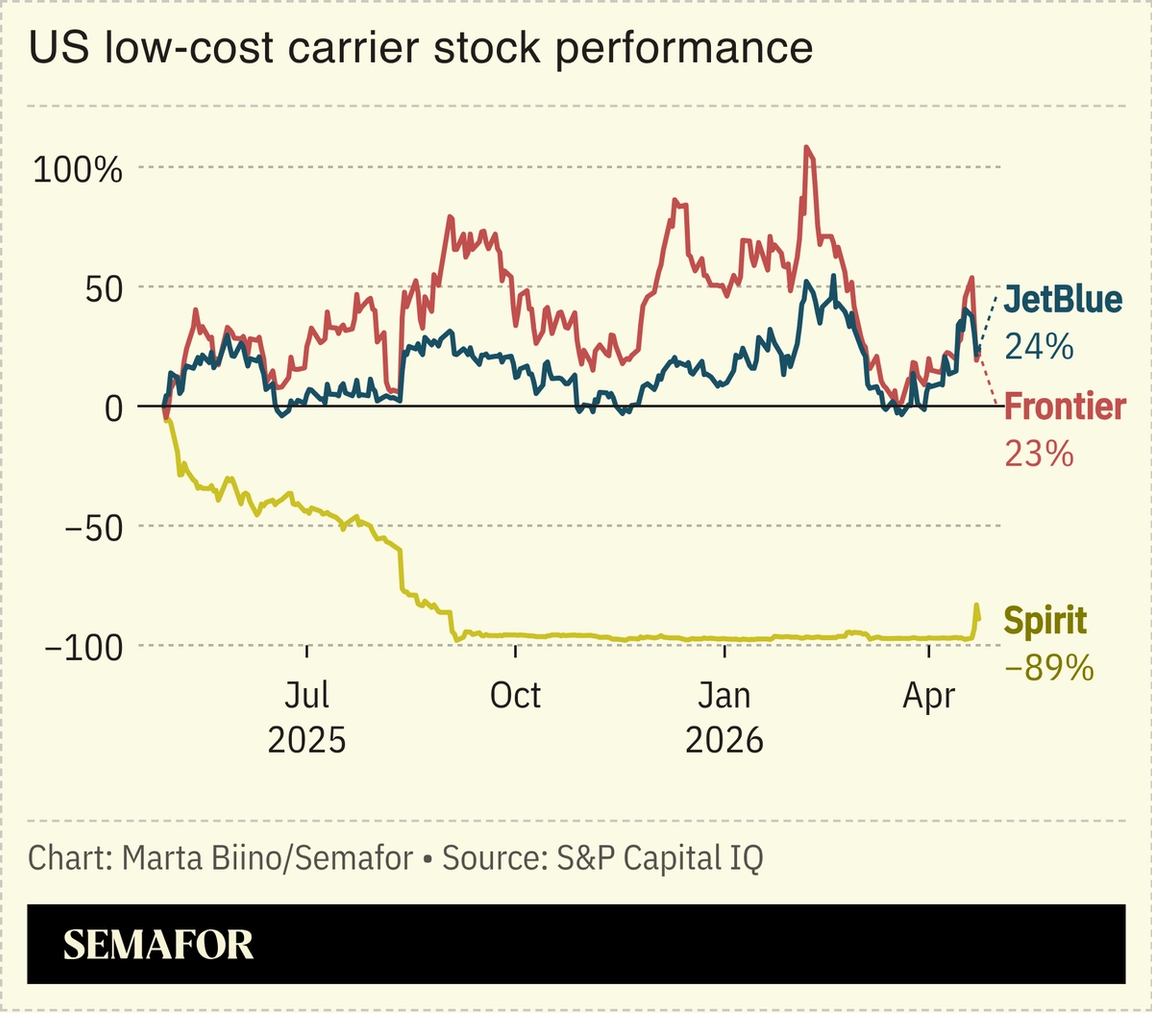 Spirit is on the verge of a $500 million bailout from the US government, according to people familiar with the matter. The deal, which could be announced as soon as today, would likely see the US government being positioned at the top of Spirit’s $7 billion debt stack, to the chagrin of creditors who are quietly organizing in opposition. On a contentious conference call Wednesday, Spirit’s lawyers at Davis Polk briefed the company’s bondholders on the terms, which contained no details on where the government’s money would come from, one of the people said. While some of the creditors may be willing to work with the government on a package, the creditor’s lawyers at Akin Gump said on the call that they found the proposal unacceptable — a government-sanctioned “cram-down” — and that they’d fight it. A spokesperson for the bondholders declined to comment. The US would have the option but not the obligation to purchase as much as 90% of Spirit’s outstanding shares, the people said. Republicans are lining up to oppose a rescue. Spirit’s problems are long-running — it has filed for bankruptcy protection twice and hasn’t turned a full-year profit since 2019 — but the spike in jet-fuel prices, coinciding with the White House’s affordability kick, has created unique pressure for a rescue. “Maybe the federal government should help that one out,” Trump told CNBC Tuesday, before the talks broke. — Rohan Goswami and Eleanor Mueller |
|
Republicans break with Trump over Fed probe |
 Kevin Lamarque/Reuters Kevin Lamarque/ReutersSenate Republicans’s message to the Trump administration: If the president wants a new Federal Reserve chair, prosecutors need to drop their investigation into Jerome Powell. A movement that began with retiring Sen. Thom Tillis, R-N.C, staking his last year in office on defending Fed independence has been gaining steam among concerned GOP bystanders who want to hand the president a win. “I’d like to see the president get his chairman; I think the best way to do that is finding an off-ramp” like a committee investigation, Sen. Mike Rounds, R-S.D., told Semafor’s Eleanor Mueller. (Treasury Secretary Scott Bessent has endorsed the idea.) Other Republican senators have suggested shifting the probe to the Fed’s inspector general. “I want the diplomacy to work,” said Sen. Kevin Cramer, R-N.D. The longer the case drags on — US Attorney Jeanine Pirro said on Wednesday that it is continuing — and the lower Trump’s poll numbers dip, the louder these pleading voices could get. “One thing all martyrs have in common: They’re dead,” Tillis said following Warsh’s hearing this week. |
|
Lululemon plucks Nike cast-off |
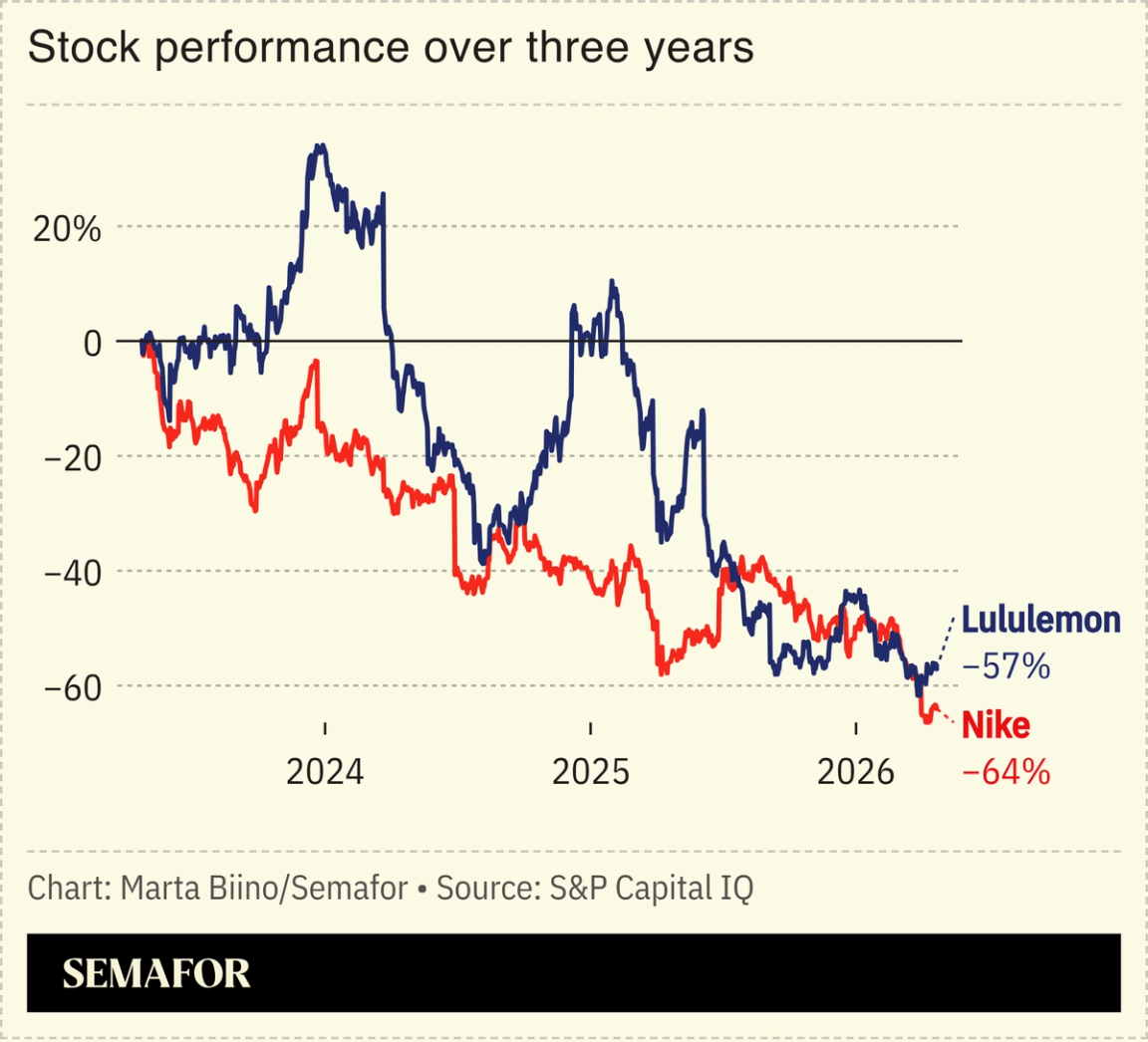 Lululemon’s shares dropped 11% Thursday after the athleisure brand picked Heidi O’Neill as its new CEO, an indication the market knows what everyone in the retail business already did. O’Neill was passed over in 2024 to run Nike (Elliott Hill came out of retirement for the gig) after a quarter century at the sneaker maker. O’Neill masterminded Nike’s pivot away from wholesale, a move that ended badly when retailers started carrying all of Nike’s competitors instead, and oversaw its women’s business, which never matched its men’s line. Hill is walking back both of those strategies at Nike, going deeper into wholesale again and working with Skims to rejuvenate its women’s business. All of which makes her an odd choice for Lululemon, a women-forward brand in need of a turnaround. Its market cap has dropped from more than $60 billion to $20 billion in less than two years. It’s fighting with its own founder, Chip Wilson, and activist investor Elliott, and bleeding customers who are moving to brands like Alo and Vuori. Lulu’s board said it conducted an extensive search and picked O’Neill because of “the breadth of her experience, her demonstrated success delivering breakthrough ideas and initiatives at scale, and her ability to be a knowledgeable change and growth agent.” |
|
Return of the Caracas Hilton? |
  Hilton CEO Chris Nassetta. Tasos Katopodis/Getty Images for Semafor. Hilton CEO Chris Nassetta. Tasos Katopodis/Getty Images for Semafor.Hilton is examining a possible return to Venezuela and Cuba and expects — one day — to reopen in Iran, CEO Chris Nassetta told Semafor. “We’re already talking to people. Some of our hotels that used to be with us, they want to come back,” Nassetta told Semafor’s Andrew Edgecliffe-Johnson. The hotelier once had 12 hotels in Venezuela, but several were nationalized by the Chávez government almost 20 years ago. Fidel Castro seized the Havana Hilton in 1959 and turned it into his headquarters, while the Royal Tehran Hilton was renamed and taken over by the state after Iran’s 1979 revolution. Asked where Hilton will return first, Nassetta said it’s “a close race between Caracas and Havana, and it’ll depend on the politics ... Tehran will take some time.” But, he added, “I think we’ll eventually be in all of them.” Nassetta said part of his task since becoming CEO in 2007 had been to reclaim Hilton’s “rightful spot in history.” Pointing to its record of opening the first international hotels in Istanbul and Tokyo after World War II, he said: “We were the pioneer.” |
|
Mark Moran, a former reality TV star, Centerview analyst, and now independent US Senate candidate, was caught betting on himself by Kalshi. He says the trade was designed to be flagged, in a bid to highlight platforms “that can be manipulated by the highest bidder/donor to move a market which will sway voters.” 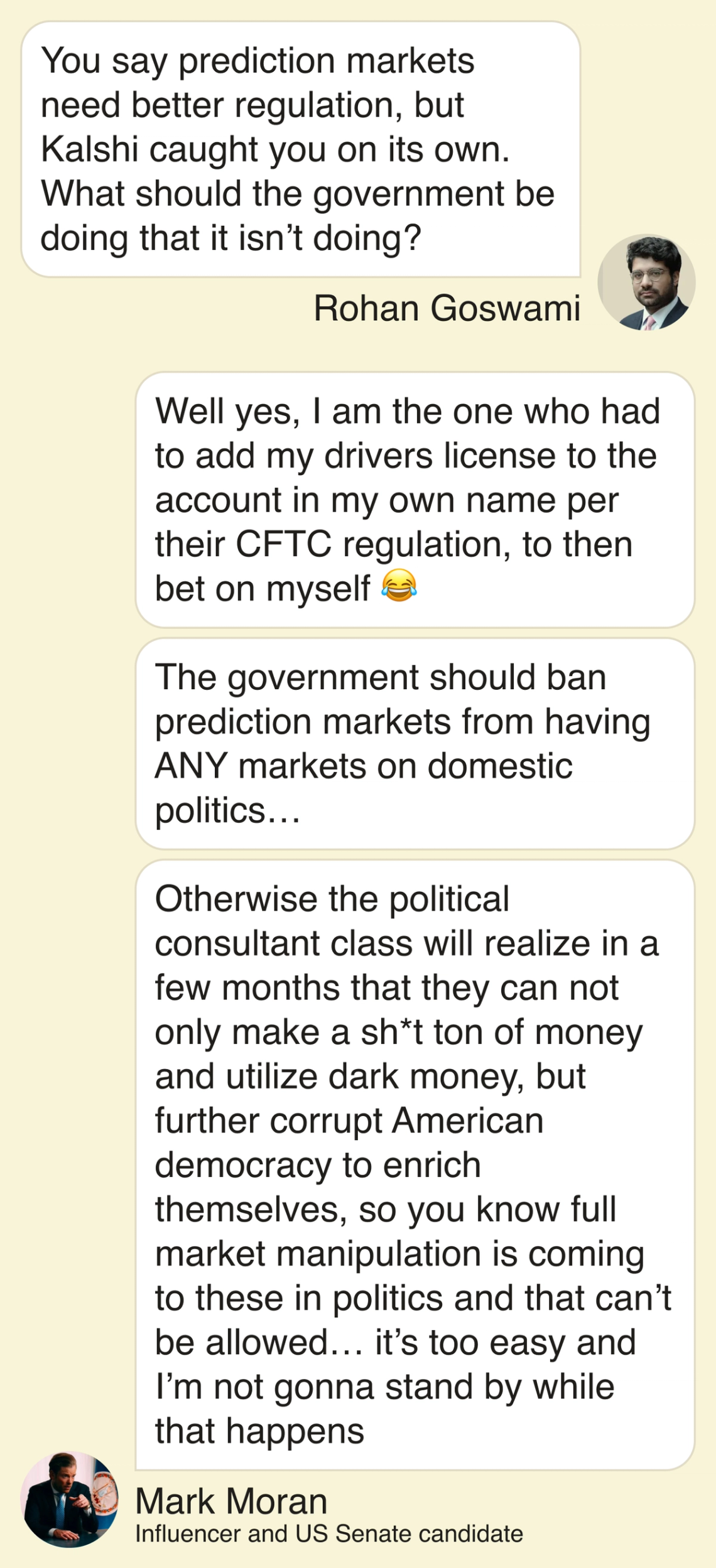 |
|
 Why do more than 1.5 million professionals start their day with The Hustle? Because it’s the only business newsletter that makes you smarter without boring you to death. Get growth stories, biz and tech trends, and insights, all in five engaging minutes. Subscribe today. |
|
➚ BUY: Weed. Cannabis stocks have surged 16% over the last week, ahead of the Justice Department’s Thursday morning decision to re-classify marijuana more leniently. ➘ SELL: Pot. Shareholders symbolically rejected CEO David Zaslav’s $886 million pay package while approving the sale of Warner Bros. to Paramount. The vote isn’t binding, so he’ll get the money anyway. |
|
 Companies & Deals- Silver lining: Tesla sales surged last quarter and Chinese solar exports doubled in March, as consumers and governments rush to protect themselves from the global energy crisis.
- Beat them or join them: After bashing private credit for months, JPMorgan is barreling in. Two executives told Bloomberg they are raising billions from investors for a fresh push into an area Jamie Dimon has repeatedly criticized.
Watchdogs- Replacement cost: A top Trump envoy wants FIFA to replace Iran with Italy in the World Cup — a move that would let the US reward a strained alley and punish an enemy.
Markets- Barrel half full: The widening gap between the oil delivered today and the cheaper price for oil futures reflects misplaced optimism that the Strait of Hormuz will reopen soon, Semafor’s Tim McDonnell writes:
|
|
|


