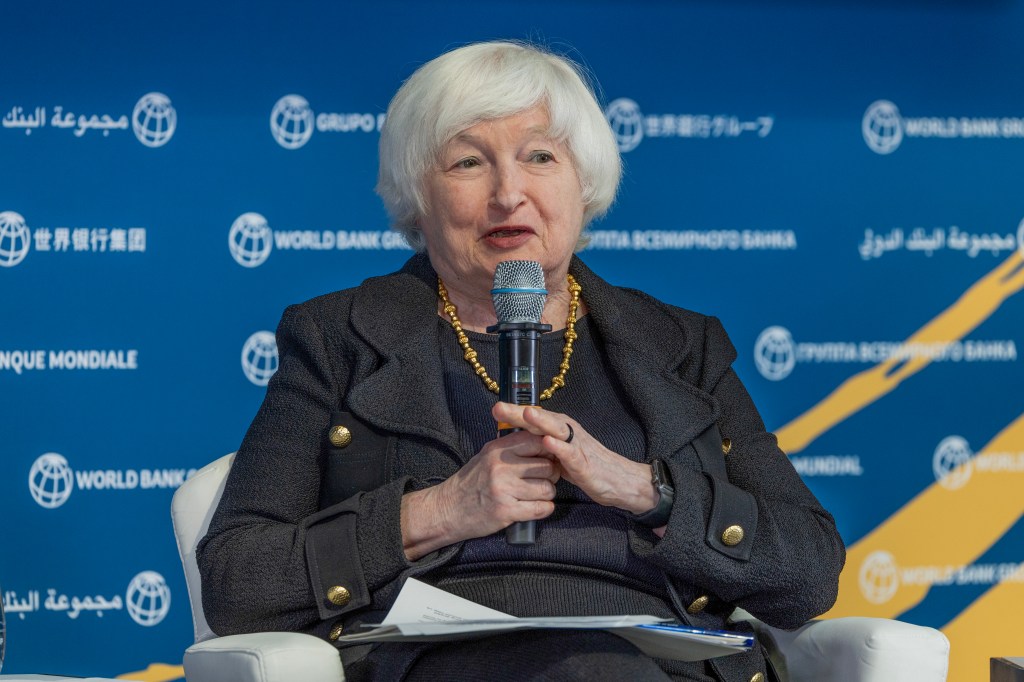
Throughout her career, Janet Yellen has broken barriers with several “firsts.” First woman to lead the Federal Reserve. First female treasury secretary. First and only person to hold the “big three” U.S. economic leadership positions—those two, plus chair of the White House council of economic advisors.
Her latest honor is as a 2026 inductee into the
National Women’s Hall of Fame. Founded in 1969 in Seneca Falls, N.Y., the Hall of Fame each year inducts a class of women, about half contemporary (or living) and half historic.
To mark the milestone, I got to chat with Yellen on both what this means to her and all her thoughts on the most pressing political and economic questions of the day. “This one is very special to me,” Yellen told me, comparing this award to all the honors she’s received in her life, “because the Women’s Hall of Fame is about the story of women in America and their struggle to achieve equality. And to me, it makes me part of that story.” Read excerpts from our conversation below and the full interview on Fortune.com
here.
How do you think about your own place in history? I see myself as being situated in this having benefited from what generations before did and inspired me, and hoping that my story can inspire future generations. I had tremendous opportunities to work in an area where there have been relatively few women. I often attended meetings, both in academia and in international meetings, where I was the only woman at the table, and was able to nevertheless succeed.
When you look back at the entire scope of your career, which achievements are you proudest of?I feel good about my ability to take my training in economics and my long-held view that the purpose of economics is to improve outcomes for people, especially people who are struggling to succeed. I’m grateful that I was entrusted with very important roles where I helped to make decisions, certainly with others that I think did advance American economic welfare, both at the Fed in trying to manage the worst financial crisis America had seen since the Great Depression, and to try to help people get back on their feet after all that they suffered.
How are you feeling about the Fed’s independence today and how worried are you in this moment? We’ve seen the worst attacks on Fed independence in certainly in my lifetime. Presidents always care about what the Fed does, and typically prefer easier monetary policy than the Fed considers it appropriate to deliver. I’ve never seen a president who has pulled out all the stops in trying to put personnel at the Fed who will go along with his views on appropriate policy. Most recently, this means weaponizing the Department of Justice against the Fed chair. It’s meant
attempting to remove a member of the Federal Reserve Board for very questionable cause.
The Federal Reserve’s job is price stability and full employment, and you have a president who has very explicitly stated the Fed’s job should be to hold down the interest costs of the debt. That’s the road in a banana republic to high or even hyperinflation. So yes, I’m very worried about Fed independence.
What’s it like for you to watch this all unfold? I’m particularly concerned about his treatment of our allies and his approach to trade, and I think he’s destroying a set of global rules that have enabled us to have a peaceful and prosperous many decades since World War II ended, essentially breaking down a system that countries largely abided by, that have kept the world on a prosperous path. He’s really having devastating effects on how the global economy works. I’m seeing a president who is undermining one of our greatest assets, which is our research capabilities and our universities, who is really destroying much of the government, tearing down the civil service, which is a store of knowledge that has been an asset for the American people. There’s a lot to be concerned about.
What do you make of Kevin Warsh as President Trump’s Fed chair pick? I was president of the San Francisco Fed during the early days of the financial crisis, and then was vice chair of the Fed and overlapped with him in both roles. He’s a person who cares a lot about inflation. It’s really one of his strongest and most consistent themes. I do believe he values and understands the importance of the independence of the Fed. I think President Trump has put him in a very difficult situation.
He said in his confirmation hearing he’s made no promises to the president about future policy, and that the president didn’t ask him to make any pledges. President Trump, on the other hand, said that he did. So I think this means that he’s starting off in a very difficult position. But he’s someone who knows both the strengths and weaknesses of the Fed and could be a good Fed chair.
If someone asked you if they should accept the chairmanship under these conditions, what would you tell them? I would warn him. I would point to what’s happened to Chair Powell as an example of the difficulties you can face with President Trump if you defend the independence of the Fed and insist on making decisions that are fact- and analysis-based and are meant to promote the Fed’s Congressionally-given mandates. It is sobering for anyone stepping into one of these jobs to see that if the president doesn’t like what you’re doing and wants you to step down and replace you, that you could see charges brought against you for no good reason at all.
Read the full interview—with more thoughts from Yellen on the “very challenging” impact of AI on the workforce—
here.
Emma Hinchliffeemma.hinchliffe@fortune.comThe Most Powerful Women Daily newsletter is Fortune’
s daily briefing for and about the women leading the business world. Subscribe here.