
|



This book consolidates and extends three editorial pieces published on businessengineer.ai in early 2026 — the Anthropic Labs founder-cell analysis, The Product Overhang Doctrine, and The Anatomy of a Founder Cell. The trilogy is reframed here around the role at the center of the AI-era product organization: the Builder-PM.
Two new chapters anchor the structure. Part IV anatomizes the role in operating detail. Part V is the transition — written for individual PMs, PM leaders at incumbents, and founders hiring into AI-native cells. An appendix compiles the named mental models from the full work into a single field guide.
How to read this book
The book is built to be read straight through, but each part stands alone.
Individual PMs may want to start with Part IV (the role) and Part V (what to do Monday).
PM leaders at incumbents will find Part III (the operating environment) and Part V the most actionable.
Founders should read in order — the strategic frame in Part II will be the most expensive to skip.
PROLOGUE
The Discipline That Just Got Rewritten
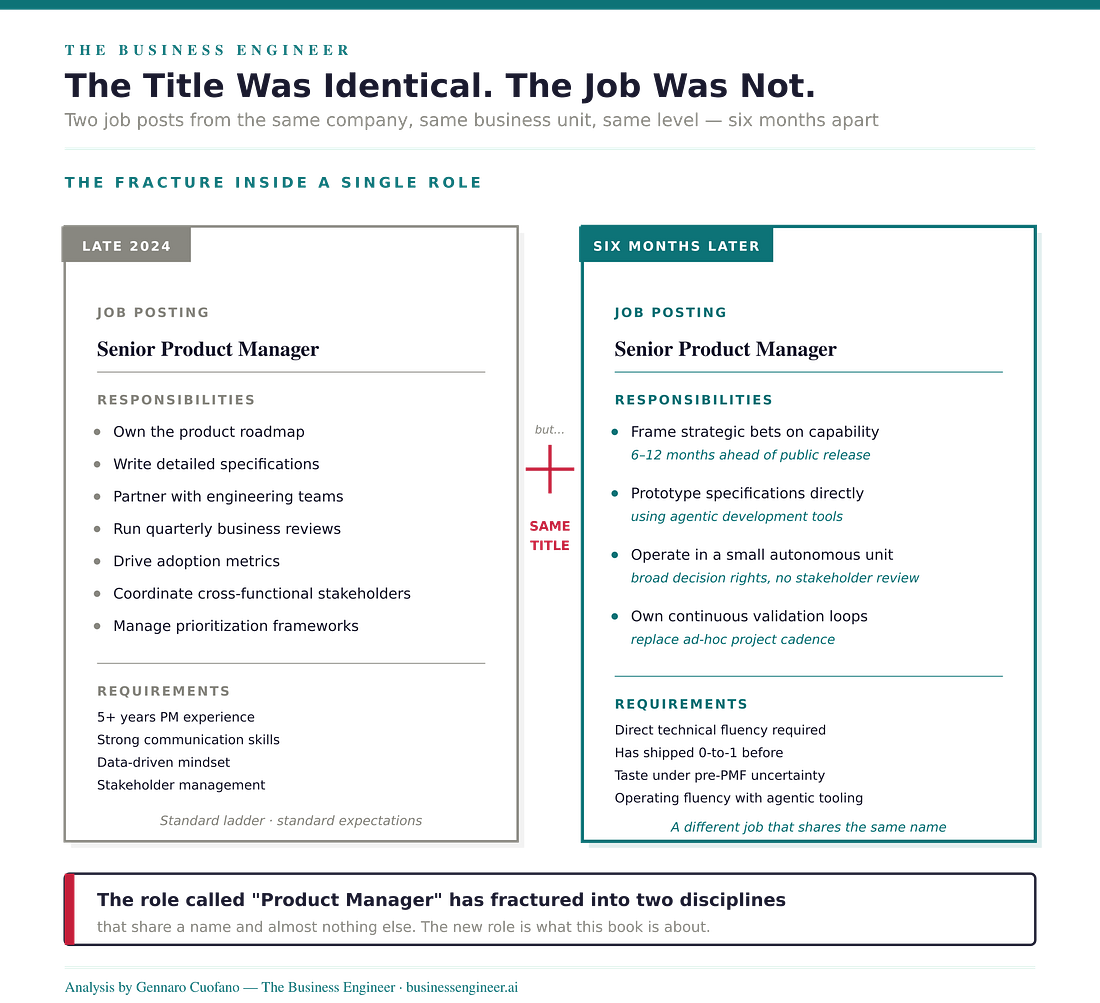 |
In late 2024, a tech company posted a Senior Product Manager job. The description was standard: own roadmap, write specs, partner with engineering, run quarterly business reviews, drive adoption metrics. Standard ladder, standard expectations, standard interview loop.
Six months later, the same company — same business unit, same level — posted a role with the same title. The description had changed almost beyond recognition. Frames strategic bets on capability that is six to twelve months ahead of public release. Prototypes specifications directly using agentic development tools. Operates inside a small, autonomous unit with broad decision rights. Direct technical fluency required.
The title was identical. The job was not.
This is not a story about one company. The pattern is now visible across every AI-native employer and a growing share of incumbents — the role called “Product Manager” has fractured into two distinct disciplines that share a name and almost nothing else.
One is the role product management has been for the past fifteen years — scoped around discovery, delivery, stakeholder coordination, and the translation function between engineering and the rest of the company. The other is something new. It writes specifications by running them. It operates inside a unit with no roadmap document, no stakeholder review, no quarterly KPI envelope. It ships product against capability that does not yet exist in any public model. It reports outside the conventional product org because the conventional product org would kill it within a quarter.
The new role is what this book is about.
Three eras of product management
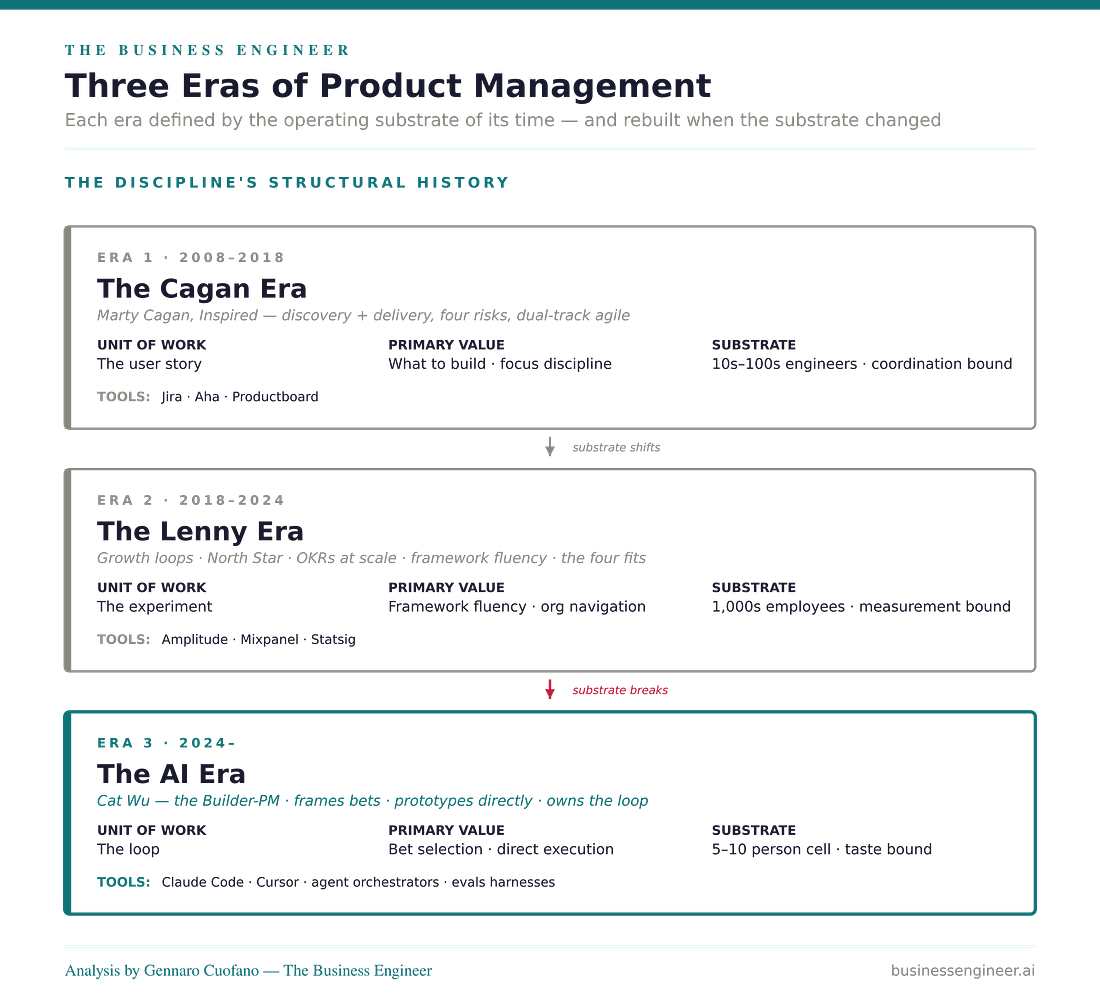 |
The cleanest way to see the change is through a historical lens. Product management, as a recognized discipline, has gone through two prior eras, each defined by the operating substrate of its time. The AI era is the third, and it is restructuring the substrate underneath the role.
The Cagan era — roughly 2008 to 2018. Marty Cagan’s Inspired codified the modern PM role as a four-risk function: value, usability, feasibility, viability. Dual-track agile separated discovery from delivery. The job was to find the right thing to build through structured customer research, validate it with prototypes, and partner with engineering to ship it.
Unit of work: the user story.
Primary value: judgment about what to build and the discipline to keep the team focused on it.
Tools: Jira, Aha, Productboard.
Substrate: a product organization growing from tens to hundreds of engineers, where coordination was the binding constraint.
The Lenny era — roughly 2018 to 2024. Lenny Rachitsky’s newsletter became the canonical reference, alongside an explosion of frameworks: growth loops, North Star metrics, retention curves, the four fits, jobs-to-be-done refinements, OKRs at scale. The job was to drive measurable outcomes — typically activation, retention, monetization — through a combination of strategic prioritization, growth experimentation, and operational coordination across function-specialized teams.
Unit of work: the experiment.
Primary value: framework fluency and the ability to operate inside an increasingly specialized org.
Tools: Amplitude, Mixpanel, Statsig.
Substrate: the consumer-software and SaaS organization, scaling toward thousands of employees, where measurement and alignment were the binding constraints.
The AI era — 2024 onward. Cat Wu’s March 2026 essay for Anthropic, Product management on the AI exponential, named the shift in operating terms that the role had begun absorbing. The Builder-PM frames strategic bets on capability ahead of release, prototypes specs directly with agentic tools, and owns continuous validation loops that replace ad-hoc project cadence.
Unit of work: the loop.
Primary value: bet selection and direct execution capacity — the ability to spec, build, and validate without the handoffs and translation layers that defined the prior eras.
Tools: Claude Code, Cursor, agent orchestrators, evals harnesses.
Substrate: the founder cell — a five-to-ten-person autonomous unit reporting outside the scaled product org.
Binding constraint: no longer coordination or measurement. It is taste: choosing what to bet on, given that the constraint of building is collapsing.