|


 |
The AI Bubble Is Real. Enterprise Usage Is Even More Telling.
The existence of an AI bubble is beyond dispute. What remains unclear is when or how it deflates. As investors know all too well, the most costly mistake in business is often being correct prematurely. The infrastructure layer has already booked revenues. This includes sectors like semiconductors, data centers, and power grids. The application side is a different story. It’s still a guessing game, and we’re still trying to figure out what customers will actually open their wallets for.
Rather than attempting to time the correction, I try to focus on what enterprises are actually doing with AI in production. When you look at what’s actually happening, the reality doesn’t quite match the headlines. It’s no secret that coding is the big winner so far, but the real news is the growth in administrative automation, and a clear preference for “simple and reliable” over “flashy and complex.” Furthermore, Chinese AI firms are pivoting aggressively toward Western markets, introducing application-layer competition to segments where U.S. firms have focused primarily on foundational research. Ultimately, we’re seeing two very different playbooks. Major Western AI labs are all-in on reaching AGI, but China is doubling down on the essentials: energy, supply chains, and diffusion — getting AI apps into the hands of as many companies as possible, as fast as possible.
Dominant Use Cases: From Code to Creative to Administrative
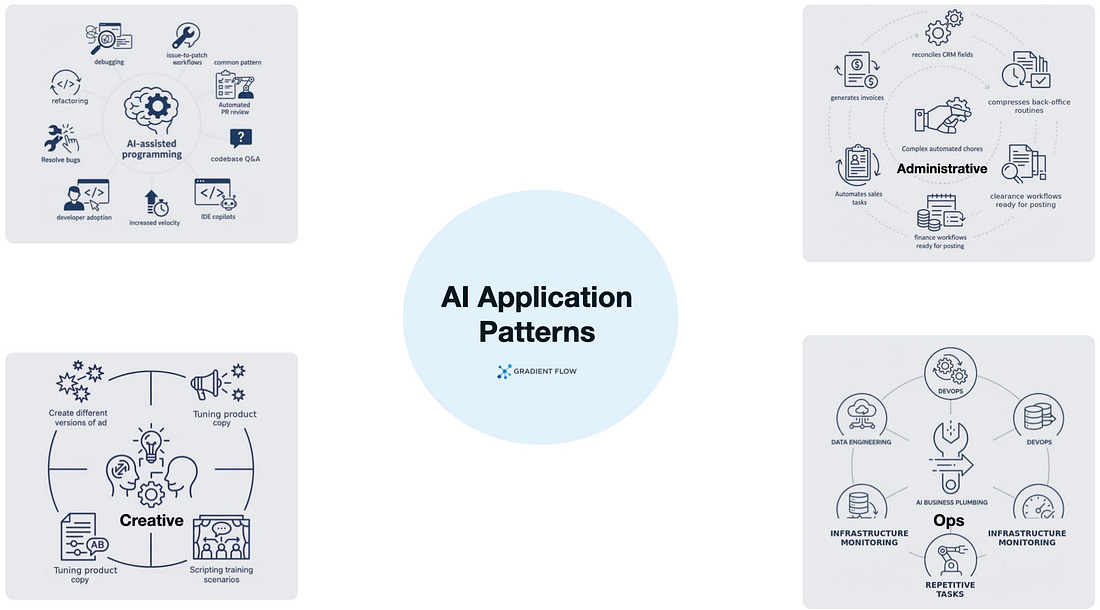
Software development is the dominant enterprise workload, rising to over half of total token usage by late 2025. AI-assisted programming and coding tasks include debugging, refactoring, and resolving bugs. Developer adoption ranges from half to two-thirds using AI tools daily, significantly increasing the velocity of the entire software lifecycle. A common pattern has emerged: teams start with IDE copilots, then move up the stack into codebase Q&A, automated PR review, and “issue-to-patch” workflows that draft changes a human can validate.
But two other areas are quietly taking off just as fast: creative applications and administrative automation. Creative use has surprised many AI teams. It isn’t just about getting the AI to write a document. It’s more like a back-and-forth process where you build ideas together. This shows up in tasks like creating different versions of an ad, tuning product copy, or even scripting training scenarios.
Automating admin work is a huge deal for the bottom line, mainly because AI is now handling complex chores rather than just writing messages. AI is taking over the “busy work” of data entry and invoicing. Tasks that used to take all afternoon, like organizing insurance files or prepping financial entries, are now done automatically and handed to a human just for a final look. By automating sales tasks like record updates and follow-up sequences, AI removes the burden of manual data entry and administrative overhead.
There is also a massive shift happening under the hood. While everyone focuses on chatbots you can talk to, some of the most successful AI deployments are happening in the “plumbing” of the business. I’m hearing about more teams using agents for high-repetition tasks in data engineering and DevOps. These agents handle the tedious work of moving data between systems or keeping infrastructure running. It’s the kind of work end users never see, but it’s where the real gains in speed and automation are being made.
 |
The Evolution of Inference Patterns
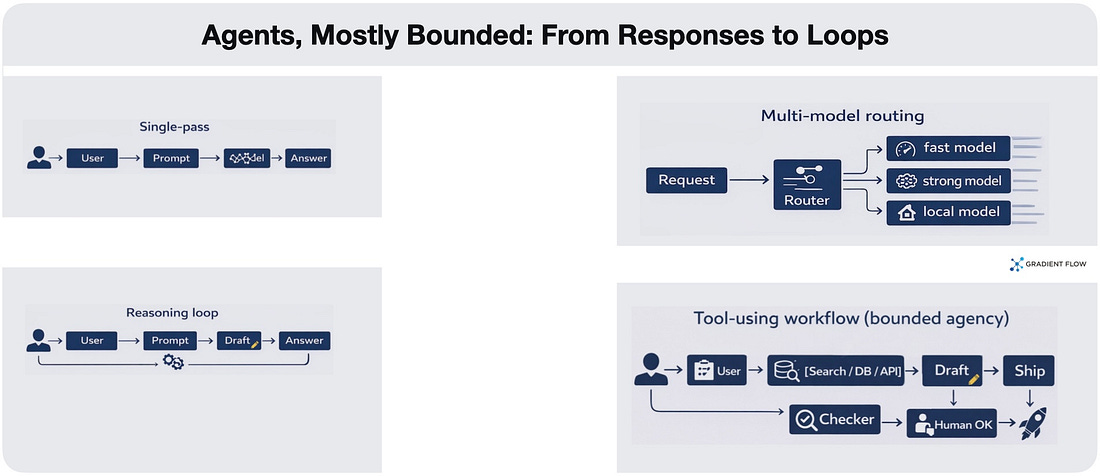
The technical architecture of AI is transitioning from single-pass pattern matching, to multi-step reasoning. New reasoning models are driving this shift. Because they allow a system to “think” before it responds, we’re seeing a total shift in the way these models use tokens. This has led to a dramatic increase in prompt lengths as developers build more complex, agentic loops. While the narrative around “autonomous agents” often outpaces the reality of production environments, there is an undeniable trend toward workflows where models plan and iterate rather than simply predict the next word.
In this architectural shift, open-weight models have carved out a stable and significant niche. Chinese models, such as DeepSeek and Qwen, have become formidable competitors, often providing performance that rivals proprietary Western models at a fraction of the cost. The strategic implication isn’t just cheaper inference. Chinese firms are using their open-weight models as a foot in the door for Western markets. Once they’ve proven their tech is legit through open-source, they move quickly into building business apps rather than just focusing on foundational models.
Deployment Patterns: Bounded Agency and Lifecycle Management
In the real world, the most successful companies are using what I call “bounded agency.” Even though we have the tech to build fully autonomous agents, most teams are choosing to keep them on a short leash. They limit the AI to just a few steps before a human has to step in and check the work. The reason is simple: reliability. By keeping a human in the loop, you ensure that if the AI makes a mistake, you can actually see what happened and fix it. This is about helping experts do their jobs faster, not replacing them.
Most teams are also choosing stability over perfection. They’d rather use a standard, off-the-shelf model with good guardrails than spend months trying to fine-tune a “perfect” custom one. It’s more practical and much easier to manage.
 |
A related trend is a pattern I call