| Welcome, Weekenders! In this newsletter: |
| • The Big Read: A radical bet on a totally different type of longevity cure |
| • The Top 5: The best home sauna tech |
| • Plus, Recommendations—our weekly pop culture picks: “The Secret World of Roald Dahl,” “Vigil” and “Love Story” |
| |
| Judging strictly by appearances, anyone who is anyone in tech is looking to carve out a niche for themselves in AI. The smart ones are asking themselves whether they’ve landed on a corner of it that has any real potential. |
| It can be hard to know for sure, I grant you, but I’ve thought of a foolproof method for figuring it out. Look around and ask yourself: Has Google shown up, hoping to bump you off? |
| Since ChatGPT’s launch caught Google off guard, the Mountain View, Calif., giant has caught up—and lately has displayed an unending restlessness. Just this week, it put the music industry directly in its sights, releasing a new feature within its Gemini chatbot that can produce 30-second music tracks, with custom lyrics and audio. This follows recent advancements in Gemini’s ability to create images and other updates that have pushed it into front-runner status among the chatbots. |
| The new music feature should scare the bejesus out of Spotify and the handful of startups working on AI music, including Suno, Udio and Klay, which have raised about $400 million altogether. |
| Sure, Google doesn’t have a history as a major player in music, and its YouTube Music service is seldom thought about. But things are as topsy-turvy as they’ve ever been right now, and don’t forget: Google has just done a deal to supply Apple with AI technology. And Apple sure does have a lengthy background with music. So maybe Apple Music stops being an also-ran behind Spotify by leaning on Google AI—which, yes, is something like an oboist finally beating out a violinist for a primo solo. |
| Broadly, all audio-based AI is shaping up as a real battleground. Earlier this month ElevenLabs, which makes AI for cloning a person’s voice, raised money at an $11 billion price tag, nearly quadrupling its valuation in a year. Obviously, voice cloning is a different matter than music generation, but they’re based on the same fundamental principle: Audio is easier for AI to create at convincingly humanlike levels than, say, video. |
| Spotify has been a real laggard in the AI era, and its shares show the damage, down nearly 25% over the past year while the Nasdaq composite has gone up 13%. Its ads business has been deteriorating, and while it has spent enormously to pad out its podcast catalog, it faces stiff competition in the podcast world from YouTube and even Netflix. Meanwhile, its tech collects cobwebs: It hasn’t meaningfully advanced in years. Recently, Spotify rolled out an AI feature: prompted playlists, which rely on natural language prompts, as chatbots do. When I played around with it, the results were about as interesting as the stack of cassette tapes in my father’s closet. |
| Around the same time, Spotify brass openly bragged that its engineers haven’t written a line of code themselves in months. (Instead, they’ve relied on AI coding tools.) And it turned into a standing Twitter joke: Yeah, it shows. |
| Well, as Spotify and the others are the latest to discover, the AI era increasingly gives new life to an old saying: In the end, Google comes for us all. |
| What else from this week… |
| • The only interesting part of Snap Inc., its augmented reality glasses unit, lost its leader over a “blowup” with CEO Evan Spiegel. |
| • Perplexity, the company that previously mired itself in controversy over its untrustworthiness, has dropped its ads business, warning that ads in AI are untrustworthy. I mean, sure, I’m willing to trust its expertise on shady content. |
| • The world’s scarcest resource? An available conference room, argues The Economist. |
| • “My industry is famous for saying no, or selling you something you don’t need. We have an earned reputation as a lot of really tiresome dudes,” writes Paul Ford, the technologist and software essayist. “But I think if vibe coding gets a little bit better, a little more accessible and a little more reliable, people won’t have to wait on us.” |
| • Three-plus years into the AI boom, when everyone wants to morph into an AI company, we toil now in the Toto Toilet Economy. |
| • These are a lot of words from Wired magazine that ultimately do little more than reinforce a longstanding truism: Any office in tech is about as gay as the back room at The Eagle. |
| • Nick Land, a reactionary techno-philosopher, may be to 2026 what Curtis Yarvin was to 2025. |
| • Polymarket announced a new partnership with Substack, declaring thunderously, “Journalism is better when it’s backed by prediction markets.” Perhaps I’ll consider making a market in whether reporters hit their deadlines. Always a gamble! |
|
|
|
|
 |
|
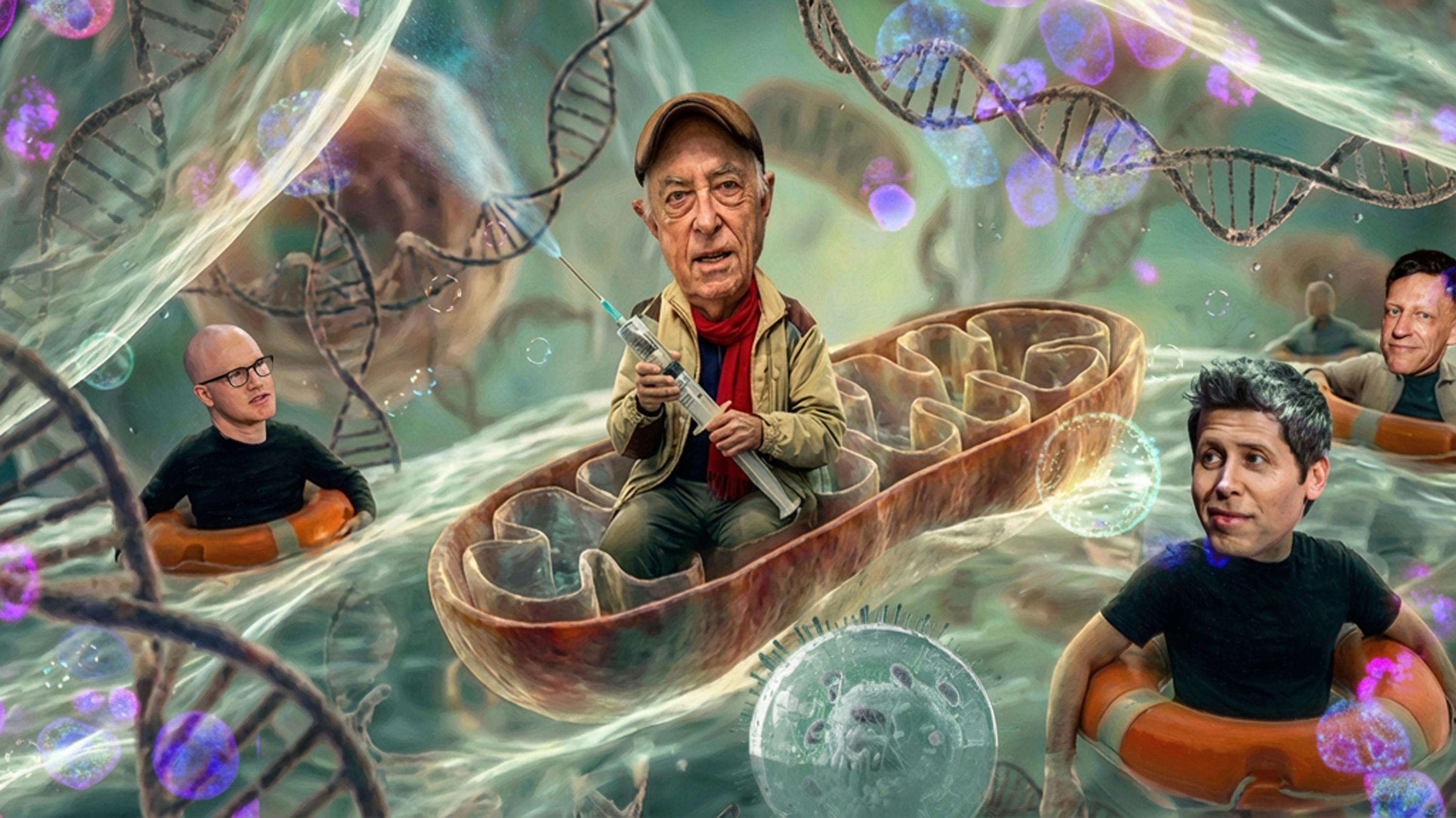
| Sam Altman, Brian Armstrong and other tech billionaires are pouring a fortune into anti-aging therapies that could take years to hit the market. One startup underdog is beginning to treat customers who may not have the luxury of waiting that long. |
|
 |
|
| Fancy a private schvitz? Setting up a sauna in the basement, backyard or even the living room has never been easier—or more luxe—with pop-up saunas, blanket saunas and more options. |
| |
 |
| Listening: “The Secret World of Roald Dahl” |
| Over nearly 30 years, Roald Dahl spun some of the 20th century’s most memorable fictions, like “James and the Giant Peach,” “Matilda” and “Charlie and the Chocolate Factory.” (He also wrote the screenplay for “Chitty Chitty Bang Bang” and another for a James Bond film.) He was prolific and prosperous, with the lifetime sales of his books dwarfing the earnings of Henry James, Herman Melville, Virginia Woolf and Toni Morrison—combined. And since 2018, Netflix has spent more than $1 billion to acquire all the adaptation rights to his library. Not bad for a guy who’s been dead for three decades. |
| “He has permeated our collective consciousness: I have never in my life—even for a millisecond—not wondered if there might be a golden ticket in there,” says Aaron Tracy, the amiable host of “The Secret World of Roald Dahl,” a slick series co-produced by Ron Howard’s Imagine Entertainment. |
| But, as Tracy promises while introducing the podcast, Dahl’s “writing is only the 19th most interesting thing about him.” In Dahl’s life, he was a wartime spy, an FDR drinking buddy, husband of an Academy Award–winning actress, and a fan of the grotesquely macabre, whose mean-spirited children’s tales rankled critics and parents. Often he treated those closest to him cruelly, and he held a lifelong belief in antisemitism. Some of the darker parts of his personality were known at the time. In another era, I’m not sure Dahl could’ve outrun cancellation. |
| Tracy, a Yale University English professor, traces his earliest reading habits to Dahl’s books and acknowledges a complicated, lifelong fascination with the author. “It’s a strange, complicated thing to super-admire so much about Dahl,” he says, “with the knowledge that he wouldn’t have come to my Hanukkah party.”—Abram Brown |
| Reading: “Vigil” by George Saunders |
| There comes a time in the lives of the extraordinarily wealthy when they contemplate what it took to accumulate those fabulous riches—to ascertain whether the pluses outnumber the minuses in the great ledger book of life. |
| What a task—what a chore. I get why putting it off sounds appealing. |
| But not doing so invites absolute deathbed bedlam in “Vigil.” Ghosts and specters pile up around oil tycoon K.J. Boone as he lies somewhere between life and death in his very nice home. By comparison, Scrooge got off easy—only four ghosts came for him. Adding to the party is Boone’s guardian angel, Jill, who tries to coax him into contemplating his past. She finds him a vexing charge, though—a fellow thoroughly committed to avoiding any sort of repentance about his journey from “Wyoming hick” to titan of industry: Among other things, he takes credit for the U.S. abandoning the Kyoto Protocol. His capitalistic drive for fossilized carbon also eradicated a great many bird species. Some of them stop by to see him, too. |
| “Vigil” presents a Vonnegutesque journey through purgatory and redemption, a specialty of author George Saunders, whose 2017 “Lincoln in the Bardo” won one of publishing’s top honors, a Booker Prize, by placing President Abraham Lincoln in his own madcap netherworld. In a recent conversation with The Wall Street Journal, Saunders described “Vigil” as an exercise in absolution and assessment, since, as he put it, “most people aren’t of the Cruella de Vil school of evil.”—A.B. |
| Watching: “Love Story” |
| A few elements of American culture have been ultradurable over recent years: wide-hem pants, the collision of politics and celebritydom—and, you know, the Kennedys. “Love Story,” the latest FX series from producer Ryan Murphy, reexamines a fairly recent chapter from the clan’s lore: the courtship, romance and fraught marriage between JFK Jr. and Carolyn Bessette. As |