by Rob Stein, NPR’s science desk correspondent and senior editor
Remember Jurassic Park? Velociraptors rampaging through the jungle?
The possibility of bringing long-gone species back to life has long fascinated humanity. But it has always been the stuff of science fiction, not reality.
But could that change? One Texas biotech company thinks the answer is yes.
Rob Stein/NPR
Colossal Biosciences Inc., says gene-editing and other powerful new technologies have given scientists the tools they need to turn the fantasy of Jurassic Park into a new kind of reality.
I’ve been keeping an eye on Colossal for years. After all, the biotech has proclaimed the audacious goal of resurrecting iconic extinct species such as the woolly mammoth, Tasmanian tiger and dodo bird.
But Colossal has long generated deep skepticism and even intense objections. Some biologists, conservationists and paleontologists say the company’s goals are far-fetched and its claims exaggerated. And even if “de-extinction” were possible, bringing back long-gone animals would be unethical and could be dangerous, they say.
Nevertheless, the company says it has raised more than $600 million, assembled a staff of more than 260 scientists, and was valued at $10 billion during a financing round in early 2025. Colossal certainly has the wherewithal to make a big effort.
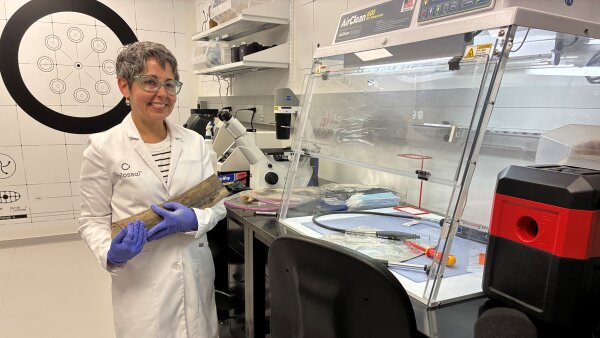
Finally, the opportunity arose for me to get an inside look. Colossal just opened a 55,000-square-foot state-of-the-art laboratory, and officials agreed to bring me behind the scenes to show off the company’s new digs and latest research.
I flew from Washington, D.C., to Dallas, jumped into an Uber and headed to Colossal. The Uber dropped me at the edge of a big parking lot on the outskirts of the city’s downtown. I made my way across the asphalt, found the right two-story brick building in the nondescript office park and took the elevator to the second floor.
When the elevator doors parted, I felt like I was entering a different world. The cavernous lobby felt like a cross between a Silicon Valley startup and a science museum. High ceilings revealed exposed pipes and ducts painted black. White floors kind of glowed. A silent, wall-sized video depicted extinct and endangered species and scientists working in white lab coats.
For the next two hours, I met with geneticists decoding mammoth DNA recovered from remains frozen in the Arctic, biologists trying to create cloned, gene-edited mammoth embryos from the skin cells of Asian elephants (the mammoth’s closest living relative), and engineers working on new reproductive technologies.
I listened to the company’s top scientists talk about their hopesthat their work will not only bring back extinct species, but also create tools that could help save species on the brink of extinction.
It remains far from clear whether Colossal's scientists will ever achieve any of the company’s bold goals. But Colossal clearly has the resources to push the boundaries of many of today’s most provocative biomedical technologies.
Read more about what I saw at Colossal’s headquarters here.
Check out more great reads from the NPR network you may have missed:
➡️ Within a week, the U.S. and Israel's war with Iran has quickly expanded globally. China said it would send a special envoy to the Middle East to mediate, and the U.K. said it wouldn’t allow the U.S. to use British military bases for any offensive attacks on Iran. These maps capture the fallout, highlighting where the fighting is happening and how the war has had ripple effects on economic markets.
➡️ More than three years after ChatGPT's debut, AI has become a staple in everyday life. At colleges, professors and students are debating how and whether to use it. An Inside Higher Ed and the Generation Lab poll revealed that 85% of undergraduates use AI to brainstorm and outline. More than half of students who use AI admitted that the tech sometimes leaves them thinking less deeply. Professors like Dan Cryer are trying topersuade students that education is aboutthe process, not the product.
➡️ Billionaires Shayne Coplan and Tarek Mansour are locked in a high-stakes feud to dominate the prediction market industry. Polymarket CEO Coplan and Kalshi CEO Mansour have competing visions over how prediction markets should grow. Their clash could change the future of the industry.
➡️ The Trump administration’s foreign aid cuts have crippled global efforts to protect women. More than 40% of organizations working to end violence against women have had to scale back or shut down in the past year, according to an October 2025 global survey by U.N. Women. Once a bipartisan priority, combating gender-based violence has turned into "radioactive" issue, says Beatriz García Nice, a research analyst for the Latin America Program at the Stimson Center.
Newsletter continues after sponsor message
The news doesn’t stop, and neither will we.
We’re here 24 hours a day, seven days a week, delivering the trusted news that millions of people rely upon.
You can help ensure that NPR remains available to everyone, regardless of their ability to pay, by donating now.
Today, we’re listening to a Life Kitthat explores some science-backed treatments and exercises to alleviate neck pain. Learn about some of these tips with the help of a spine surgeon, sports medicine doctor, sleep expert and physical therapist.Listen to the episode, orread the transcript.
Love podcasts? For handpicked episode recommendations every week, check out Pod Club — a newsletter written FOR podcast fans BY podcast fans. Subscribe here!
And on The Sunday Story from Up First, NPR’s Diaa Hadidinvestigates the black market for human eggs in India. She traces the supply chain from high-end fertility clinics to slums and meets the women who sell their eggs to survive.
Hush
NPR
It's time for the Sunday Puzzle! This week's on-air challenge is a “quiet” puzzle in which every answer is a word that starts with "SH-." Puzzle master Will Shortz will provide you with two words. The answer can proceed these two words in order to make a compound word or a familiar two-word phrase. For example, if you are provided the clues “Holder” and “Cropper,” the answer would be “SHare,” because the clues can make the words “shareholder” and “sharecropper.” Test your skills here. Check the page later to hear the answers, or catch them live on Weekend Edition at 8:41 a.m. ET.
This week's online challenge comes from Donn Dimichele, of Redlands, Calif. Name a famous musical duo. Remove four consecutive letters of the duo's name and phonetically you'll name a famous nonmusical duo. Who are they? Submit your answer here, and you could win a chance to play next Sunday's on-air puzzle.
You received this message because you're subscribed to Up First emails. This email was sent by National Public Radio, Inc., 1111 North Capitol Street NE, Washington, DC 20002