|
|
|
Newsletter continues after sponsor message
|
|
|
Narongrit Doungmanee/Getty Images/iStockphoto |
|
A certain amount of aches, pains and strains come with an active lifestyle. If you exercise regularly, you might notice that as you get older, it’s easier to injure yourself in the course of your usual routine. The risk of overuse injuries, like plantar fasciitis, achilles tendinopathy and tennis elbow increases with age.
If rest, physical therapy and over-the-counter pain meds aren’t enough to restore your functioning, there’s an alternative non-invasive therapy for these conditions with some good evidence behind it, as NPR’s Allison Aubrey reports.
Shockwave therapy is approved by the FDA for treating plantar fasciitis and tennis elbow. In a shockwave therapy session, a medical provider uses a wand-like device on the area where you’re feeling pain. The device releases high-energy sound waves that create pressure, boosting blood flow to the area.
"It feels like somebody's tapping with a rubber hammer onto your tissues," says Jonathan Segal, a cyclist and pickleballer in his 70s who received the therapy both on his achilles tendon and on his heel for plantar fasciitis. It’s uncomfortable, but manageable, he says.
Researchers don’t know precisely why shockwave therapy is effective, but they have some ideas: Including the potential growth of new blood vessels in the damaged areas, interrupting pain signals by overwhelming nerve endings that have grown into the injured tissue, and destroying nerve fibers in the affected area.
Segal says that his heel pain disappeared after three sessions, though not everyone experiences complete relief. Another advantage to the treatment is that patients only have to make small changes in their activity after and between sessions. Basically, they can stay active while being treated. The downside is you’ll probably have to pay out of pocket – shockwave therapy is not typically covered by insurance.
Learn more about treating injuries and tendon issues with shockwave therapy.
Also: 6 feel-good exercises to alleviate sore, achy feet |
|
The news doesn’t stop, and neither will we.We’re here 24 hours a day, seven days a week, delivering the trusted news that millions of people rely upon.
You can help ensure that NPR remains available to everyone, regardless of their ability to pay, by donating now.
|
|
|
|
Sunnu Rebecca Choi for NPR |
|
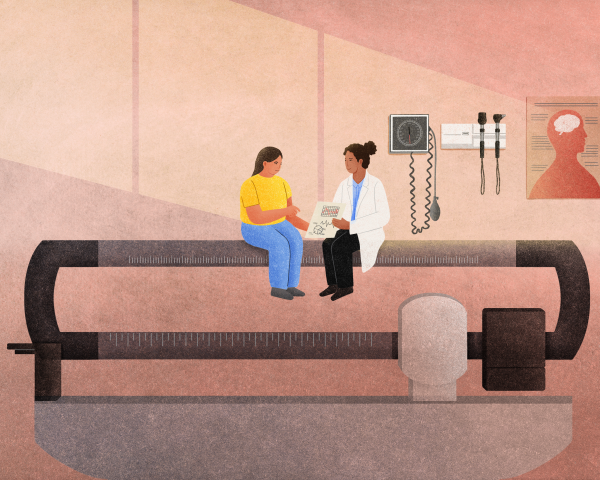
On his award-winning podcast Weight for It host Ronald Young Jr. gives listeners an intimate look at life in a bigger body. In one episode he records an extremely cringe-worthy conversation with his doctor. At this point Young has been lifting weights, doing cardio, and eating a diet with plenty of lean protein and fiber. He’s already lost 20 pounds since his last visit.
When the doctor asks Young what brings him in, he says that he hasn’t been sleeping so well, and would like an order for a sleep study so that he can get a CPAP machine. But instead of asking him about his sleep, the doctor fixates on Young’s weight. He specifies what he thinks Young’s goal weight should be based on his height, tells him he should be exercising even more and recommends a diet without being asked. Young leaves the appointment feeling both furious and ashamed.
Young is far from alone when it comes to patients who are sick of hearing about their weight when they go to the doctor, and wish for a more holistic approach to their health picture.
Primary care doctor Mara Gordon, who writes our Real Talk with a Doc column, takes a different approach.
“When my own patients come in for a checkup, I usually like to start with this question: ‘What are your goals?’ she writes. “What it means to be ‘healthy’ is different for every patient, so I try to take the time to explore what a full, flourishing life looks like for them.”
Instead of body mass index, Gordon uses metrics like blood pressure, glucose tolerance, mobility and mood to assess a patient’s health and progress toward their goals. She tests most patients regularly for glucose intolerance, which can be a precursor to diabetes, using a blood test called a Hemoglobin A1C. For patients with an A1C in the pre-diabetic range, she recommends regular exercise, which can prevent diabetes, even if you don’t lose weight doing it. She also says it's crucial to help patients understand and reduce their heart disease risk.
Gordon takes into account a patients’ particular situation when making recommendations. For instance, if you’re caring for a young child, it makes sense to prioritize sleep over an exercise regimen. If you’re in perimenopause, weight-bearing exercise becomes more important if you’re looking to prevent bone loss.
Read Gordon’s essay for more, including phrases to use to nudge your doctor towards health indicators other than weight and BMI.
Are you looking for an honest answer to a medical question? Dr. Mara Gordon, a family physician in Camden, N.J., answers reader health questions monthly. Write us at: thrive@npr.org.
Plus: Your next primary care doctor could be online only, accessed through an AI tool |
|
Parents, are you sure your kid's car seat is installed right? Here's how to know
Listen: Why is good food so sexy?
A new one-a-day-pill holds promise for HIV's 'forgotten population'
The secret to long-lasting friendships? Don't keep score |
|
We hope you enjoyed these stories. Find more of NPR's health journalism online.
All our best and please take care of yourself,
Andrea Muraskin and your NPR Health editors |
|
Listen to your local NPR station. |
|
Visit NPR.org to find your local station stream. |
|
|
| |
|
|
|
|
|
|
|
|
| |