|
 |
Every week, Popular Information shines a light on stories powerful people would rather keep in the shadows. We conduct investigations, uncover new facts, and impact the national political debate. Consider four examples from the first few weeks of 2026:
On January 5, Popular Information revealed how the military ouster of Venezuelan President Nicolás Maduro created a financial windfall for a prominent Trump-supporting billionaire, investor Paul Singer.
On January 20, Popular Information broke the news that ICE had stopped paying for all medical treatment for detainees and would not resume such payments for months.
On February 9, Popular Information uncovered how the Trump administration was rigging immigration courts against Somali migrants, assigning their cases to one Trump-appointed judge who rejects nearly all asylum claims.
On February 17, Popular Information exposed how major corporations — including General Motors, State Farm, JPMorgan Chase, Delta, and Microsoft — were bankrolling a political ad that featured a white supremacist slogan.
Popular Information has over 535,000 readers, but only a small percentage support our work as paid subscribers. We could put up a paywall to encourage more people to pay, but we believe access to crucial information should not be limited by income.
Original reporting is time-consuming and expensive. If you value this work and can afford$6 per month or $50 per year, please consider helping Popular Information fight for the truth bybecoming a paid subscriber.
9 days in, the most basic question about the Iran war remains unanswered
In just over a week, Trump and top administration officials have given at least 17 different responses about why the war began
| |||||||||||||||


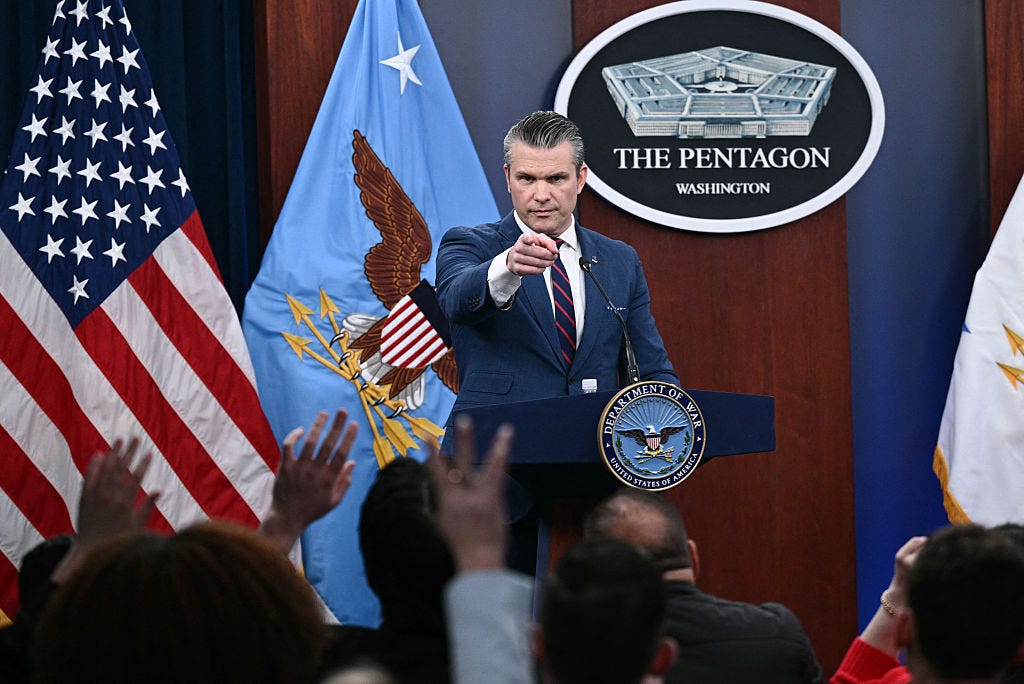 |
On February 28, President Trump announced that “the United States military began major combat operations in Iran.” The war has claimed the lives of more than 1500 people, including about 1300 Iranians, dozens in neighboring countries, and six U.S. troops. The Pentagon has estimated the conflict is costing U.S. taxpayers about $1 billion per day — and that figure may be too low.
And yet, nine days into the war, Trump and his administration have failed to clearly answer the most fundamental question: Why did the war begin?
Instead, the Trump administration has offered a bewildering series of shifting, contradictory, and factually incorrect answers. In just over a week, Trump and top administration officials have given at least 17 different responses about why the war began:
Iran’s nuclear program was “obliterated” last June, but the U.S. started the war because Iran refused to abandon its “nuclear ambitions.” In his February 28 announcement, Trump said that “in Operation Midnight Hammer last June, we obliterated the regime’s nuclear program.” The U.S. initiated this attack, Trump said, because Iran “rejected every opportunity to renounce their nuclear ambitions, and we can’t take it anymore.”
The U.S. attacked Iran to prevent a nuclear war. “If we didn’t do what we’re doing right now, you would have had a nuclear war, and they would have taken out many countries,” Trump said on March 3.
Absent an attack, Iran would have had a nuclear weapon within two weeks. “If we didn’t hit within two weeks, they would’ve had a nuclear weapon. When crazy people have nuclear weapons, bad things happen,” Trump said on March 4.
Iran is developing long-range missiles that “could soon reach the American homeland.” In his February 28 speech, Trump said that Iran was “developing the long-range missiles that can now threaten our very good friends and allies in Europe, our troops stationed overseas, and could soon reach the American homeland.” The idea that Iranian long-range missiles posed an imminent threat is not supported by public intelligence assessments. An assessment by the Defense Intelligence Agency published last May estimated that Iran would need ten years to develop a missile capable of reaching the United States — if it chose to pursue that capability.
The war is necessary because Iran has too much control over the global oil supply. On March 2, Secretary of State Marco Rubio said, “This terroristic regime, led by radical clerics, has the ability potentially to shut off 20 percent of global energy. That’s the kind of leverage they have because of their navy. We’re going to destroy their navy.”
The U.S. started the war because it knew Israel was going to attack Iran, endangering U.S. troops. “We knew that there was going to be an Israeli action, we knew that that would precipitate an attack against American forces, and we knew that if we didn’t preemptively go after them before they launched those attacks, we would suffer higher casualties,” Secretary of State Marco Rubio said on March 2.
The U.S. did not start the war because it knew Israel was going to attack Iran. The following was an exchange between Rubio and a reporter on March 3: “Q: Mr. Secretary, yesterday you told us that Israel was going to strike Iran and that that’s why we needed to get involved… SECRETARY RUBIO: Yeah, your statement’s false.”
Trump pushed Israel to join an attack on Iran because he believed Iran would otherwise attack first. “You see, we were having negotiations with these lunatics, and it was my opinion that they were going to attack first. …If we didn’t do it, they were going to attack first. I felt strongly about that. …So, if anything, I might have forced Israel’s hand,” Trump sai