What matters in U.S. and global markets today

Get full access to Reuters.com for just $1/week. Subscribe now.


Morning Bid U.S.

Morning Bid U.S.

A Reuters Open Interest newsletter

What matters in U.S. and global markets today


By Mike Dolan, Editor-at-Large for Finance and Markets

‘Oil shock’ and ‘stagflation’ are overused phrases in financial markets, often pulled out as a scare tactic when mapping out worst-case scenarios. But both are now very much in play with energy markets in turmoil as the Middle East war enters its second week with no end in sight.

Crude oil prices soared above $100 per barrel on Monday to their highest since just after the Ukraine invasion four years ago. If triple-digit oil prices are more than a short-term phenomenon, the U.S. and global economy could be in for some real pain - and central bankers may find themselves facing their worst nightmare: stagflation.

I’ll get into that and more below.

But first, for more on the market impact of the eye-popping oil surge, listen to today's episode of Morning Bid.


Data refreshes every time you open this email. For more U.S. market news, click here. Please send any feedback to morningbid@thomsonreuters.com.


Today's Market Minute

  • Oil prices surged above $100 per barrel on Monday as some major producers cut supplies and fears of prolonged shipping disruptions gripped the market.
  • Iran on Monday named Mojtaba Khamenei to succeed his father Ali Khamenei as supreme leader, signalling that hardliners remain firmly in charge.
  • The escalating Middle East crisis has dramatically changed the outlook for global central banks, posing a difficult trade-off between underpinning growth and countering inflation.
  • The current Iran conflict threatens to turn into a global fuel crisis thanks to mounting miscalculations and a retreat to self-interest by major countries, writes ROI Asia Commodities and Energy Columnist Clyde Russell.
  • Oil glut forecasts are being dismantled as buyers tap every available barrel amid the Iran war, making undersupply more likely, writes ROI Energy Columnist Ron Bousso.
 

Oil's triple-digit trouble

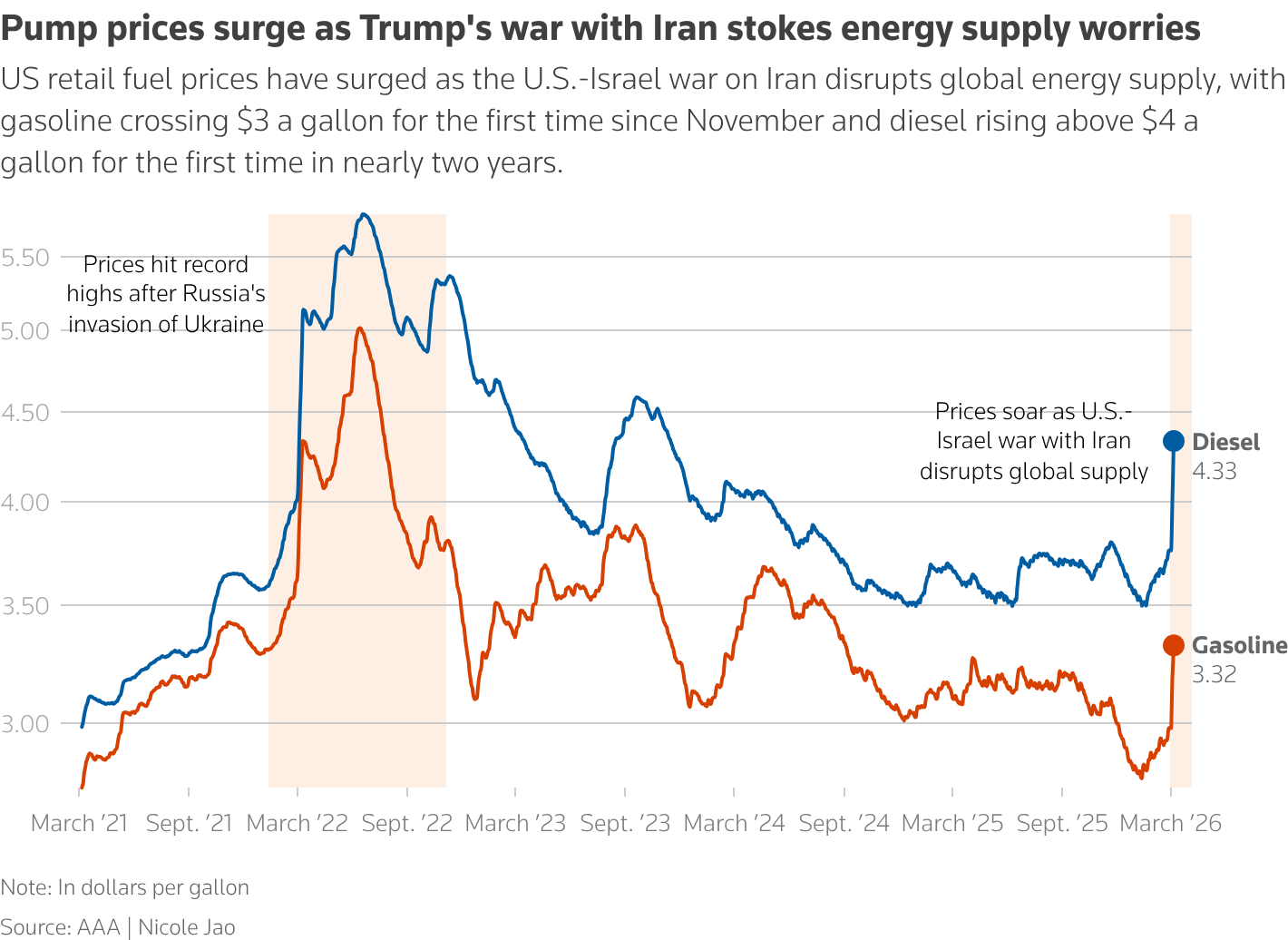
The energy crisis set off by the war in Iran is escalating. U.S. fuel prices have surged well above $3 per gallon, and they’re set to rise further. President Donald Trump wrote on social media overnight that rising oil prices were “a very small price to pay” for winning the war, though many voters may question that.

The worrying thing for central banks and investors is that this latest inflationary spur comes after Friday’s surprisingly weak U.S. employment report. The data may have been skewed by bad weather in February, but there were few positive points and many signs that the labor market has stalled.

This raises the dark prospect of ‘stagflation’ - slow or no growth coupled with mounting price rises. How the Fed and other central banks react to that is very much an open question. Most likely, they will just stand pat for longer, which is apt to please almost no one.

The renewed inflation concerns have rattled global bond markets, intensifying last week's selloff and sending yields higher - especially in Britain, where two-year gilt yields are on track for their biggest one-day rise since 2022.

Meantime, stock markets tumbled around the world, with Japan’s Nikkei losing over 5% and South Korea’s high-flying KOSPI shedding nearly 6%. That comes on top of losses last week of 5.5% and more than 10% for those indexes, respectively.

U.S. stock futures are down more than 1% before the bell and - much like last week - the greenback climbed as investors sought safety in the liquidity of dollar cash. Gold, usually the most reliable safe haven, once again failed to rise to the occasion, weighed by the stronger dollar and climbing Treasury yields.

Markets will now look to see if countries begin tapping their national oil reserves to stem the bleeding, with reports on Monday suggesting G7 finance ministers would discuss a joint release from emergency reserves.

Meantime, U.S. Senate Democratic Leader Chuck Schumer called on President Trump to release oil from the U.S. Strategic Petroleum Reserve, a move the president has so far not supported.

How far or for how long any of that can alleviate the situation remains to be seen as the crisis itself deepens, with Gulf states continuing to cut output amid persistent threats to shipping through the vital Strait of Hormuz.

Meantime, Tehran appears to be doubling down as it appoints hardliner Mojtaba Khamenei, son of Ali Khamenei, as Iran’s new supreme leader.


Today's key chart  


Graphics are produced by Reuters.

The jump in fuel prices since the start of the U.S.-Israel war with Iran could prove a political headache for the Republican Party ahead of November's midterm elections.

Some of the steepest rises have been in parts of the Midwest and the South, including swing states that supported Donald Trump in the 2024 presidential election.


Today's events to watch

  • U.S. 3-month and 6-month bill auctions
 

Want more smart, engaging financial analysis in your inbox? Subscribe to Trading Day by Jamie McGeever, a daily newsletter delivered just after the market close. And check out Reuters Open Interest (ROI), an essential new source for data-driven, expert commentary on market and economic trends. You can find ROI on the