Hello and Good Morning, particularly to the 24% of America’s 18-29 year olds who “usually or always” forget about changing their clocks to Daylight Saving Time, per a new YouGov survey. We hope you made it to work on time! Today we’re exploring: |
- Gas up: The Iran oil shock isn’t hitting every state equally.
- Not into mezzo: Timothée Chalamet’s ballet and opera comments caused a stir a week before the Oscars.
|
Where in the US have gas prices jumped the most since the US-Iran conflict? |
With the US-Iran war escalating, oil markets have become the global gauge of the conflict — and American drivers are already feeling the pain at the pump.
On Sunday, crude prices surged past $110 a barrel for the first time since the early days of the Russia-Ukraine war in 2022 as tankers began avoiding the Strait of Hormuz, a narrow chokepoint along Iran’s coast through which roughly one-fifth of global oil supply flows every day.
|
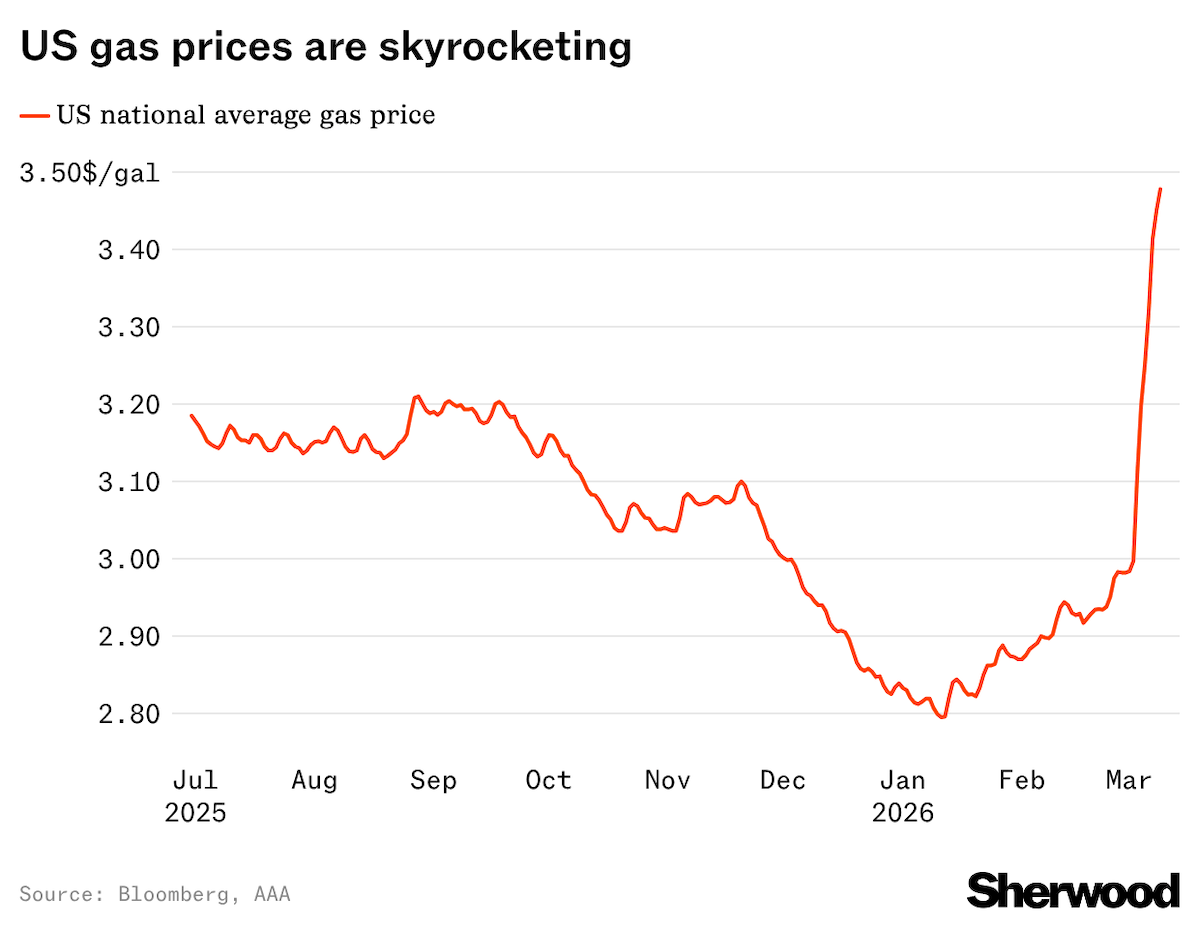
Because gasoline is refined from crude — with 60% of the pump price tied to oil costs — the shock is already showing up at gas stations. The national average price of regular gasoline climbed to $3.48 per gallon on Monday, up nearly 50 cents (+17%) from when the US and Israeli strikes on Iran began on February 28, according to the American Automobile Association.
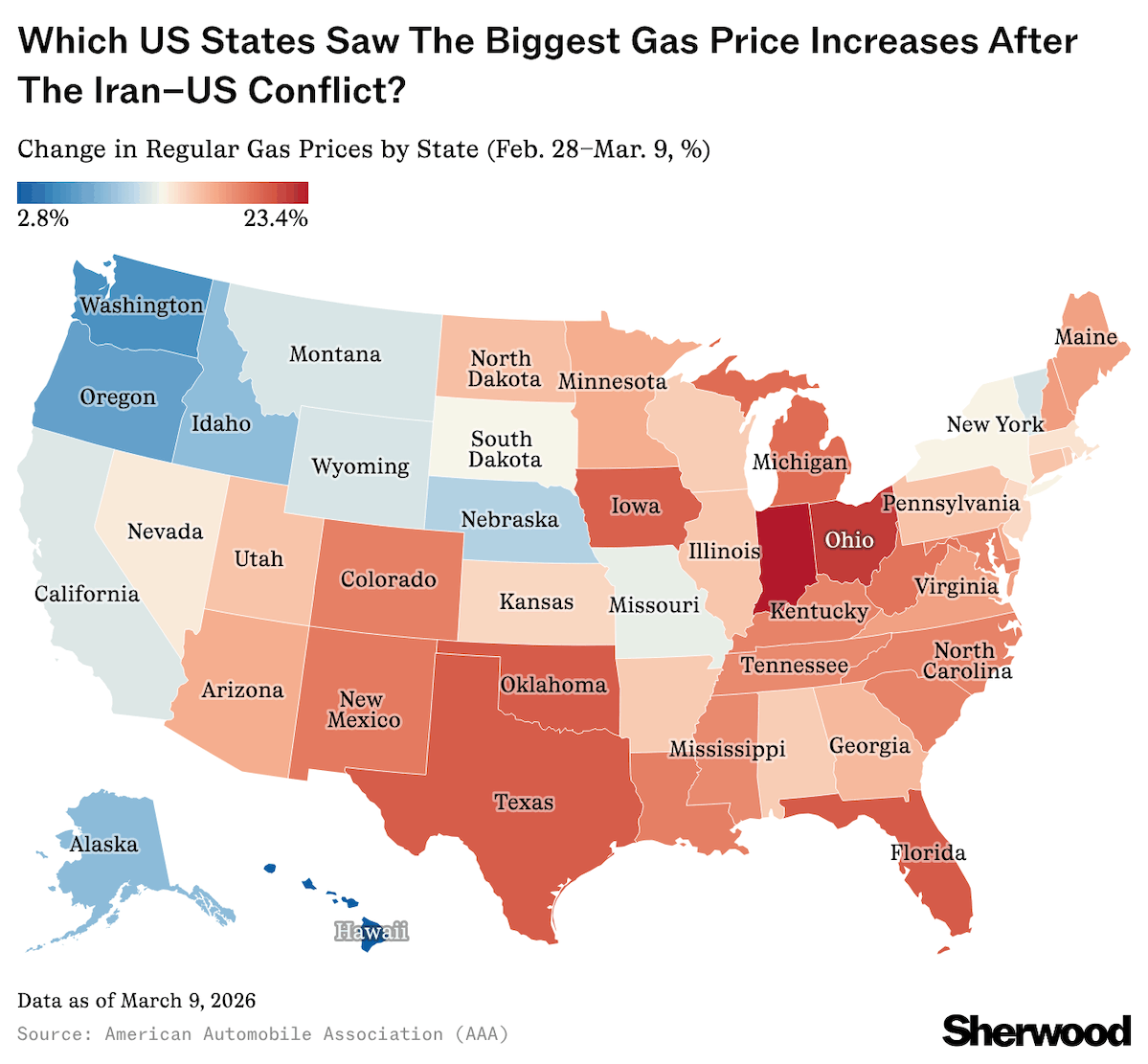
But the price hikes aren’t landing evenly across the country. |
States that have seen the sharpest increases include Indiana (+23%), Ohio (+22%), Oklahoma (+21%), and Texas (+20%). While these regions had relatively cheaper gasoline to start with — below $3 a gallon, leaving more room to rise — they’re also deeply connected to the Gulf Coast refinery network, which runs on crude priced against global benchmarks. So, when Middle East disruption sends those prices surging, the shock travels straight through the pipelines to local pumps.
Western states, however, saw far smaller increases. Hawaii (+3%), Washington (+6%), Oregon (+7%), Alaska (+9%), and Idaho (+9%) each posted single-digit price jumps, as the region operates largely outside the Gulf Coast fuel network, meaning that shocks from the Middle East tend to arrive slower and softer. They also had generally higher prices to begin with.
Still, Energy Secretary Chris Wright said Friday the surge in gas prices should last "weeks, not months,” while President Trump yesterday called rising oil prices "a very small price to pay” for “safety and peace.”
For now, US drivers are already shelling out roughly $187 million extra per day on gasoline compared with the weekend before, per Patrick De Haan, head of petroleum analysis at GasBuddy. In a Substack post on Sunday, De Haan also said there’s roughly an 80% chance the national average reaches $4 per gallon “within the next month or sooner.” At the time of writing, prediction markets seem to broadly agree with him.
|
Timothée Chalamet has upset opera and ballet fans a week before the Oscars |
A conversation between Oscar winner Matthew McConaughey and Best Actor nominee Timothée Chalamet at the University of Texas in February went viral over the weekend.
But rather than creating buzz about the motion picture arts, the “Marty Supreme” actor has drawn ire over his comments about the classical arts instead: “I don't want to be working in ballet, or opera, or things where it's like, ‘Hey, keep this thing alive, even though like no one cares about this anymore.’ All respect to all the ballet and opera people out there.”
Now, with less than a week to go before the 98th Academy Awards, backlash from the ballet and opera worlds has already seen traders on prediction markets react in favor of another Best Actor hopeful, “Sinners” star Michael B. Jordan. |
Final voting for this year’s Academy Awards officially closed on March 5 — which means that the recent outcry over Chalamet’s comments can’t really have had any true impact on his chances of scooping the Best Actor Oscar this coming weekend.
Still, the ballet and opera communities have voiced their frustrations with the actor’s recent comments, including industry icons, the actor’s old school, and the Metropolitan Opera, America’s biggest opera institution. While the notable retaliation goes some way in proving that people do still “care” about the art forms, the Met Opera’s mounting financial woes have seen the institution turn to the likes of Saudi Arabia and Elon Musk to try and help sustain its business, the New York Times reported yesterday.
|
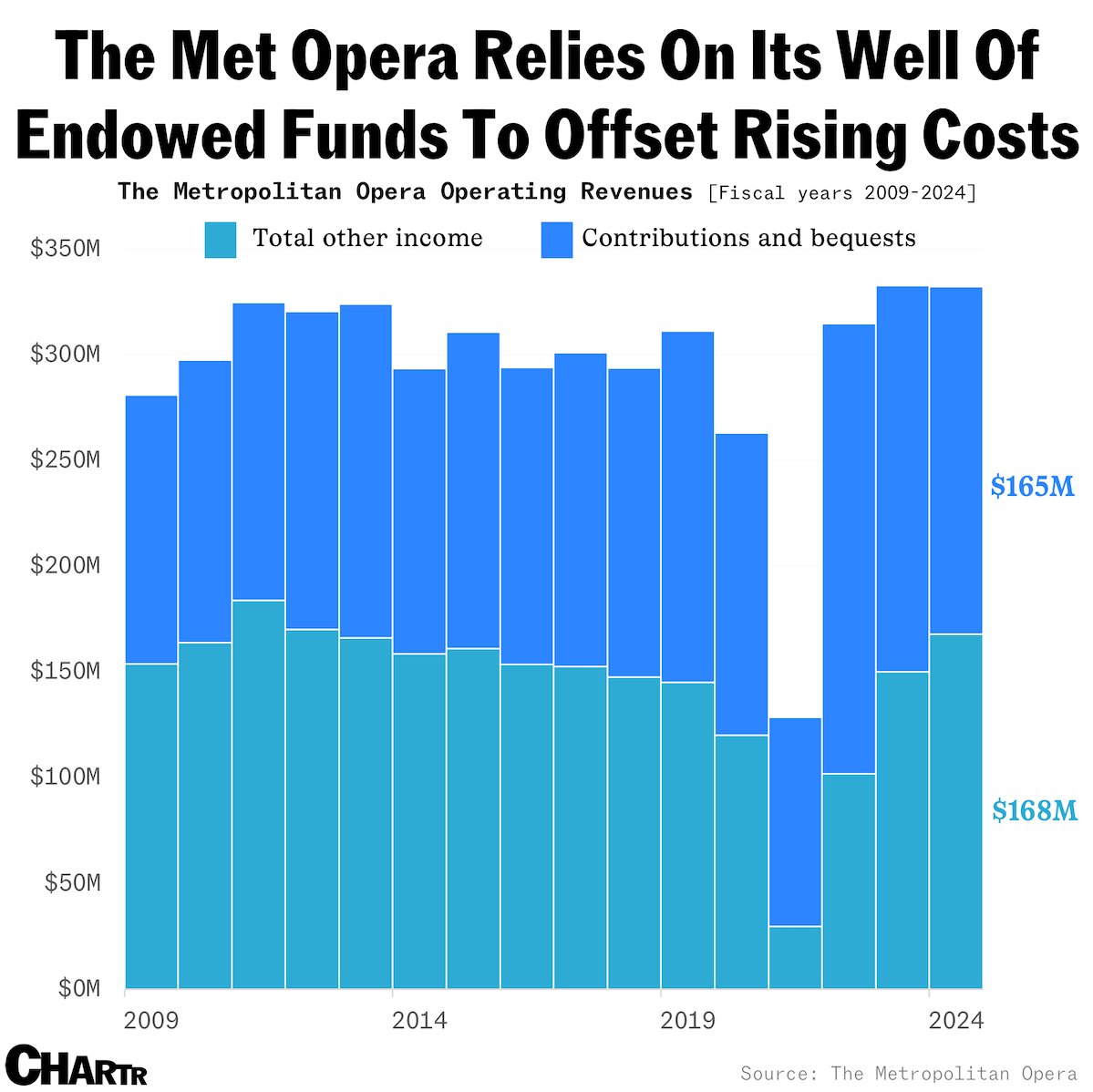
Looking at the Met’s financial reports, the company has started to tap into its endowment fund to offset mounting expenses, as ticket revenues continue to shrink. Per the NYT, the size of its endowment fund has decreased by one-third since 2022 to just $212 million today. |
Due to rising production costs, the 2026-27 season will be the Met’s smallest in at least 60 years, with just 17 productions on the slate. Naturally, though, it’s leaning into the classics: 71 of the 187 individual opera performances this year will be across “La Bohème,” “Aida,” and “Tosca” — all of which are among the Met’s top 5 most-performed operas ever... and all of which were last shown in 2025.
|
|
|
Diversified large-cap exposure meets monthly income. |
Looking to invest for long-term growth and monthly income?
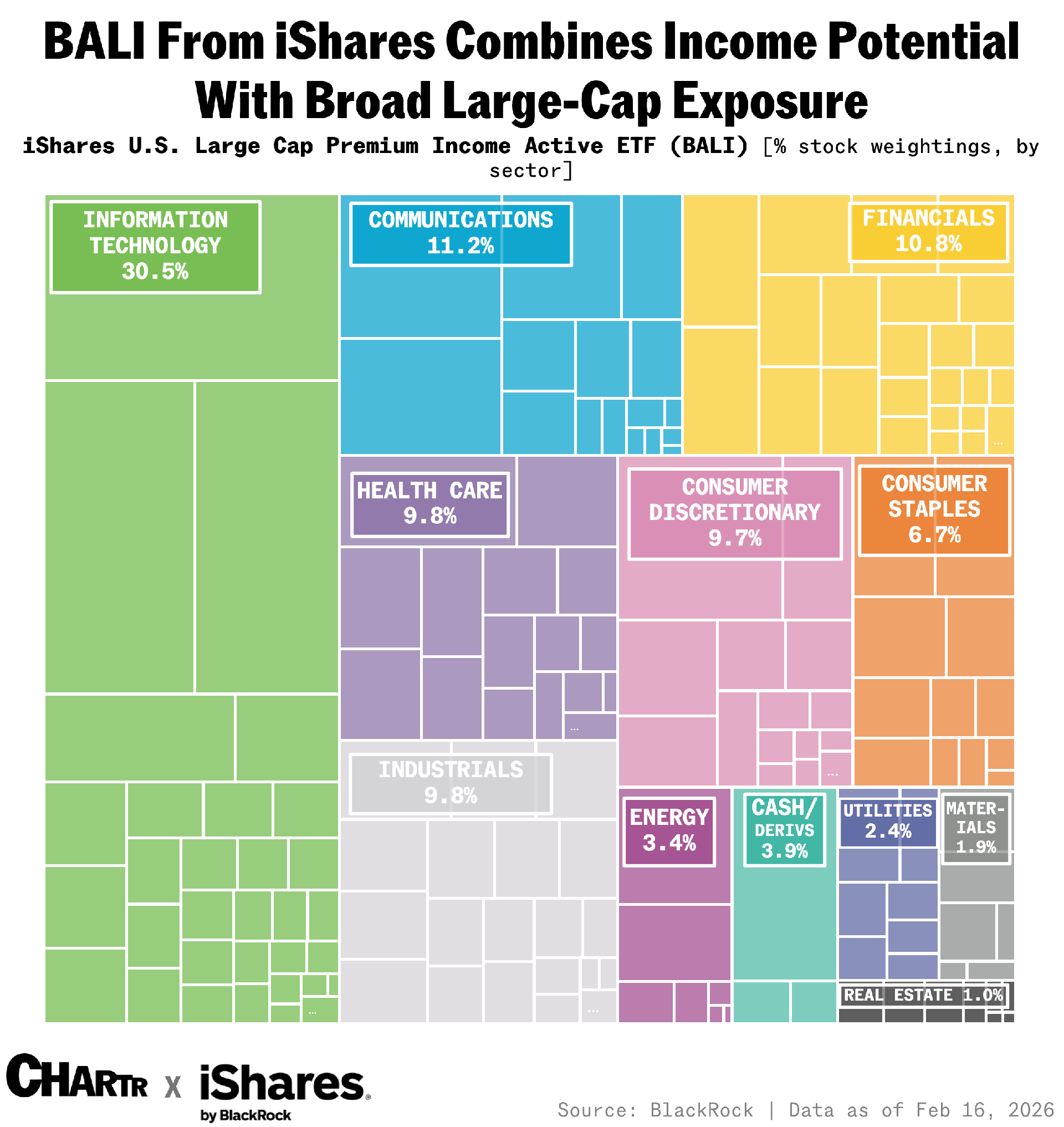
BALI provides U.S. large cap exposure that actively seeks to capture upside potential and manage volatility, while also aiming to generate income. The fund aims to deliver monthly payouts to investors via two potential sources: equity dividends on large-cap stocks and the sale of call options.
BALI employs a systematic, data driven stock selection process to identify large-cap U.S. companies with strong fundamentals and active characteristics. On top of the income received from large-cap stocks within BALI’s diversified portfolio, premiums collected from selling call options can also provide income to investors. |
Designed to be a core holding, BALI can be used to seek consistent income along with upside potential in U.S. large-cap equity markets.
Capture potential dividends, options income and long-term growth in a single ETF: discover BALI from iShares. |
|
|
-
Telehealth company Hims gained more than 50% in premarket trading today on reports that Novo Nordisk will sell its weight-loss drugs on the US-based platform.
-
Waymo money: Alphabet CEO Sundar Pichai has had up to $260 million of his compensation tied to Waymo’s performance, marking the first time the autonomous vehicle unit has been linked to his pay.
-
Microsoft, still a major shareholder in OpenAI, is using rival Anthropic’s AI models to power its Copilot workplace tools.
-
Dam good: Pixar’s “Hoppers” leapt to the top of the box office on its debut weekend, with the beaver-robot flick taking $88 million worldwide — the animation house’s biggest opening since 2017.
-
Uber is rolling out ‘Women Preferences,’ a nationwide program that matches female riders with female drivers after a successful pilot in 5 cities last August was expanded to 60 cities by the year’s end.
|
|
|
BALI from iShares: Get exposure to large-cap stocks plus S&P 500 E-Mini futures and options contracts on large-cap indexes. It can be used to seek consistent income with upside potential in U.S. large-cap equity markets — find out more. |
|
|
-
Changing rooms: A 100-year history of White House renovations from USAFacts.
-
Charting the world’s deadliest animals by annual human deaths (and no, humans aren’t top).
|
Off the charts: Which entertainment company has now reportedly reached a settlement with the DOJ in its antitrust lawsuit trial that started a little under a week ago? [Answer below]. |
Not a subscriber? Sign up for free below. |
Advertiser’s disclosures:
Carefully consider the Funds' investment objectives, risk factors, and charges and expenses before investing. This and other information can be found in the Funds' prospectuses or, if available, the summary prospectuses which may be obtained by visiting www.iShares.com or www.blackrock.com. Read the prospectus carefully before investing. Investing involves risk, including possible loss of principal.
When the Fund sells call options on a large cap equity index, it receives a premium but it takes on the risk that these options may reduce any profit from increases in the market value of the long equity positions held by the Fund. Any such reduction in profits would be the difference between the payoff of the call option and the premium received. The Fund would also retain the risk of loss if the long equity positions decline in value. The premiums received from the options may not be sufficient to offset any losses sustained from the long equity positions. Factors that may influence the value of the options generally include the underlying asset’s price, interest rates, dividends, the actual and implied volatility levels of the underlying asset’s price, and the remaining time until the options expire, among others. The value of the options written by the Fund typically do not increase or decrease at the same rate as the underlying asset’s price on a day-to-day basis due to these factors.
The Fund is actively managed and does not seek to replicate the performance of a specified index, may have higher portfolio turnover, and may charge higher fees than index funds due to increased trading and research expenses. There is no guarantee the fund will meet its investment objective.
The Fund's use of derivatives may reduce the Fund's returns and/or increase volatility and subject the Fund to counterparty risk, which is the risk that the other party in the transaction will not fulfill its contractual obligation. The Fund could suffer losses related to its derivative positions because of a possible lack of liquidity in the secondary market and as a result of unanticipated market movements, which losses are potentially unlimited. The iShares Funds are distributed by Black |
|
|
|