Alphabet is known for many things — Google Search, YouTube, and lately, its Gemini AI — but it also has “Other Bets” it’s making, a division where the tech giant develops and tests its experimental ventures, such as its Wing drone delivery arm. In a huge, flashing neon sign that one of those bets is moving from moon shot to main character, the company has tied CEO Sundar Pichai’s pay to driverless car service Waymo for the first time, and if he meets the lofty goals, it could be the most massive payout of his tenure.
The S&P 500, Nasdaq 100, and Russell 2000 jumped higher yesterday, trimming significant losses from earlier in Monday’s session, after Weijia Jiang, CBS’s senior White House correspondent, reported that President Trump said, “I think the war is very complete, pretty much.”
|
|
|
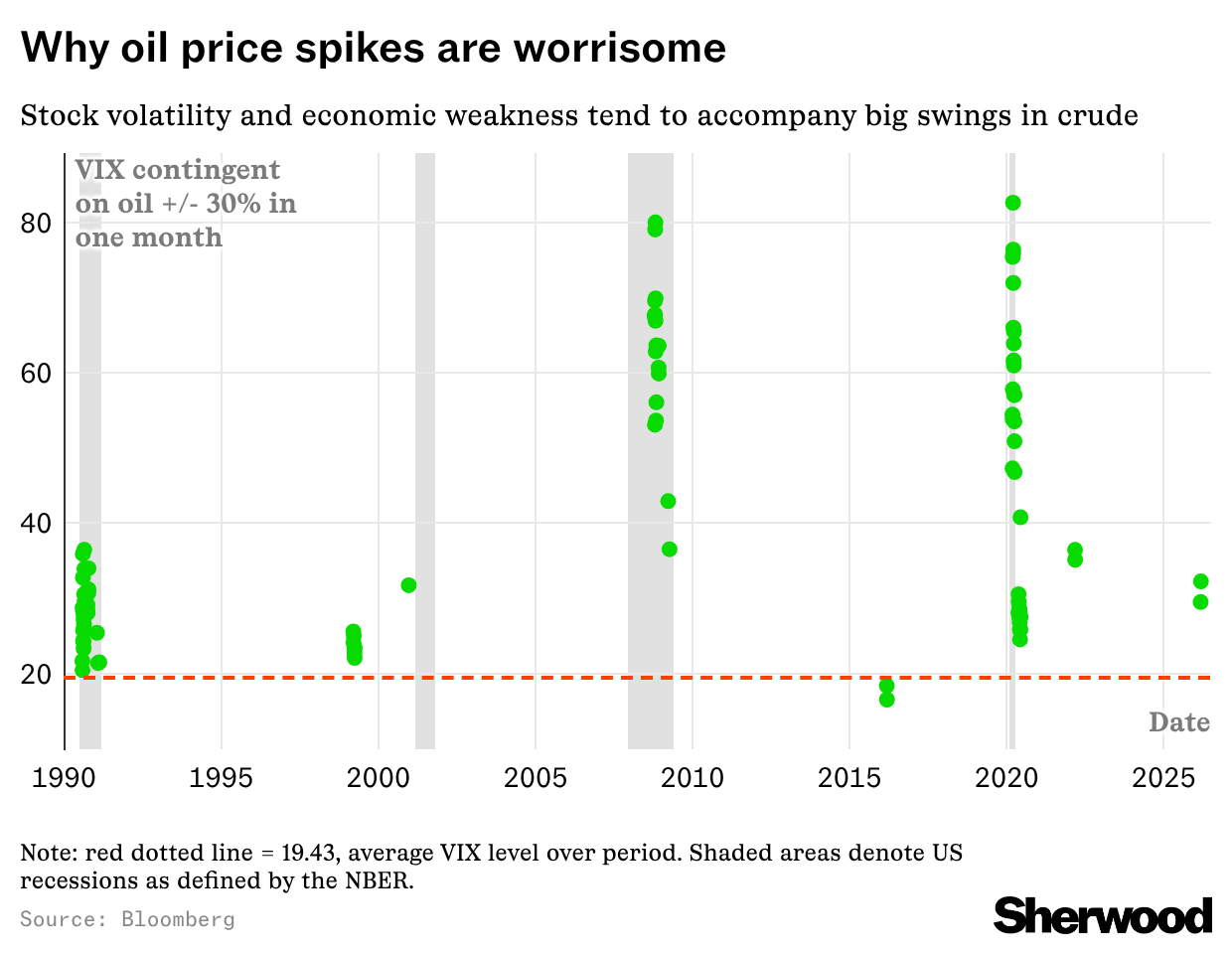
History tells us that extreme moves in oil prices tend to either reflect, or cause, big changes in demand. That is, oil going down a lot tells us that demand is bad; oil going up a ton tells us that demand will soon be bad because of how high prices are. |
- Outside of crude rebounding from a supply-driven tumble in Q1 2016, every time front-month Brent futures have risen or fallen 30% or more in a month, that’s been accompanied by above-average stock market volatility. In most cases, it’s either coincided with or been soon followed by a recession.
-
Yesterday, this was on display pretty much everywhere. Oil-sensitive stocks and companies relying on middle-class spending got crushed early in the day ahead of an announcement that the president would speak to the press after the bell.
-
Beyond the usual suspects among the airlines, the pain was widespread, with industries where oil prices are a major input, such as chemical manufacturers, industrial machinery makers, and building products, also getting shellacked.
-
More ominous — economically speaking — is the performance of companies catering to America’s middle class, including Macy’s, Kohl’s, and Best Buy. The drop suggests that investors and traders expect the rising cost of fuel to eat away at disposable income, potentially setting the stage for an economic slowdown.
|
Because oil plays a role in determining the price of everything that’s shipped, as well as how much most people spend filling up their tanks, it has a big macroeconomic impact. |
|
|
Whether or not an individual company will face stress from surging oil prices is missing the forest for the trees — or rather, missing the tankers for the empty strait.
Oil price volatility is something that tends to mark a crisis. What’s happening right now is certainly a geopolitical crisis, and could metastasize into an economic and market crisis. It certainly doesn’t have to! But one thing we know about humungous gyrations in oil prices is that they’re fuel for higher correlations, and in times of crisis, correlations tend to go to one.
|
|
|
Gold futures can offer traders more for their money |
Actively trading the gold market? CME Group futures provide the capital efficiency you need to deploy your cash more strategically.
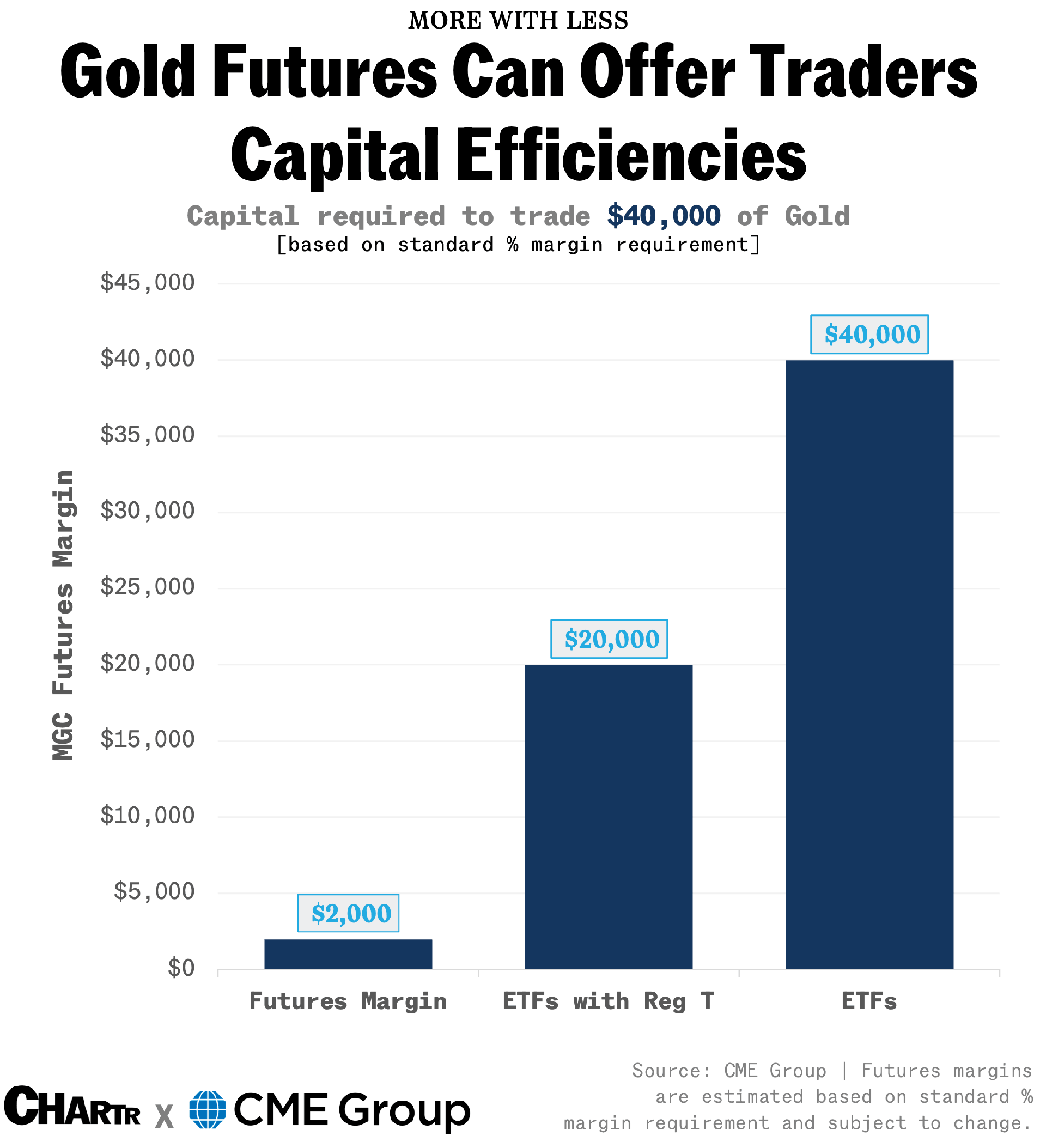
To control $40,000 of gold, an ETF investor must deploy the full $40,000 in cash—or $20,000 if using standard Reg T margin. Meanwhile, a Micro Gold futures (MGC) trader can access that same exposure by putting up roughly $2,000 in margin.1
By utilizing futures, you unlock 20x the capital efficiency of a cash-backed ETF. This allows you to diversify your portfolio or allocate capital to other opportunities without sacrificing market exposure. Ready to do more with less? Explore Micro Gold futures at CME Group today.
1 Margin requirements are subject to change. Brokers may charge additional fees. |
|
|
-
Fuel hedging can insulate airlines against volatile swings in fuel prices. You know, like the ones happening right now.
-
The practice famously helped Southwest in particular, including saving it $1.3 billion in 2008 amid a fuel surge during the global financial crisis, and $1.2 billion in 2022 during another spike as Russia invaded Ukraine.
-
But the practice can also lock carriers into higher fuel costs during drops in oil prices, which is why carriers like American, United, and Delta stopped doing it about 10 years ago. JetBlue stepped away from hedging in 2021, and Alaska Air suspended its program in 2024.
|
Now, those decisions are being called into question, with US jet fuel prices up 87% this year, according to the Argus US jet fuel index. Airline shares have been pummeled in March, with carriers shedding billions of dollars in market cap. |
|
|
Without hedges, airlines are expected to hike airfares quickly — as they historically do when oil prices surge. Last week, United CEO Scott Kirby said fare increases would “probably start quick.” Getting ahead of criticism around the airline’s lack of hedging, Kirby also said that “no one hedges anymore” and “even if you do, hedging the crack spread is really hard to do.”
More industrywide cost-saving strategies may come soon. The 2008 spike in oil costs coincided with the widespread adoption of bag fees by American carriers. In the years following the 2022 surge, budget carriers shifted heavily into the business of catering toward wealthier travelers who don’t change their plans as quickly when fares climb. |
|
|
|