| | In this edition, worries persists in energy markets despite an oil price retreat, and is this finall͏ ͏ ͏ ͏ ͏ ͏ |
| |  | Business |  |
| |
|
 - Oil worries persist
- Treasury oil intervention?
- Ackman, take 2
- Trump’s CEO tagalongs
- Live Nation lives to fight
- Bilt CEO on Compound Interest
|
|
 AI mania has given companies air cover to do something many have been itching to do since the overhiring (out of exuberance) and underfiring (out of a desire not to look heartless) of the pandemic: lay off a lot of employees. The war in Iran and its threatened ripples across global markets provide another belt-tightening excuse. Energy prices are soaring. Abu Dhabi, Kuwait, and Iraq have already slowed oil production as tankers remain stranded in the Gulf. Odds of a recession have spiked on prediction markets. February’s job losses were ugly and extended deep into the private sector, beyond DOGE’s government cuts. The flight from private credit may be overblown, but it’s undeniably real and coming from retail investors (read: consumers) who internalize that panic by curbing spending further. The combination of stubborn inflation and weakening employment spells trouble for any central bank. It’s a nightmare scenario for one under express pressure from the president to cut interest rates. Sure, the US is a $30 trillion economy that has proven hard to knock off its course and investors are still holding on to a lot of that optimism. Just look at how rapidly the markets turned positive yesterday on the suggestion that oil worries may subside. But it’s a CEO’s job to boost the company’s bottom line. And while they may use euphemisms like “uncertain macroeconomic outlook,” “financial discipline,” or “right-sizing for current conditions,” layoffs will follow not because the economic conditions demand it — but because the economic fears allow it. |
|
Oil prices retreat but worries persist |
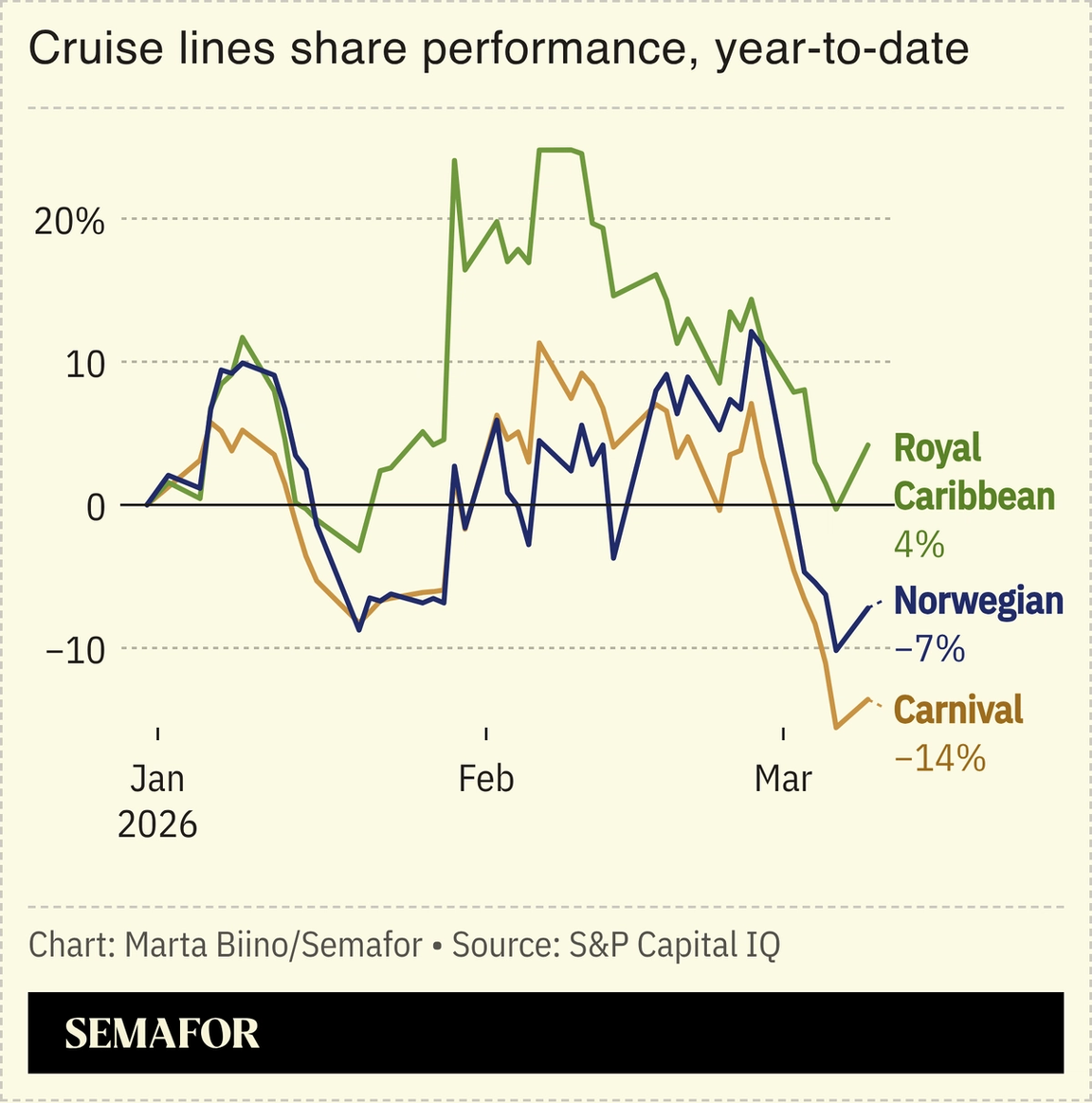 The war in Iran has quickly evolved from a regional military confrontation into a global energy shock. Oil continued its retreat today from a flirtation with $120-a-barrel Monday, but remains 25% higher than before the US-Israel strikes began. Saudi Aramco’s CEO warned of “catastrophic consequences” for the world economy if the Strait of Hormuz, a conduit to one-fifth of the world’s oil, remains blocked. The conflict has created winners and losers in the Gulf, Amena Bakr writes for Semafor: Saudi Arabia, the UAE, and Iran have options to bypass the chokepoint, while Bahrain, Iraq, Kuwait, and Qatar do not. (Industry sources tell Amena that Iraq’s 4.2 million daily barrels are down to 1.7 million.) Energy prices are putting pressure on airline and cruise stocks — and exposing weaknesses in their varied approach to hedging their fuel costs. Royal Caribbean has hedged about 60% of its fuel purchases to a cost of $474 per metric ton, which equates roughly to $75-a-barrel oil, according to Barclays analysts. Norwegian has hedged about half its exposure at a slightly higher price. Carnival doesn’t hedge at all, which means that at $100-a-barrel oil, it’s facing fuel prices between 10% and 20% higher than its peers. Airlines are regretting their decision to mostly stop hedging after taking heavy losses doing so in the early 2010s. |
|
Leave the oil trading to Wall Street |
 An oil tanker in Muscat, Oman. Benoit Tessier/Reuters. An oil tanker in Muscat, Oman. Benoit Tessier/Reuters.The US Treasury is reportedly considering trading in oil futures to bring down energy costs as the war in Iran tests President Donald Trump’s affordability kick at home. Experts are pleading: Please don’t. “This is the worst oil supply crisis in modern history,” Amos Hochstein, former US assistant secretary of state for energy resources, tells Semafor. “You can’t financial-paper-exercise your way out of it.” Bloomberg and Reuters reported that Treasury officials are considering a range of options to tamp down gasoline prices that have surged alongside oil, including buying long-term futures while selling shorter-dated ones. (It’s a version of a playbook occasionally used in the interest-rate market, mostly recently in 2012’s Operation Twist.) Administration officials appeared to backtrack from the idea, pivoting to proven options like a gas-tax holiday and releasing oil from the US’ strategic reserve. “I understand the idea, but the risk is that the US government ends up in the mother of all short squeezes,” Joe Brusuelas, chief economist at RSM, told Semafor. “It could easily be challenged by global investors” willing to test its mettle. The multitrillion-dollar global oil futures market is hard to bully, even for the world’s richest country. “The Fed can print reserves, the Treasury can print money, but neither can print oil,” Brusuelas said. |
|
Is it finally Bill Ackman’s moment? |
 Mike Blake/Reuters Mike Blake/ReutersAs Warren Buffett leaves the investing stage, an aspiring successor is trying to emulate him — again. Bill Ackman filed today to take his investment firm public. He has long described Pershing Square as a mini-Berkshire Hathaway — a stable of blue-chip companies, held for the long term with minimal meddling from above. That stable could also include a fleet of funds of various flavors: One to help take public large startups that would once have been too big for traditional IPOs (a twist on another of Ackman’s unfulfilled dreams) and another focused on asymmetric macro bets, like his Big Covid Short in 2020 or his inflation wager in 2021, which together turned $200 million into $4 billion. This is Ackman’s second attempt at listing Pershing Square, after withdrawing an oversized plan in 2024 that found little market appetite. This time around he’s throwing in a sweetener: Investors who buy shares in Pershing’s new closed-end fund will also get a slice of the management company, which chooses investments and collects fees. That entity had $250 million of profits last year on $763 million of revenue, according to a filing. |
|
Seating charts are everything, even in China |
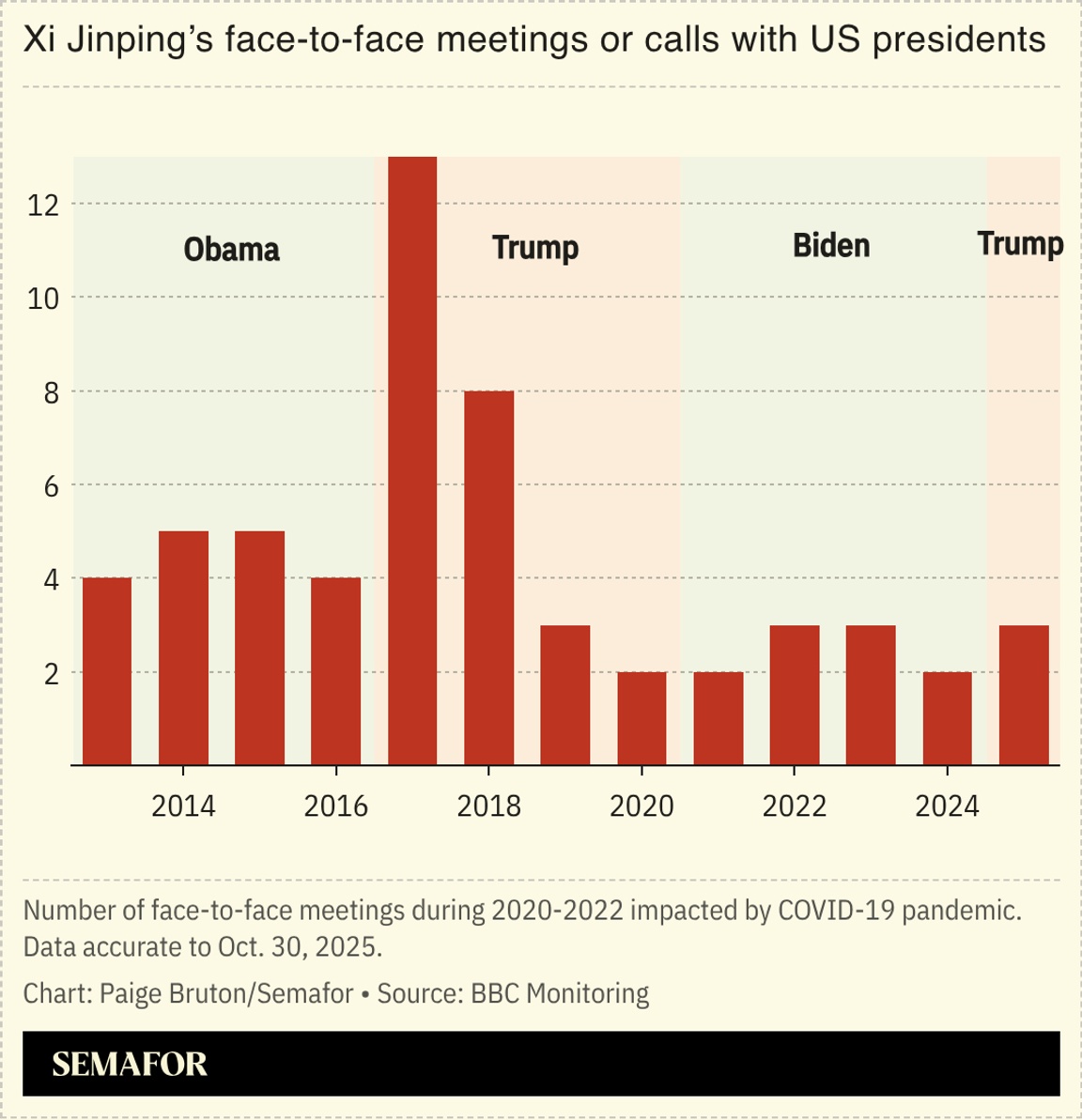 Spare a thought for the protocol officers in Beijing. Three weeks out from Trump’s crucial trip to China, planning for a contingent of CEOs to join him — and potentially validate commercial deals between the world’s two biggest economies — remains scattershot, Semafor reports. There’s talk of a CEO dinner in Beijing, but no invites have gone out yet, according to people involved in the planning. Top executives in key industries like aviation, technology, finance, autos, and agriculture said they haven’t yet been contacted about participating in a private-sector delegation that would formally accompany the president or convene on the sidelines. (UK Prime Minister Keir Starmer and German Chancellor Friedrich Merz brought 90 corporate executives between them, when they visited Beijing earlier this year with economic wish lists of their own.) A White House official said it’s not unusual for details to be ironed out closer to presidential foreign trips and that there is “no disagreement internally” about inviting CEOs on the trip, the person said. |
|
Live Nation-Ticketmaster drama not over yet |
 Jennifer Gauthier/Reuters Jennifer Gauthier/ReutersLive Nation’s deal Monday with the Justice Department, which will avoid a breakup of the ticketing giant, was all but foretold by the ouster of the DOJ’s top antitrust cop last month who had wanted a tougher approach. But the drama isn’t over: State attorneys general in New York and California say they aren’t joining the settlement and will press their cases arguing that Live Nation operates an illegal ticket monopoly. The federal judge overseeing the DOJ’s case, which began a little more than a week ago, also suggested that both the government and Live Nation had misled him in the days before the deal was announced. “It is absolutely unacceptable,” Judge Arun Subramanian said. (He has the power, under the Tunney Act, to block this deal.) Lobbyists for Live Nation had negotiated a deal directly with top Trump officials, bigfooting DOJ antitrust chief Gail Slater and her office, Semafor previously reported. Those efforts have paid off, with a settlement coming despite widespread popular support for a breakup of Ticketmaster and Live Nation. Note: We’ll be interviewing the world’s top antitrust enforcers later this month — and asking them about this settlement — including interim DOJ chief Omeed Assefi, FCC Chair Brendan Carr, and FTC Chair Andrew Ferguson. You can sign up to attend in person in Washington or virtually. — Rohan Goswami |
|
Bilt CEO on the ‘four-banana problem’ |
 Semafor/YouTube Semafor/YouTubeBeware the Redditors. Ankur Jain, CEO of Bilt Rewards, learned that lesson the hard way, when he was briefly outwitted by a dedicated band of his own customers. Bilt, a six-year-old, $10.8 billion startup that made a name for itself with a popular rewards-for-rent credit card, was forced earlier this year to retool a credit-card partnership with Wells Fargo that doled out perks to cardholders as long as they made at least five purchases per month. Instead of turning to their Bilt cards for more high-ticket items to reach the minimum spend, though, a lot of users just paid their rent and bought four individual bananas. “People played the game and I respect it,” Jain said on the latest episode of Semafor’s Compound Interest show, but “it can really upside-down your P&L.” The P&L was technically Wells Fargo’s, which ultimately bailed on the money-losing fiasco. The partnership was a growth hack for Bilt, and Jain said it has held on to about 85% of those cardholders as it transitioned in recent weeks to a new bank partner (with some new hiccups). We’ve been critical of the credit-cards rewards economy, in which poorer customers who carry high-interest balances from month to month subsidize travel perks for richer and more financially savvy users. With much of its early growth already subsidized by Wells Fargo, Bilt’s twist is to instead tap corporate marketing and processing costs. “Historically you’d have to go put flyers under the door,” he said. |
|
 Semafor Washington, DC is expanding to twice a day, with an afternoon edition of the must-read email briefing. This new edition harnesses the expertise and intelligence of our extremely well-sourced Semafor Washington, DC team, now strengthened by new congressional reporter Nicholas Wu. Delivered to inboxes every weekday around 4:30 pm ET, the afternoon edition delivers a sharp snapshot of the day’s developments driving Washington and a clear-eyed preview of the narrative shaping the next 12 hours. Sign up for our twice-daily briefing here. |
|
➚ BUY: Pants. Fabletics is pivoting to jeans as the post-pandemic athleisure boom fades and “hard pants” stage a comeback. ➘ SELL: Shorts. Nearly $40 million in tokenized oil contracts were wiped out on crypto platform Hyperliquid after energy prices spiked, one of the largest single-asset liquidation events the platform has ever seen outside of Bitcoin and Ethereum. |
|
|


