|
Dear all,
British Science Week provides an opportunity to celebrate the science, technology, engineering and mathematics (STEM) that underpin health security. The range of STEM disciplines underpinning public health protection is wide — from genomics and data modelling, to engineering new diagnostic platforms and applying behavioural science to pandemic preparedness. Very little of this work happens in isolation, with partners in academia, industry, the NHS, local and national government, and internationally all playing a vital role.
This week UKHSA has marked the occasion by sharing our second annual Science Review, which looks back at our scientific work across 2025 and explores UKHSA’s goals to build the science base the future requires. The Science Review organises progress around the five scientific ambitions at the heart of UKHSA's wider Science Strategy, and across all five, 2025 saw real advances; from breakthroughs in genomics to new frontiers in global health preparedness.
We hope this edition of the Stakeholder Cascade gives you a sense of what is being achieved, and of the ambition of UKHSA in driving public health science forward.
If you have any questions please get in touch by emailing externalaffairs@ukhsa.gov.uk
As always, you can also follow UKHSA on X, on Instagram, on BlueSky, and on LinkedIn for all the latest updates. You can also find the latest news from UKHSA on our news page on GOV.UK.
Best wishes,
UKHSA External Affairs Team
New and updated stories
- UKHSA's 2025 Science Review
- Staying ahead of emerging threats: insights from Oropouche
- UKHSA e-bug programme
- Celebrating UKHSA Women in Science, Technology, Engineering and Mathematics (STEM)
- Update on infant formula recalls
- New toolkit to help make farm visits fun and safe this spring
- Norovirus cases remain high while respiratory viruses fall
- Latest measles case data
- Measles resources for stakeholders - updated blog
- World TB Day - 24 March
Ongoing issues
- National flu immunisation programme 2026 to 2027 letter
- Help us build our infectious disease image library
- Childhood immunisations campaign 2026
- Request for stakeholder feedback: winter vaccines campaigning and communicating vaccines webinar series
- Public advised to stop using some non-sterile alcohol-free wipes
- Infant formula recalls
- Avian influenza
- Report a Notifiable Disease Tool
Events
- UKHSA Conference 2026
- Next week: UKHSA & RCGP TARGET Antibiotic webinar - 17 March
UKHSA communications toolkits
- Information on how to access the range of communication toolkits we produce for stakeholders
UKHSA data, analytics and surveillance:
- Statistics at UKHSA
- UKHSA data dashboard
- Notification of Infectious Diseases report

To mark British Science Week (6 to 15 March), UKHSA has published our 2025 Science Review, which captures what we have achieved and sets the direction for what comes next.
From advances in pandemic preparedness to leading collaborative work around emerging viruses on the global radar, the Review reflects on a year of significant progress against our 10-year Science Strategy. Behind every finding in the Review is the work of colleagues across UKHSA – scientists, analysts, public health specialists and many others – whose expertise and dedication help protect people from health threats.
And as we look ahead to evolving health threats that are more frequent and complex, it highlights how turning ideas and evidence into real-world impact needs to stay at the heart of what UKHSA does.
|

Preparing for future health threats starts long before a virus makes the headlines. That’s why UKHSA works with partners around the world to study emerging pathogens and identify key gaps in knowledge and research. Our latest blog on Oropouche focusses on one of the global viruses our scientists are monitoring, shows what this approach looks like in practice, and how it helps us strengthen preparedness long before any threat reaches the UK.
|

This British Science Week theme encourages children and young people to take the lead: asking the questions that matter most to them, exploring the world with curiosity, and discovering how science helps us find answers. UKHSA's e‑Bug programme helps children learn more about microbes, hygiene, antibiotics and immunity. It provides free educational resources to schools to help support children and young people to play their role in infection prevention and control.
|
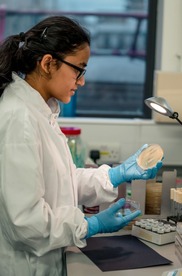
To mark International Women's Day, this month's Research Spotlight celebrates the women scientists and engineers at UKHSA who work to keep the nation safe.
Their research spans chemical threats, radiation protection and environmental hazards — generating the evidence that shapes public advice, surveillance and emergency response.
UKHSA women researchers are leading on developing smarter ways to detect everyday chemical and pollution exposures and are using artificial intelligence to track pollen and airborne particles in real time. In radiation science, UKHSA experts influence international regulatory guidance across the nuclear sector.
Across all of this work, these researchers help to address health disparities, ensuring that evidence-based protection reaches those who need it most.
UKHSA is proud to partner with the Women into Science and Engineering network to champion women across STEM.
|
Some infant formula products have recently been recalled.
This is because they might contain a harmful toxin called cereulide. Cereulide is a toxin produced by food poisoning bacteria Bacillus cereus, and can cause food poisoning symptoms which can be quick to develop and include vomiting, and stomach cramps.
The formula products which have been recalled include some batches from SMA, Aptamil and Cow & Gate. You can read more on the infant formula recall page on the Food Standards Agency website.
As of 2 March 2026, UKHSA and partner agencies have received 61 notifications where children who have consumed implicated batches and have symptoms consistent with cereulide toxin poisoning. Given the widespread availability of these products prior to the recalls, this is not unexpected.
Testing of the recalled formula has confirmed presence of the toxin in some batches at levels that exceed limits set by the European Food Safety Authority and therefore pose a potential health risk.
The FSA advice is that parents, guardians and caregivers should:
- Check which formula your baby is using.
- If it is one of the affected batches, stop using it immediately, even if your baby seems well.
- If you have already fed one of the recalled formulas to your baby and are concerned about symptoms, contact your GP or call NHS 111.
We are sharing these alerts on behalf of the Food Standards Agency.
|
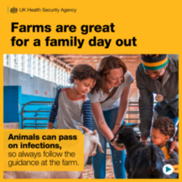
Farm visits are a popular family activity across the UK as spring gets underway, offering children and adults alike an enjoyable and educational day out. However, visiting a farm carries a small risk of catching infection from animals or the environment.
Our updated stakeholder communications toolkit aims to help support you in sharing important safety messages with your audiences. It includes background information on farm visit risks, practical guidance on staying safe, advice on what to do if someone feels unwell after a visit, and ready-to-use social media assets and blogs.
The toolkit is available on our Google Drive.
For further information please contact externalaffairs@ukhsa.gov.uk.
|
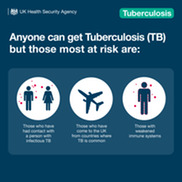
World TB Day is on Tuesday 24 March. Each year we commemorate World TB Day to raise public awareness about the devastating health, social and economic consequences of tuberculosis (TB) and to step up efforts to end the global TB epidemic.
The latest UKHSA provisional annual data for 2025 shows that reported notifications of TB in England were broadly stable compared to 2024, with 5,424 people notified compared to 5,487 in 2024 – a decrease of 1.1%. Tuberculosis continues to be associated with deprivation and is more common in large urban areas. 81.6% of all TB notifications in 2025 were in people born outside the UK, consistent with previous years. However, we saw increases in both non-UK born and UK born individuals.
TB remains a serious public health issue in England. We are urging stakeholders who work with groups more at risk of TB to be aware of the signs and symptoms and promote awareness of the disease amongst these groups.
To support you with this, we have a stakeholder communications toolkit. This includes translations of social media assets and videos, alongside suggested stakeholder copy for press releases and publications. Please share the toolkit with your own networks as you see fit ahead of World TB Day.
|
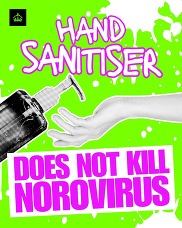
Latest UKHSA data shows norovirus cases remain high but have now started to decrease, while flu cases have returned to baseline levels, likely signalling the end of the flu season if these levels continue.
Cases of norovirus are still highest in those over 65 and laboratory reports were 30.5% higher than the 5-season average over the past 2 weeks. To help prevent further spread and bring levels down, people are reminded of the steps they can take. Washing hands with warm soapy water and using bleach-based products to clean surfaces are both effective in reducing the spread. It’s important to remember that alcohol gels do not kill norovirus.
UKHSA surveillance indicators have suggested that flu is no longer circulating widely in the community. However, it’s important that people continue to take simple hygiene steps to ensure this trend continues.
Messaging on preventing the spread of respiratory and gastrointestinal viruses, alongside useful resources including social media assets, can be found in our winter illness communications toolkit. As well as norovirus messaging, it also contains messaging on how to reduce the spread of respiratory infections such as flu or COVID-19.
|
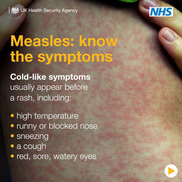
The latest measles case data* shows that activity has increased since January 2026, mostly driven by an outbreak in North London.
Between 1 January and 2 March 2026, there have been 195 laboratory confirmed measles cases reported in England, an increase of 37 cases since the last report on 26 February 2026. Measles activity has increased since January 2026, mostly driven by an outbreak in North London.
Measles is a nasty illness for any child, but for some it can lead to serious long term complications and tragically death, but is so easily preventable through vaccination.
Having two doses of the Measles, Mumps, Rubella and Varicella (MMRV) vaccine gives children the vital protection they need against this highly contagious disease. It also helps protect more vulnerable children around them who are too young or unable to have the vaccine due a weakened immune system.
Older children and adults who missed out on their vaccine when they were younger can catch up at any age with the Measles, Mumps and Rubella (MMR) vaccine.
*As of Thursday 19 February, measles case data is being published weekly during this period of increased activity. Thereafter we will return to fortnightly or monthly reporting. Our measles dashboard is also updated weekly.
|
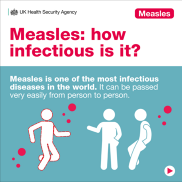
To help support your communications on measles, we have a series of resources relating to measles and childhood immunisations which you may find useful:
Measles
This past week we updated our blog: What are the symptoms of measles and how can I best protect my child? which you may find useful to share with your networks.
We also have a measles communications toolkit to help support colleagues who are managing outbreaks in their communities.
We are currently finalising further social media assets to help raise awareness of measles, its signs and symptoms, and the MMRV/MMR vaccine.
MMRV resources
| |