Tesla Q1 earnings and revenue beat Wall Street’s estimates |
- The company reported revenue of $22.4 billion (versus a $22.1 billion FactSet analyst consensus estimate) and adjusted earnings per share of $0.41 (compared with Wall Street’s $0.35).
-
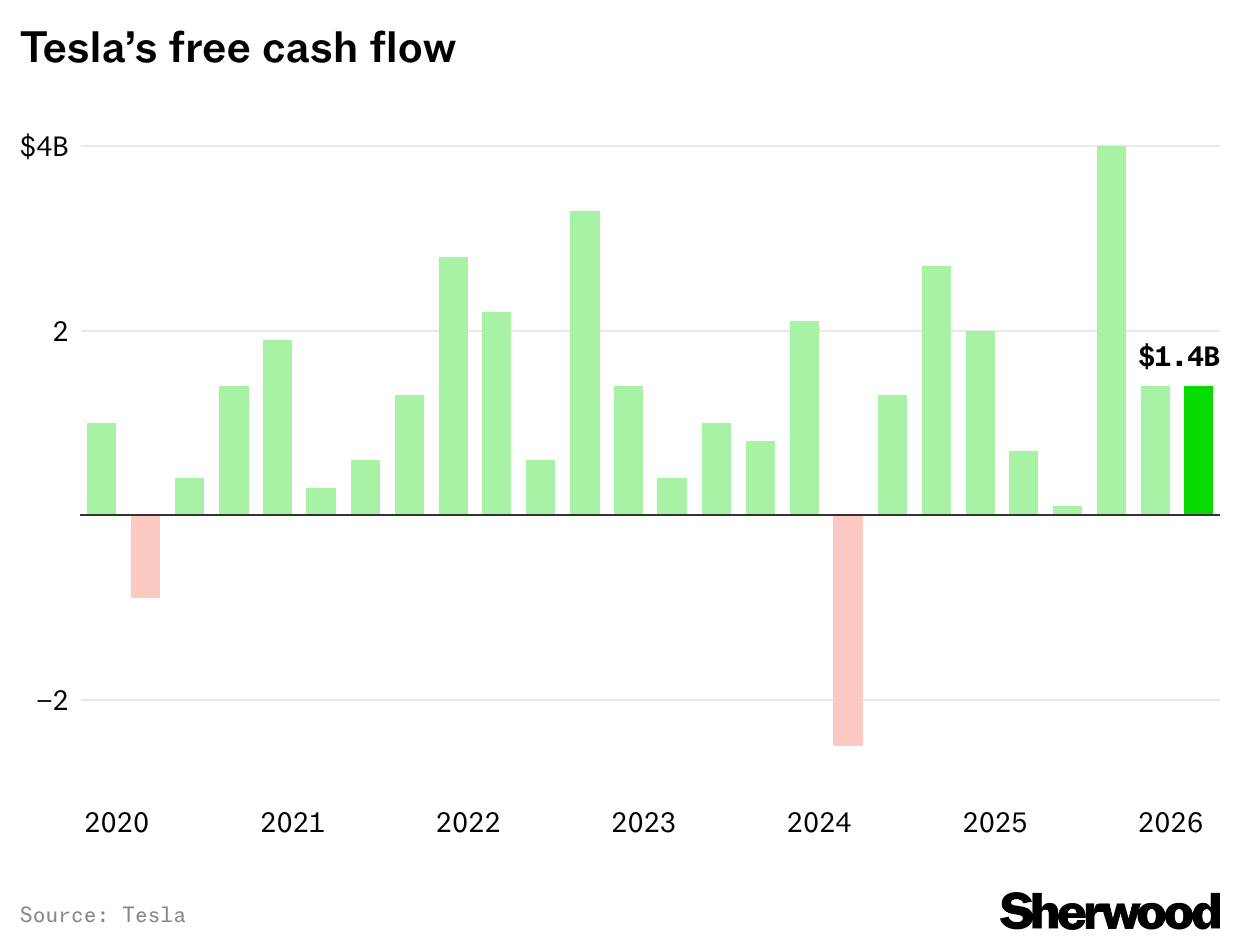
Meanwhile, its free cash flow was $1.4 billion, much better than the $1.5 billion loss the Street expected, as the company contends with lower regulatory credit revenue, ongoing pricing pressure, and burgeoning capital expenditure.
-
Analysts have been hoping that growth in the company’s energy generation and storage business would continue to offset its weakening automotive business. Energy segment revenue rose to $2.4 billion (lower than FactSet’s $3.2 billion) while the automotive segment grew to $16.2 billion (compared with the consensus expectation of $14.9 billion).
|
Shares were up 4.4% in after-hours trading following the report before giving up a big chunk of those gains as investors appeared to digest the company's increasingly eye-watering capex estimates for 2026.
In the earnings release, Tesla said that “over time, we expect our hardware-related profits to be accompanied by an acceleration of AI, software and fleet-based profits,” but didn’t give an actual timeline. |
|
|
Investors will be looking beyond near-term financials and toward the moon shot AI and autonomous projects on which Tesla is staking its future. That includes expanding into new markets and removing safety monitors from existing ones. So far, Robotaxi is running in San Francisco, Austin, and on a much smaller scale in Dallas and Houston, and safety monitors still attend a vast majority of its rides. Investors will be also looking for any incremental news on Optimus robot and AI chip progress.
Of course, Tesla’s automotive business remains its main source of revenue and the major mechanism with which it finances those forward-looking ambitions. |
|
|
Are you overlooking the middle? |
Mid caps like MDY hit a rare balance of growth, stability, and US focus—and they may deserve a more prominent role in your long-term strategy.
Explore the outperformance potential of mid caps with this tool and discover how the first mid-cap ETF delivers cost-efficient, liquid exposure to 400 US-based mid-sized companies in a single trade.
MDY also gives investors the ability to invest in the next generation of industry leaders before they become household names. Innovators like NVIDIA, Netflix, Starbucks, and JetBlue Airways all started as mid-cap holdings. Get to know MDY. |
|
|
GE Vernova and Vertiv are giving us a glimpse into the future of the AI boom |
There’s no shortage of CEOs willing to declare — with dead certainty — what the future holds, but those tech visionaries can be tough to pin down on the details.
But then there’s what we got yesterday morning: two earnings reports from the picks-and-shovel AI companies that actually support the massive build-outs. First, we got numbers from an honest-to-god metal-bending industrial company at the heart of the AI data center boom. Electrical equipment and gas turbine maker GE Vernova’s results provided a sturdy block of evidence that the AI boom has room to run.
|
- Order backlogs at GE Vernova jumped 32% to a new high of $163.28 billion during the three months that ended March 31, as we charted.
-
The surge in orders is why RBC Capital Markets analyst Chris Dendrinos thinks GE Vernova will be completely sold out of its production capacity for heavy-duty turbines through 2029 — and possibly into 2030 — by the end of this year.
-
To be sure, orders are not the same thing as actual sales. But “GEV’s got more demand than they have slots. They can be choosy as to who they want to work with,” Dendrinos said. And the company can mitigate the risk that when push comes to shove, buyers can’t or won’t meet their commitments.
|
But on the other side, Vertiv Holdings, another stock at the white-hot center of the data center boom, had a different experience. |
- It too reported better-than-expected results early Wednesday.
- But it also stopped reporting quarterly backlog numbers — the firm will give those annually now.
-
Without that data, the market focused on Vertiv’s guidance for the coming quarter, which was… uninspiring. So the stock sold off.
|
|
|
So, what’s the lesson? Well, one may be that after the ride investors have had on some of these AI stocks, they’ll need almost constant reassurance that the boom still has legs.
GE Vernova’s report provided it; the stock went up. Vertiv didn’t. Shares fell. As we head into a big week of tech earnings next week, similar dynamics will be at play for traders when results roll in. |
|
|
4 charts that show the speculative boom is back on |
|
|
Invest like you’re going places.
|
Because you are. With ETFs like MDY, you can tap into a powerful combination of resilience, quality, market opportunity and outperformance potential. Discover how MDY – the original mid-cap ETF – delivers cost-efficient, liquid exposure to 400 US-based mid-sized companies in a single trade.
Invest in where you’re going with the growth potential of mid-caps. |
|
|
|