The era of energy shocks

Global news you can trust.

Download the Reuters App.


Power Up

Power Up

A Reuters Open Interest newsletter

By Ron Bousso, ROI Energy Columnist


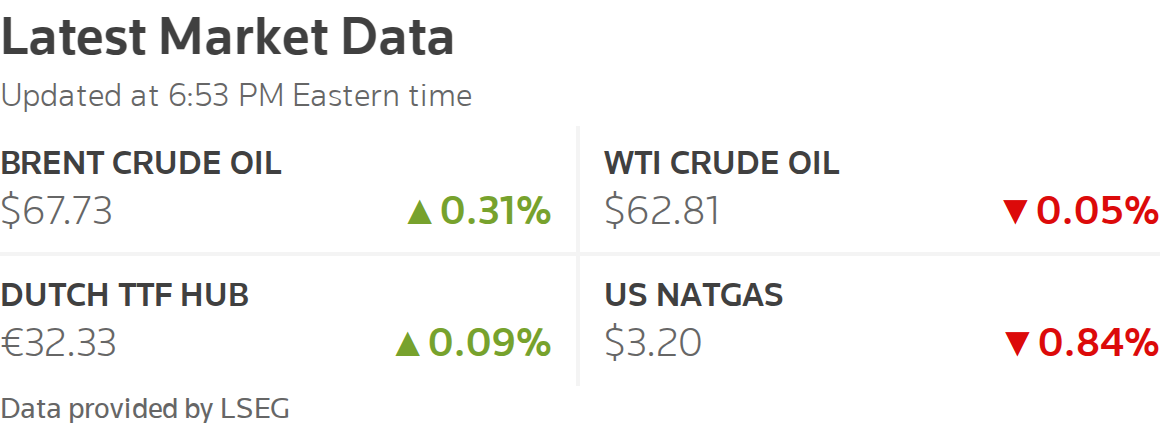
Data refreshes every time you open this email. For more energy news, click here. Please send any feedback to powerup@thomsonreuters.com.

Hello Power Up readers,

The U.S.-Iranian standoff continues and peace negotiations remain elusive after President Donald Trump extended the ceasefire indefinitely on Tuesday. The Middle East standoff centers on the double blockade of the Strait of Hormuz, which has left the region and global markets in a tense holding pattern.

Both sides upped the ante in recent days, with the seizure of several Iranian ships and tankers by U.S. forces and Iran’s capture of two ships in the vital waterway.

With around 13% of global oil supplies and a fifth of liquefied natural gas supplies stranded in the Gulf – and hopes for an imminent reopening of the strait fading – Brent crude prices jumped back above $100 a barrel.

The stress on economies also continues to spread. In Europe, German airline Lufthansa cancelled 20,000 flights over the coming months due to jet fuel shortages. Meanwhile, the European Union is considering measures to deal with fuel shortages and higher energy costs. Demand for rooftop solar systems across Europe has also surged.

The spike in energy prices and supply shortages have crushed global oil consumption, sending it plummeting by 4 million barrels per day, or 4%, since the start of the conflict, according to some estimates.

But even though the impact of the acute crisis is deepening each day the Strait of Hormuz remains closed, the long-term impact of the crisis may, paradoxically, work in oil’s favour, as I wrote about earlier this week.

If all this makes for grim reading, just remember that things can always get worse. The Iran war marks the latest in a quick succession of energy shocks this decade, which could well become the norm going forward. More on this below.

Here are some more headlines:

  • Asia's imports of liquefied natural gas (LNG) are poised to drop to the lowest in nearly six years in April due to the Hormuz closure. But ROI Asia Commodities Columnist Clyde Russell argues that Asia's LNG markets are successfully adjusting to the fallout from the war.
  • Nine months after the Trump administration gutted a swath of clean energy policies and pushed for greater output from fossil fuels, the U.S. electricity system keeps setting more clean-power milestones, ROI Energy Transition Columnist Gavin Maguire wrote.
  • Traders placed a series of bets worth $430 million on a drop in crude prices just 15 minutes before Trump extended the Iran ceasefire. This is the fourth time since the start of the war on February 28 that large, well-timed directional bets on the oil price have been made shortly before major announcements.

As always, don’t hesitate to contact me at ron.bousso@thomsonreuters.com or follow me on LinkedIn with any questions or thoughts.


Top energy headlines

  • Brent crude futures jump on Trump's threats over Strait of Hormuz
  • Iran war revives European rooftop solar demand to cut energy bills
  • Asia deepens refining cuts due to Iran war, putting diesel and jet fuel supplies at risk
  • Druzhba oil flows to Slovakia and Hungary after Ukraine war standoff
  • US oil executives expect crude output to rise as Iran war continues, survey shows


The age of energy shocks

The past decade has brought a rapid succession of global energy crises, driven by military conflict, extreme weather and supply-chain snarls. As today’s highly interconnected oil and gas markets become more fragmented and the low-carbon transition accelerates, recurring shocks may be becoming the norm.

First came the post-pandemic inflationary surge in 2021, quickly followed - and amplified - by Russia's invasion of Ukraine in 2022. Now, four years later, comes the Iran war, which has sparked the greatest disruption to oil and gas supplies in history.

Three shocks of such magnitude in such a short span far exceed the historical norm. Broadly speaking, the world has averaged one major energy crisis per decade since World War Two.

More worryingly, the underlying causes of the recent crises - geopolitical and trade fragmentation - suggest the world may face more frequent shocks in the decades ahead.


Read the full column
 

Get full access to Reuters.com for just $1/week. Subscribe now.