The oil market’s known unknowns

Follow energy market shifts and the forces driving the transition to clean power. Subscribe to Reuters.com for $1/week.


Power Up

Power Up

A Reuters Open Interest newsletter

By Ron Bousso, ROI Energy Columnist


Data refreshes every time you open this email. For more energy news, click here. Please send any feedback to powerup@thomsonreuters.com.

Hello Power Up readers,

The shaky two-month-long ceasefire between the United States, Israel and Iran was rattled again on Sunday when Iran launched a salvo of missiles at Israel over its attacks in Beirut, prompting Israel to launch its own attacks in Iran. Israel’s response clearly went against the wishes of President Donald Trump who keeps insisting that a peace deal is very close, with little evidence of significant progress so far.

The Israeli military said it had carried out multiple strikes across Iran, including a petrochemical plant in Mahshahr. Iran’s Revolutionary Guard said it responded by targeting a similar plant in the city of Haifa in northern Israel. For now, there have been no reports of Iranian attacks against energy infrastructure across the Gulf.

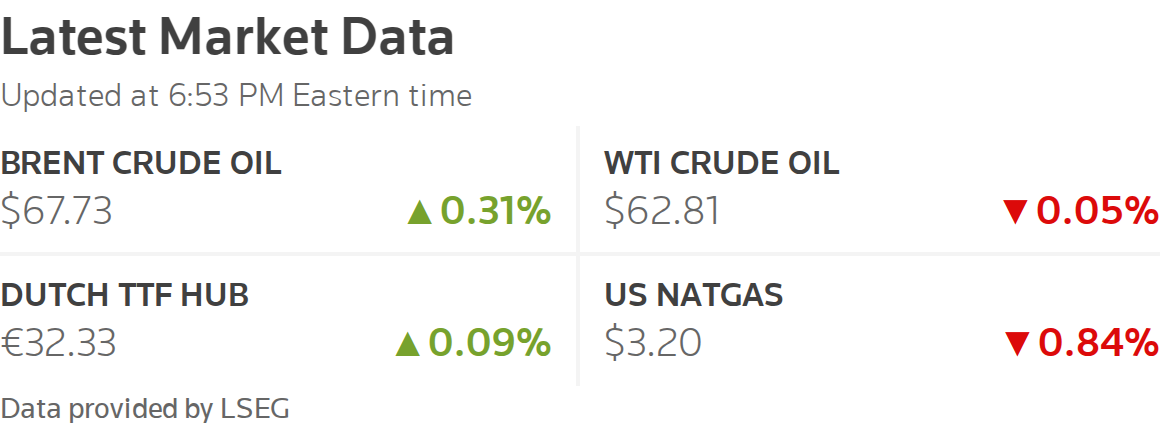
Oil markets jumped higher in response to the flare-up. Brent crude rose to over $98 a barrel, before paring back gains after Iran announced it had ended its operation against Israel. In any case, oil prices are well below the recent high of $118 reached after the start of fighting in March, comfortably within the range of the past two decades.

So, to recap, the biggest oil supply shock in decades is in its fourth month and there is no resolution to the conflict in sight, yet the market remains rangebound and surprisingly calm. This disconnect reflects an uncomfortable reality: the biggest drivers of today’s energy market are a host of unknowns. More on this below

Here are a few more headlines:

  • Europe's push to rebuild natural gas inventories is shaped mainly by global LNG flows and storage targets. But another key underappreciated constraint lies farther south - in the Alpine reservoirs that underpin Italy's hydroelectric system, writes ROI Energy Transition Columnist Gavin Maguire.
  • I enjoyed this one – a wealthy cohort of CEOs, celebrities and sports stars is defying soaring jet fuel prices and flying by private jet in greater numbers than ever ‌before, to glitzy events from the Monaco Grand Prix to the Cannes film festival.

As always, don’t hesitate to contact me at ron.bousso@thomsonreuters.com or follow me on LinkedIn with any questions or thoughts.


Top energy headlines

  • Oil prices pare gains after Iran and Israel say they have halted attacks
  • US airlines' fuel costs soared in April to $6.5 billion
  • Airline CEOs warn EU plan to expand carbon costs will raise fares
  • Why the Iran-aligned Houthis threatening Red Sea shipping could mean more for the oil market this time
  • EU plans tax changes to reduce electricity bills, draft shows


The known unknowns

The surprising calm that has settled over the oil market has happened even though the Strait of Hormuz – the world’s most critical oil chokepoint – has remained largely ‌shut for more than three months, disrupting flows equivalent to roughly 13% of global supply.

A large part of the market’s sanguine mood reflects expectations that conditions in the Gulf could change overnight. Trump’s repeated assertions in recent weeks that a deal with Iran is imminent have helped cool prices.

Even if a formal reopening of Hormuz occurs in the next few weeks – a scenario that is hardly the base case – this would not instantly translate into a full recovery of flows. Shipping is governed as much by risk assessments as by geopolitics. Tanker operators, insurers and traders are likely to remain cautious about re-entering the Gulf, fearing vessels could once again become stranded in the event of renewed hostilities.

While there are increasing indications that more cargoes have been leaving the Gulf in recent weeks using stealth channels, these are short-term solutions being employed by desperate operators, not a long-term strategy for the world’s largest energy ⁠companies.

What’s more, this opacity speaks to the larger problem. Oil traders are mostly operating in the dark, regarding both supply and demand, raising the risk of a nasty surprise if their assumptions prove faulty.

Read the full column
 

Sponsors are not involved in the creation of newsletters or other Reuters news content. Advertise in this newsletter or on Reuters' website

LiveIntent Logo
AdChoices Logo
 

Power Up is sent twice weekly. Think your friend or colleague should know about us? Forward this newsletter to them. They can also sign up here.

Want to stop receiving this email? Unsubscribe here. To manage which newsletters you're signed up for, click here.

This email includes limited tracking for Reuters to understand whether you’ve engaged with its contents. For more information on how we process your personal information and your rights, please see our