
|
 |
An Update on Trump's Birthday Celebration
Will there or won't there be cage fights on the South Lawn of the White House?
|
| |||||||||||||||


There was a flurry of activity this morning in Douglas v. NPS, the lawsuit we discussed last night that challenges Trump’s plan to hold UFC cage fights to celebrate his birthday the 250th anniversary of our independence. The federal courts' electronic document system, PACER, is only available to users who pay for its services, and at the time I wrote this, none of the documents from this case were publicly available yet, so I’ve taken screenshots. Hopefully, more of them will show up with public links by the end of the day or tomorrow if you like to read the entire document for yourself.
The case has been assigned to Judge Amit P. Mehta, an Obama appointee. A little background on him is relevant because we’re likely to see a barrage of attacks from Trump.
Judge Mehta has the civil January 6 case, where private parties are seeking to hold the former president legally responsible. Mehta rejected Trump’s motion to dismiss on presidential immunity grounds, ruling that the immunity grant did not shield Trump’s conduct around the insurrection. In March, he rejected most of Trump’s arguments for summary judgment, which would have ended the case in Trump’s favor without a trial. He determined that the “fight like hell” speech Trump gave that morning before sending his people to the Capitol was political, the work of "candidate Trump not President Trump, and also held that claims that Trump’s speech incited the riot could go forward. Trump is appealing the First Amendment question to the D.C. Circuit, so the case is on hold for now.
Judge Mehta is one of the judges currently serving on the FISC, the Foreign Intelligence Surveillance Court, which has been in the news in connection with the renewal of Section 702 of FISA. Judges on the FISC are charged with reviewing secret government requests for electronic surveillance, search warrants, and other investigative tools used to collect information about the activity of foreign powers and actors inside of the U.S. The judges on the FISC are appointed from the sitting federal judiciary by the Chief Justice, which means that John Roberts holds Judge Mehta in high esteem. It’s unlikely that Donald Trump feels the same way.
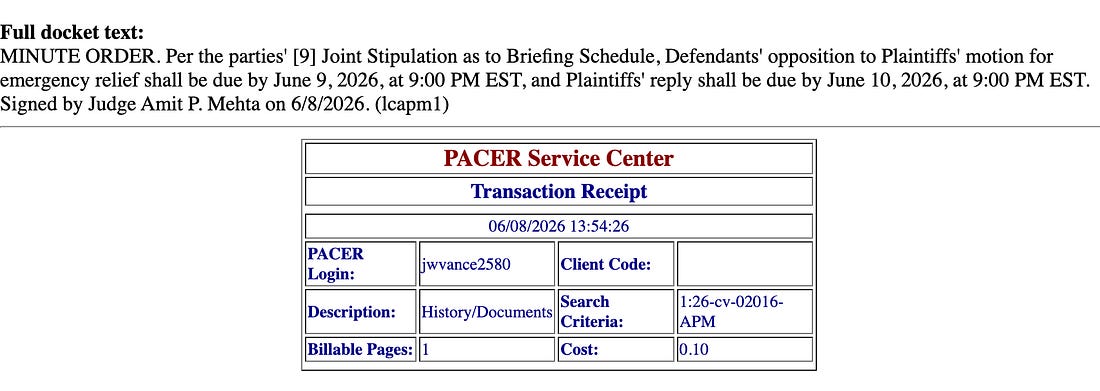
Given the timing of the main event, which would take place next Sunday if the courts allow it to proceed, Judge Mehta is moving quickly. This morning, he entered a minute order on the docket, requiring the parties to “meet and confer and, by noon on June 8, 2026, propose a schedule for briefing on Plaintiffs' motion for emergency relief.”
That order followed a “Notice of Correction” filed by plaintiffs Susan Douglas and Paul Romano last night. They explained even greater time urgency existed than they had originally understood. The weigh-in of fighters at the Lincoln Memorial had been publicly represented as happening the night of Saturday the 13th. But in a story posted after they filed the lawsuit, ESPN reported that “according to the Ultimate Fighting Championship (“UFC”), which is organizing the event, the press conference, including face-offs, will occur at the Lincoln Memorial on Friday, June 12, while the ceremonial weigh-in will occur at the Ellipse on Saturday, June 13. The fights will occur as previously stated, on the South Lawn on Sunday, June 14.” That left the court with one less day to act. The plaintiffs concluded that their “request is accordingly even more time-sensitive than previously indicated, as relief with respect to the Lincoln Memorial’s use would need to be granted before Friday evening to be effective.”
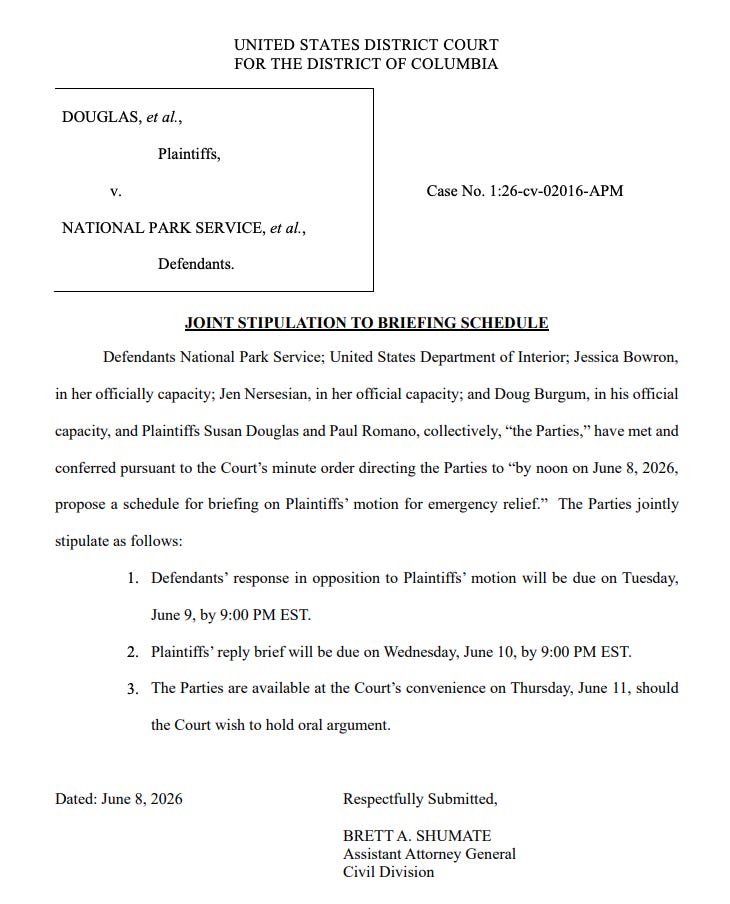
By Monday afternoon, Judge Mehta had entered a scheduling order that sets the following deadlines:
The defendants' (the government individuals and offices) opposition to Plaintiffs' motion for emergency relief is due by 9:00 p.m. Tuesday.
The plaintiffs' reply is due by Wednesday at 9:00 p.m.
That’s lightning speed for a court. The parties can file ahead of schedule, and given the timing here, we might well see them, especially the plaintiffs, jump in early so the matter is ripe for Judge Mehta to issue a ruling. The briefing schedule itself appears to have been agreed to by the parties before the Judge ordered it, which will make it more difficult for the government to argue down the road that they didn’t have sufficient time to respond. Still, we can expect to see some variant of that argument (along with standing, which, as we discussed last night, is certain to be part of the government’s arsenal of responses here), since “The Claw” has been in progress for weeks and the challenge has only just been filed, days before the event itself is scheduled to take place.
 |
But even if Judge Mehta denies the request to shut the festivities down, the plaintiffs will have done the job of drawing attention to the violent, profane, racist nature of the fights and their impropriety on the White House grounds. This is what Trump bargained for and what he intended and he owns the consequences.
 |
Justice Department lawyer Eitan Sirkovich has filed a notice of appearance on behalf of all defendants. He is also representing the government in the ballroom case. That’s the case where, during a D.C. Circuit appellate argument last week, Judge Patricia Millett expressed concern over the government’s apparent view that it has the power to “move fast and break things” without legal repercussion, so long as it acts before a court orders it to stand down. “If this were complete lawlessness by the government … it couldn't be stopped?” she asked at one point, before offering this hypothetical: “If the government decides, very quickly, to bulldoze the Statue of Liberty — the people whose ancestors that was the first thing they saw coming to this country, but the government moved too fast — nothing can be done?” “I think that's right, yes,” Sirkovich’s colleague, Yaakov Roth, responded.
That’s a likely foretelling of the muscular view of executive branch power we’ll see the government lawyers assert here as we get into the case.
Once the parties submit their briefs, Judge Mehta will consider the plaintiffs’ Motions for Temporary Restraining Order and a Preliminary Injunction.
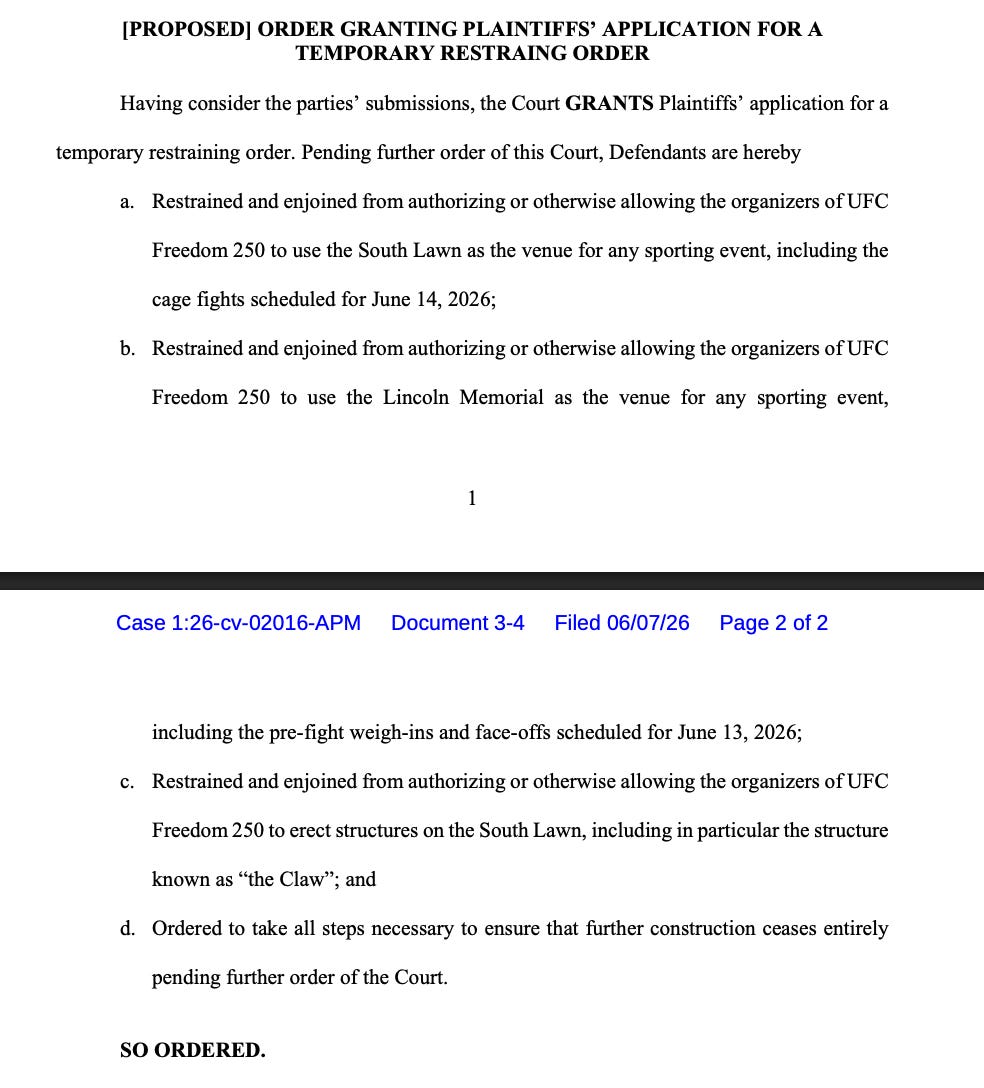
The plaintiffs submitted a proposed order for the Judge to sign, along with their motions, which helps us understand what they are asking for. Offering a court a proposed order is routine, and required in some settings. Here, the proposed order shows that the plaintiffs are asking the court to put an end to building The Claw or any other structures, as well as to the cage fights on Sunday, the weigh-in advance, and any other activity by the UFC.
 |
The clock is ticking.
If you want to follow Douglas v. NPS as it moves through the courts—it's going to move fast—Civil Discourse is the place to be. I'll have the briefs and Judge Mehta's ruling as soon as they're available, with the analysis you need to understand what it all means. Civil Discourse is free because access to information matters. If you're in a position to support my work with a paid subscription, I'm grateful.
We’re in this together,
Joyce