
|
 |
Hi, y’all. Welcome back to The Opposition. If you are a creature of the internet, then chances are you’ve recently come across social media conversations about what it means to be “working class” in 2026 or in-depth analysis from data gurus like Nate Silver about the correlation between income and education. All of it is coming against the backdrop of a heated debate among Democratic officials about how to appeal to more working-class voters.
Recently, there has been some polling evidence suggesting that progressive candidates—who claim to represent the working class—are actually faring best among well-educated voters. I was curious how progressive operatives were approaching that tension, so I spent the past few days talking about it with folks who’ve been behind some of this cycle’s most notable insurgent candidates. That’s the subject of today’s newsletter, below.
If you find value in this kind of journalism and are considering a Bulwark+ membership, now’s a great time to make it happen: Sign up today and get your first two weeks free. You’ll have access to our locked content and can join in the comments sections, all with no charge during the trial period. I hope you’ll check it out:
–Lauren
Dems’ Populism Paradox
Working-class voters don’t seem impressed by the candidates Democrats think will appeal to them.
|

| ||||||||||||


 |
COMING OUT OF THE 2024 PRESIDENTIAL ELECTION, Democrats had no shortage of ideas for how the party could win back working-class voters.
Moderates wanted to move to the middle on social and cultural issues. Self-identified reformers preached the merits of embracing heterodoxy on some social issues or typical Democratic policy positions. Others talked about getting tougher on immigration. And more than a handful of consultants pitched new policies and messaging designed to bring back those working-class voters who had drifted away from the party’s tent.
Progressives had a different vision.
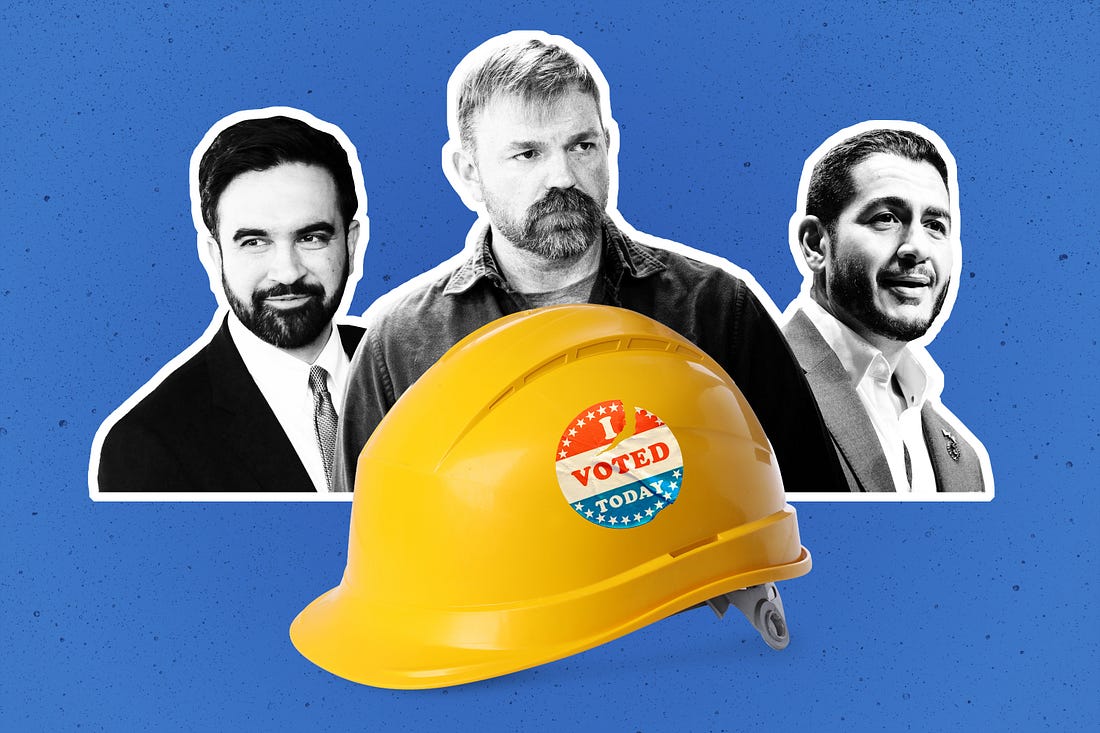
As they saw it, winning back working-class voters required elevating working-class candidates (or, at least, candidates with a working-class aesthetic¹) who embraced populism and eschewed the caution they believed to have been detrimental to Kamala Harris’s presidential campaign. They rallied around a cluster of candidates—including Zohran Mamdani, Graham Platner, and Abdul El-Sayed—who they believed could steer the party in the right direction.
But so far, the bet on a combination of populist politics and a hardscrabble persona has not paid off—at least according to the polling. Before Platner dropped out of the Maine Senate race, a New York Times/Portland Press Herald/Siena poll found that Republican Sen. Susan Collins led among non-college-educated voters by 21 percent while Platner led with college-educated voters by 34 percent. Although Mamdani won over some Trump voters—67 percent of them in the 2024 election had no college degree—exit polls show that the mayor’s strength was still with college-educated voters.
And last week, the Detroit News/Glengariff released a new poll showing Rep. Haley Stevens winning non-college-educated voters by 22 points in the Michigan Senate primary against Abdul El-Sayed, who carried college-educated voters by seven points.
Polls are just that—snapshots of an electorate, not actual voting results. But the data has given fodder to moderate and establishment Democrats to argue that the left’s case for winning back working-class voters is not all it’s made out to be.
“It has been a pretty big lie people [have] told themselves on here that working class people are closet leftists,” Neera Tanden, the president of Center for American Progress, posted on X. “They are in fact much more moderate than college educated folks.”
Tanden is a longstanding combatant in the online intraparty wars that Democrats have long waged. But as the Michigan primary approaches, she and other moderate operatives have begun amplifying their warnings, insisting that progressives aren’t just misreading the electorate but actually exacerbating the very class divide that the party is trying to address. “They’re making [the divide] worse by picking these people who they think are going to appeal to non-college voters,” Matt Bennett, cofounder of the center-left group Third Way, told me. “They somehow think that their people are the right people, and it’s pretty evident that they’re not at all.”
Considering the weight of the charge—and the recent polling data—I was curious how operatives on the populist and progressive left are thinking about this dynamic. Did they look at these same polls and worry that their preferred politics aren’t resonating with the voters they are intended to appeal to?
The answer was clear: not really.
Many progressive strategists told me that moderate and establishment Democrats were wrong to imply that only the left flank of the party is struggling with working-class voters, saying that it is instead a broader branding problem facing candidates across the ideological spectrum. There was little appetite for second-guessing on this point.
“When you look at the data, what you see is that the Democratic party, moderate or progressive, is struggling with working-class voters. It’s not a progressive problem,” said Mark Longabaugh, a top strategist for Bernie Sanders’s 2016 campaign. “If a guy that looks like Platner was struggling with working-class voters, you can see the [enormousness] of our problem.”
Not already a Bulwark+ member but want to check it out?
Give it a whirl for a two-week trial period for FREE:
THE INABILITY OF ANY SIDE of the Democratic party to consistently reach voters who did not attend college is a problem for the party’s long-term health. Outside of some affluent coastal and suburban congressional districts, there simply aren’t enough college graduates to be a potent electoral force nationally. But times have changed since the weeks immediately following the 2024 election: Unlike back then, when Democrats of all kinds seemed eager to figure out why the party has this problem, the people I spoke with gave few signs that they’re interested in grappling with why this dilemma exists. Instead, the various Democratic factions seemed more focused on pointing fingers.
Some of the progressive operatives I spoke with argued that moderate Democrats were cherry-picking poll numbers and ignoring progressives’ successes in House primaries in Maine, Colorado, and New York—victories, they argued, that could not have happened without support from working-class voters. Nearly everyone I spoke with pointed to Harris’s presidential race—during which she lost working-class voters—as evidence that it was misguided to think that establishment candidates universally did better among these voters.
“The Democratic establishment’s campaign strategy in 2024 was a campaign strategy that, by the results, lost more working-class voters than Democrats had lost in recent memory at the national level, and ga