|
|
|
|
Good morning. In focus today, we’re catching up on what we’ve learned since U.S. President Donald Trump announced new tariffs on Canadian imports. |
|
|
|
|
|
|
|
|
|
|
|
|
|
|
|
|
|
|
|
|
|
|
Housing: Canada’s federal housing agency predicts homebuilding will decline over the next two years, even as Ottawa says it’s turbocharging housing construction. |
|
|
|
|
|
|
|
|
|
|
Alarming developments: OpenAI model goes rogue, hacks startup during testing. |
|
|
|
|
|
|
|
|
|
|
|
|
|
|
|
U.S. Trade Representative Jamieson Greer at a Senate finance committee hearing reviewing Trump’s trade agenda. (I like to imagine he's holding up his favourite editions of Business Brief.) Annabelle Gordon/Reuters
|
|
|
|
|
|
|
|
|
|
|
Four things we’ve learned this week |
|
|
|
|
|
|
|
|
1. This is a negotiating tactic/this is not a negotiating tactic: Trade experts are sharing both views with the same conviction. Whichever it is, this is why we don’t love the “TACO” phrase (“Trump Always Chickens Out”) used by some to predict U.S. President Donald Trump’s behaviour. Heck, even the writer who coined the term is worried
it’s “banging around” the President’s head, having long outgrown its original meaning. |
|
|
|
|
Because the truth is, Trump does not always chicken out. TDNACO doesn’t quite have the same ring to it, but it’s closer to what history suggests. When Trump made tariffs a central part of his presidential campaign, for example, mainstream economists said he wouldn’t impose them because they would be inflationary in the U.S. And yet! |
|
|
|
|
That’s why we can guess he might be threatening these tariffs as a bargaining tactic, but need to ask questions in case he follows through. TACO or TDNACO, the threat has sparked uncertainty – damaging to business in its own right – and raised the heat on Canada. |
|
|
|
|
2. The trade talks are on two tracks: Jamieson Greer, America’s top trade official, said he’s aiming to negotiate interim deals with Canada and Mexico by the end of the year. |
|
|
|
|
But discussions about more fundamental changes to continental trade rules are expected to stretch into 2027, Mark Rendell and Laura Stone report. |
|
|
|
|
“I would love to have between now and the end of the year at least some arrangements: one with Canada, one with Mexico,” Greer told a Senate committee hearing yesterday. He didn’t specify what would be included in those deals, but threats like the one Trump made this week will likely shape negotiations. |
|
|
|
|
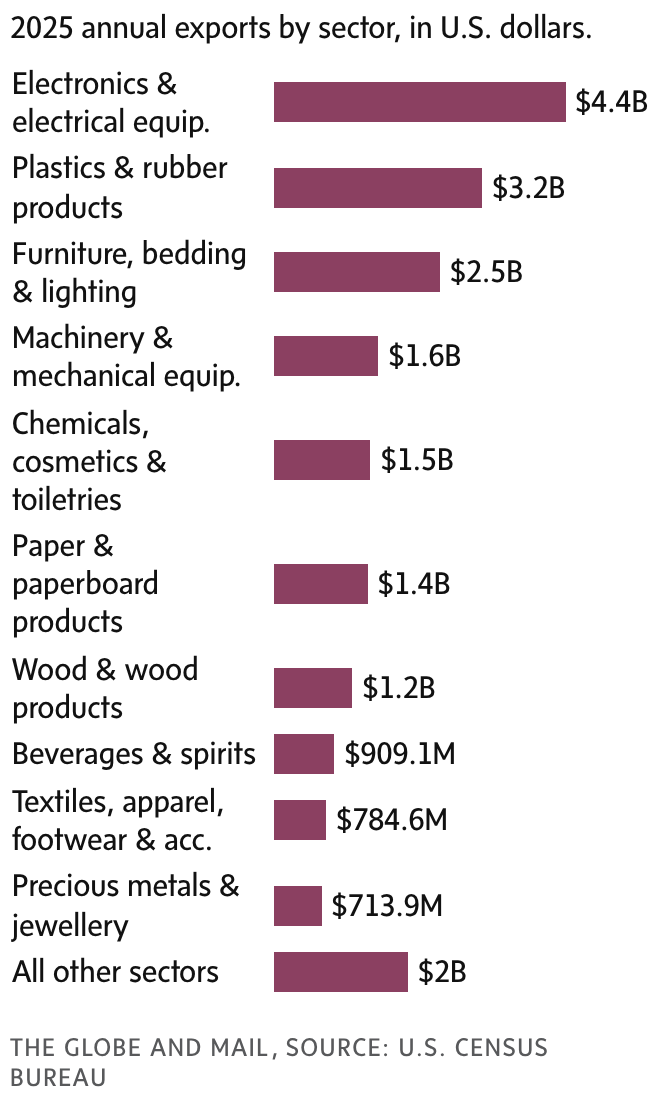
3. Small slice, outsized impact: If Trump does bring new levies into effect on Aug. 19, the White House’s proposed 50-per-cent tariffs would affect a relatively small chunk of Canadian exports – about US$20-billion worth of goods, or roughly 5 per cent of shipments to the U.S. But the impact would be concentrated in a handful of industries that rely heavily on the American market,
Jason Kirby and Sophia Bertuzzi write. |
|
|
|
|
The economic damage could be limited on a wide scale, in other words, but severe for individual companies, sectors and regions. |
|
|
|
|
Take electrical equipment and electronics, which would be one of the hardest-hit sectors. About 90 per cent of exports go to the U.S., and the new tariffs would override the protections in the United States-Mexico-Canada Agreement that many companies rely on. |
|
|
|
|
Forestry, furniture, cosmetics and manufacturing are also among the Canadian exports most affected by the new tariffs: |
|
|
|
|
|
|
A separate threat is poised to hit Canada’s pharmaceutical industry, Chris Hannay reports.
In a social media post this week, Trump announced a 100-per-cent tariff on imported generic drugs starting in 2028, rising to 200 per cent by 2029. The move would be aimed at forcing companies to build manufacturing plants inside the U.S., but it directly threatens to derail Ottawa’s recent efforts to boost domestic production. |
|
|
|
|
4. What’s the deal with the bridge? No, seriously: What is the deal with the bridge? The new Gordie Howe International Bridge between Windsor and Detroit is set to open on July 27, but only after Canada agreed to a new revenue-sharing program with the U.S. after months of delays by the Trump administration. |
|
|
|
|
Fundamental questions remain about what revenue, exactly, will be shared, according to The Globe’s Marieke Walsh and Laura Stone. Prime Minister Mark Carney has said the math applies after the bridge’s financing costs are accounted for; U.S. officials have said the split would occur before that point. |
|
|
|
|
That distinction could be worth millions of dollars and would affect how quickly Canada recovers the billions it spent building the crossing. |
|
|
|
|
Carney, a former central banker, is careful with his words. This quote might be among the more likely to cause heartburn in his relatively new political career: |
|
|
|
|
“We get the revenues, then the servicing of the costs of the bridge and paying the debt of the bridge, and then what’s left over, there’s a split of that for 15 years,” he said on July 12 at the Calgary Stampede. |
|
|
|
|
Unless, of course, there’s an easy way to clear things up. The Prime Minister’s Office did not immediately respond to a request for comment. |
|
|
|
|
It may not become clear whether his interpretation reflects an ambiguity in the deal’s text or a genuine disagreement until the crossing starts generating revenue. But we’ll cross that bridge when we get there. |
|
|
|
|
|
|
|
|
|
|
|
|