Hello,
Heatwaves, wildfires and dried-up waterways share the focus in today’s newsletter as France, Spain and Italy continue to battle blazes, while reservoirs and rivers become parched and arid from the Danube and Rhine to Peru and Arizona due to rising temperatures.
Firefighters battled huge blazes in Spain and France this week. Two firefighters died on Tuesday in France as their truck was engulfed in flames in the southwest region of Gironde.
More than 10,000 people were evacuated overnight in southwestern France as a rapidly spreading wildfire scorched through 2,000 hectares (4,942.108 acres) of land west of the city of Bordeaux, officials said on Thursday.
Europe is the world's fastest-warming continent and scientists say human-driven climate change is increasing the intensity of heatwaves, droughts and wildfires, while also creating conditions for sudden, destructive storms. Over in Peru, birds are flocking to ports and coastal areas in search of food while one of Arizona’s largest reservoirs in the United States has nearly disappeared.
Before we dive into the heatwaves and droughts, here are some data center ESG stories that are also on my radar: |
|
|
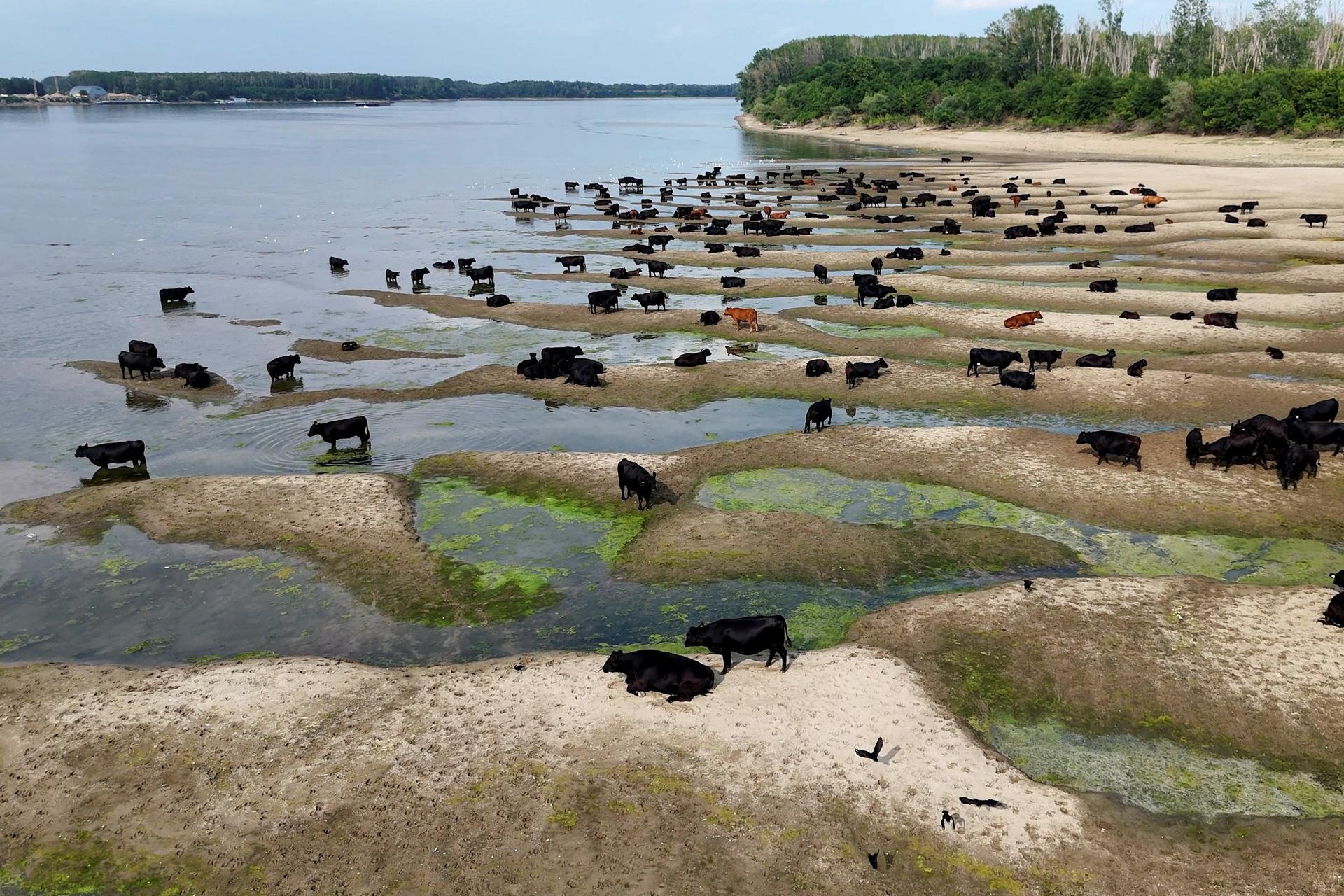
Cattle sit on sand dunes visible after Danube river's level fell substantialy, near Calarasi, Romania. Inquam Photos/Ovidiu Micsik via REUTERS
|
The continent has endured three stifling, virtually back-to-back heatwaves so far this year. Intense heat has also been blamed for thousands of excess deaths in the May to June period. A fast-moving wildfire that erupted in the Var department in southern France on Tuesday has burned more than 2,500 hectares and forced 400 people to flee their homes, local authorities said.
Spain's worst wildfire so far this year has burned an estimated 32,000 hectares in the Guadalajara region. It started to stabilise on Tuesday after forcing evacuations in 34 municipalities and confinement orders in 14 others.
Spain's weather agency AEMET said the danger of wildfires remained "very high or extreme" across most of mainland Spain and the Balearic Islands and was expected to increase further in the coming days.
Dozens of wildfires also swept across the Italian island of Sicily on Wednesday, straining emergency services and forcing the evacuation of more than 100 people, local media reported.
The Reuters Climate Monitor, an interactive tool providing real-time data, showed the average high temperature across Western Europe is forecast to be 26.6 degrees Celsius (79.8 degrees Fahrenheit), which is three degrees above the normal high for July 23 in the period from 1961 to 1990.
Click here for a link to the Reuters Climate Monitor tracker on Europe's heatwave. |
|
|
|
In keeping with the spotlight on Europe, water levels of the Danube River in Romania fell to their lowest since 1996 over the weekend, prompting irrigation restrictions for farmers and partially disrupting shipping and tourism along its banks.
The river Rhine in Germany has also fallen again, with shallow water hindering cargo shipping and increasing costs for freight transport, commodity traders said. Waterways across Europe have been affected by prolonged heatwaves and drought this year.
Over in South America, hundreds of hungry pelicans are flocking to Peruvian ports and coastal markets in search of food, an increasingly visible sign of a strengthening El Niño weather pattern that is threatening key sectors of the country's economy.
Scientists say warmer ocean temperatures linked to El Niño are disrupting marine ecosystems off Peru's Pacific coast, reducing fish stocks and forcing pelicans toward urban areas. Some birds receive scraps from fishermen and traders, but others may not survive. "That's what happens: the birds leave their breeding grounds and die from lack of food," marine biologist Carlos Zavalaga said.
It’s not just pelicans in South America searching for water and food. Over in Arizona, demand from farmers and towns has drained the reservoir to 1% capacity, leaving herons and pelicans to feast on bass and carp littering its parched floor. Click here for a photo-led story.
Climate experts have warned of a strong or super-strong El Niño this year, raising risks of droughts, floods, and heatwaves. |
A flooded amusement park after heavy rain caused flooding and led the Chilean authorities to declare a state of emergency, in La Serena, Chile. REUTERS/Jorge Vega |
-
Deadly Chilean rains: The heavy rains that have hit much of Chile have left 13 people dead and seven missing, authorities said. Storms have struck from the country's central region down to the south, causing widespread flooding, road closures and damage to homes. The minister of the interior, Claudio Alvarado, said the government plans to initiate disciplinary proceedings against electricity distribution companies for delays in restoring services.
-
Chinese flood period: China has entered its peak flood control period, weather experts said, with extreme rainfall set to increase in frequency and intensity from late July to early August, with much of northern China set to experience 20% to 50% more rainfall than usual. Swaths of China have experienced downpours in recent weeks. At least eight people died in the landslide and rescue teams continue to search for as many as 34 people. Click here for the full Reuters report.
- Gulf Arab desalination plant attacks: We’ve got an interesting explainer on Gulf Arab states' reliance on desalination for their basic water needs following Iranian strikes that damaged this vital infrastructure in Kuwait over the weekend. Click here to learn more.
-
Fatal floods in India, Pakistan and Afghanistan: At least 82 people have died after heavy rains across northeastern India, Pakistan and Afghanistan this week, authorities said, as flooding caused widespread damage to farmland, infrastructure and public facilities.
-
U.S. hydrofluorocarbons lawsuit: The Trump administration was sued by 18 Democratic-led states, Washington, D.C. and New York City over an Environmental Protection Agency decision to roll back deadlines for companies to substitute climate-friendly refrigerants for hydrofluorocarbons, or HFCs. The lawsuit claims that a new federal rule would harm the climate by giving companies more time to stop using dangerous hydrofluorocarbons in commercial refrigeration equipment.
|
|
|
|
British Prime Minister Andy Burnham's government has announced it will cap most single bus fares in England at £2 from January 2027 as a measure to ease living costs, funded in part by switching investment set aside for international climate finance to loans. Click here for the Reuters story on that.
Danny Gross, climate campaigner at international environmental organization Friends of the Earth, shared his thoughts: “Andy Burnham’s move to reinstate the £2 bus cap is a commendable, early policy decision which will help to ease the cost of living for those who need it most here at home.
"But with the UK already doing far below its fair share on international climate finance, funding it by replacing climate grants with loans is nothing short of a travesty. "By heaping more debt on countries that have done least to cause the crisis, the lives of those already on the frontlines will be put at greater risk and the global climate effort undermined.
“There’s no doubt the government has tough choices to make, but this certainly isn’t the answer – especially for a government that says it’s on the side of those facing injustice. "And given bus services have been decimated over the last 15 years – with those outside of London halved – this decision only scratches the surface of what’s needed for people struggling in the UK.
"As well as reducing travel costs, which should be lowered still, the government must also focus on increasing the quality and quantity of services so that those without a car can access work, local amenities and the social connection too many are missing out on.” |
|
|
|
|