| | In this edition, Google’s spending spree is alarming investors, and sports betting takes a financial͏ ͏ ͏ ͏ ͏ ͏ |
| |  | Business |  |
| |
|
 - Google’s cash crunch
- Intel looks for partners
- IBM wants off the treadmill
- Sports betting takes a toll
- Lina Khan’s new gig
 Zuck: Don’t be a doomer |
|
 IBM’s big earnings miss, previewed last week but somehow coming in even worse than suggested, boiled down to their customers buying less of their AI-adjacent stuff so they could buy more of other people’s AI-critical stuff. The episode, in addition to being a black eye for one of America’s most reliable corporate numbers-hitters, shows the mad scramble for dollars in the world of AI, which has been a giant sucking sound in the economy for a while now. It’s also a sign the “let 1,000 flowers bloom” phase of this cycle is falling away under the harsh glare of priority-setting and thinning shareholder patience. “Deals are slipping a few weeks here, deals are slipping a few weeks there, because people are in this process of evaluating what AI can do and what AI can’t do,” Vice Chair Gary Cohn told me this morning. In a fitting bit of corporate justice, IBM did the same thing to its vendors that its customers did to it, hoarding inventory of memory and power ahead of expected price hikes in its own supply chain. The company won a Pyrrhic victory over customers who figured it was desperate enough to hit its quarterly numbers to offer last-minute discounts. “That was the history of IBM,” which is retraining customers not to expect it, Cohn explained. (He has some thoughts on the role quarterly reporting played into the miss; read on for that.) The cost to implement AI — tokens, engineers, McKinsey advice, etc. — “is occupying a huge majority of [companies’] budgets, and if they don’t get more budget, they’re forced to not buy something else,” Cohn said. That’s basic corporate math, but only in a world where CEOs are no longer being rewarded for AI spending; otherwise, they’d simply tap wide-open credit markets and buy everything they want. We’re in the “educational friction” era, as Cohn puts it, where lessons are being learned on the fly and budgets are reworked accordingly. Spare a thought for the bean counters. |
|
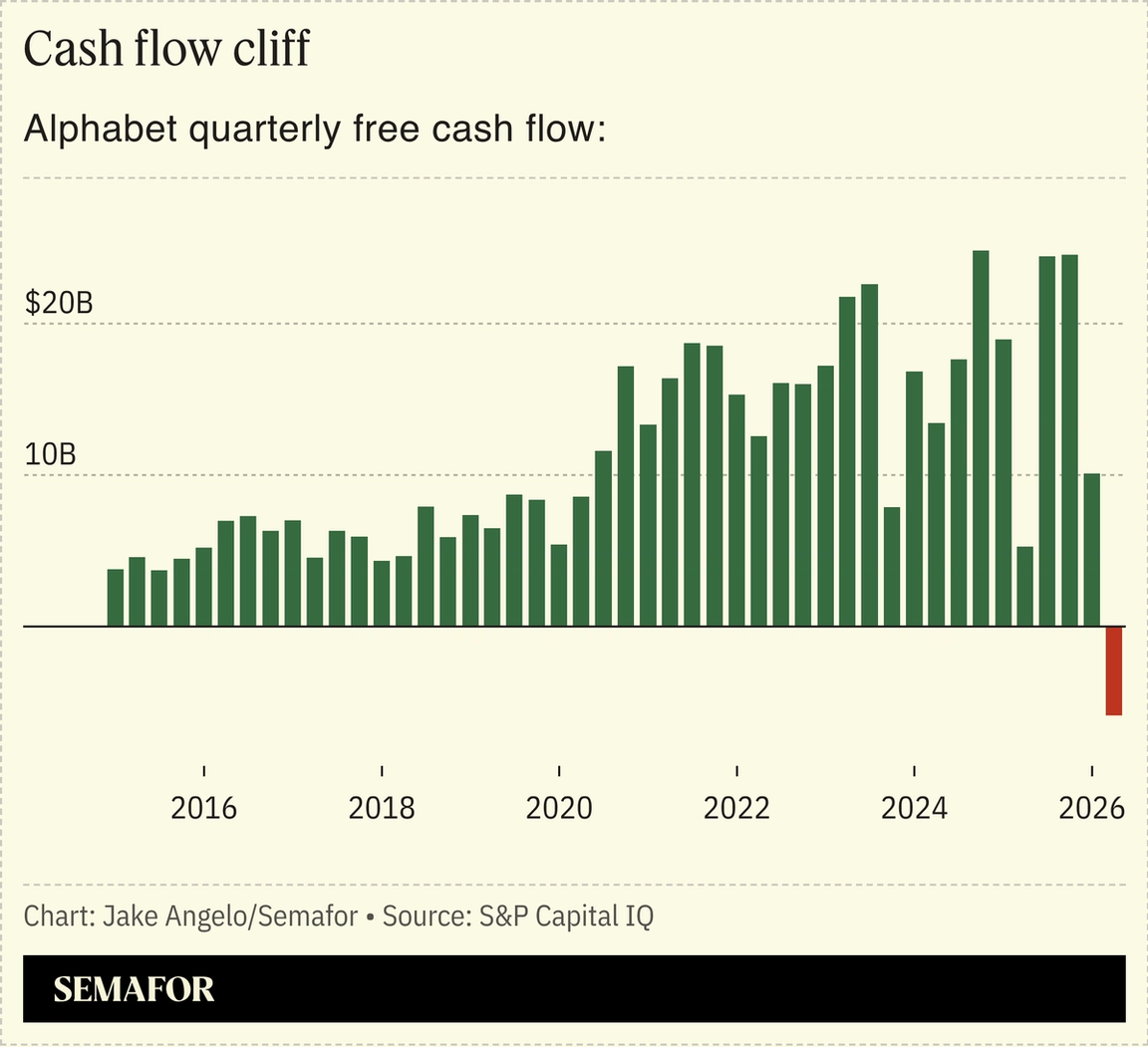 Alphabet is spending like there’s no tomorrow, and it’s freaking shareholders out. Its shares dropped 7% after it raised its AI spending for the third time this year to $205 billion. Its free cash flow turned negative for the first time in its 22 years as a public company, and it bought back zero shares for the second straight quarter. It also has a pending $40 billion share offering, which will put further pressure on the stock price. CFO Anat Ashkenazi said the company’s 2027 capex will increase significantly and “continue to put pressure” on profits. That Google — perhaps the best positioned of the hyperscalers to keep spending, given its money-spinning ad and cloud businesses — is being punished shows growing investor skepticism that all the AI spending will pay off. The tech companies without Google’s cash cows will be left in an even weaker spot, which explains why Meta is hustling to launch its own cloud business. — Rohan Goswami |
|
Semafor Exclusive Intel wants some help |
 Tsai Hsin-Han/Reuters Tsai Hsin-Han/ReutersIntel is looking for a partner to help it run its Ohio chip-making facility, a massive US memory operation that has long been mired in delays and setbacks, Rohan scooped Wednesday. Among the companies Intel is considering working with on the Ohio facility is South Korean memory giant SK Hynix, according to people familiar with the matter. The plant is central to Intel’s endeavor of bringing more chipmaking production to the US, which has gained importance for the company after it handed over a 10% stake to the Trump administration. President Donald Trump’s championing of Intel has been both a blessing and a curse: It’s given the company the financial wherewithal to compete with bigger rivals like TSMC, helped its stock surge 161% in a year, and pushed customers and competitors that may otherwise have written the company off to engage with it. But the government’s involvement also means that when the president speaks, Intel has to listen. If partnering with SK Hynix is the way to speed up production at its beleaguered chip plant while retaining possession of it, it may be one way to curry favor with Intel’s most important shareholder. |
|
 Romina Amato/File Photo/Reuters Romina Amato/File Photo/ReutersIBM’s earnings whiff could give the Trump administration more ammunition to rethink the quarterly earnings treadmill, which a top company executive called “outdated.” “It forces companies to do irrational things” like offering steep end-of-quarter discounts, IBM Vice Chair Gary Cohn said in an interview. (IBM chose not to do those things this quarter and paid handsomely for it: Its earnings-miss preview shaved $69 billion off its market cap last week.) A third of the contracts IBM had expected to sign before June 30 have since come through, the company said, and will show up in its third-quarter report in October. The Securities and Exchange Commission proposed in May letting companies share their financials just twice a year instead of four times, as many European companies already do. Shareholder groups are aggrieved. But when quarterly reporting was mandated in 1970, “it’s because it was the only time shareholders could hear anything about the company,” Cohn said. “I’m sitting here with a TV in front of me with four business channels on it; CEOs are talking every day.” |
|
Sports betting’s financial toll |
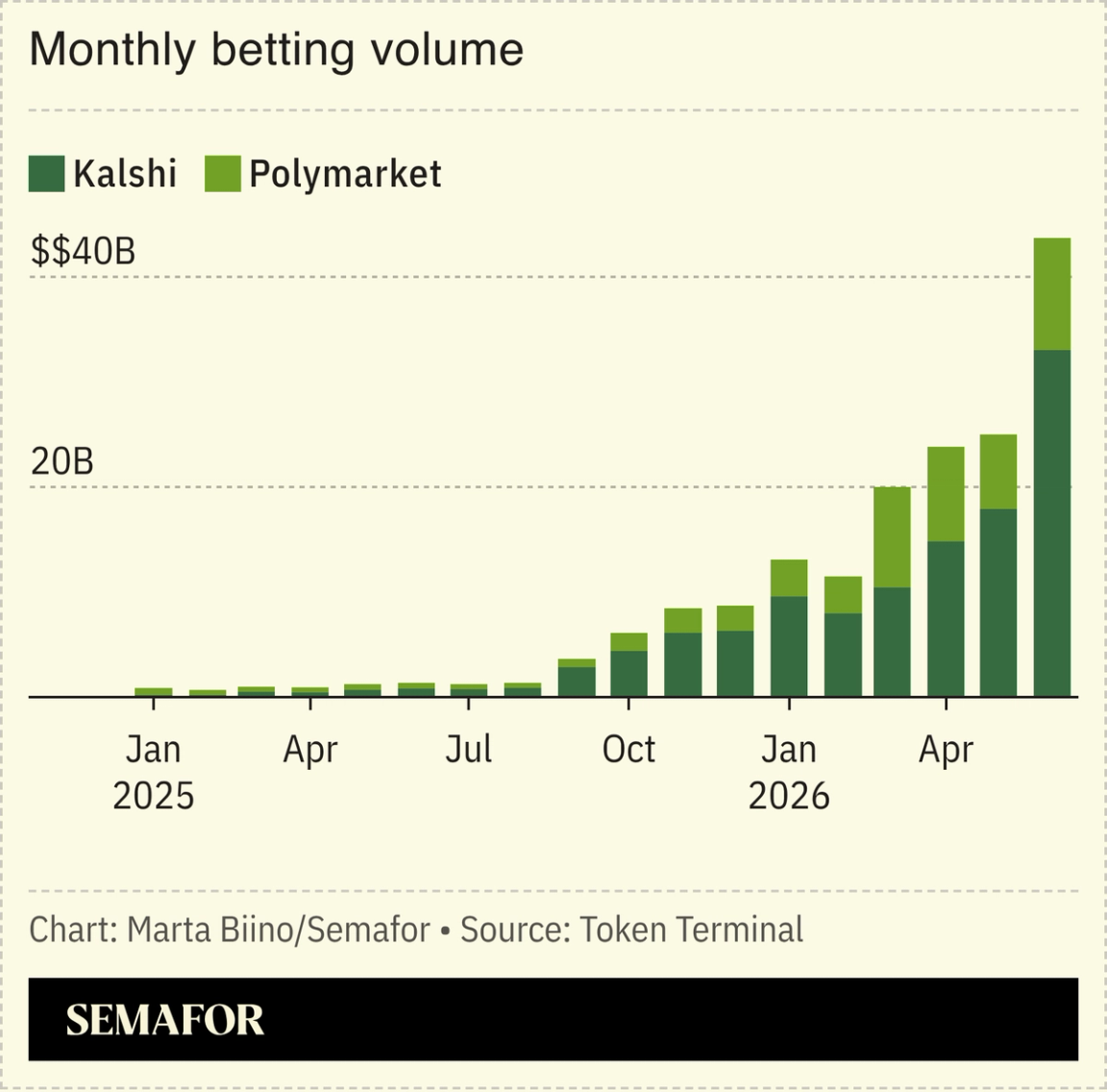 Sports betting is degrading the financial health of the most vulnerable households, according to a new study that tees up an emerging political issue. The study, which draws on transaction data from more than 180,000 households, found that sports betting doesn’t replace shopping or other gambling, like lottery tickets or casino outings, but adds to it, eating into savings and driving up debt. “Risky bets crowd out positive expected value investments,” like buying a house or investing for retirement, the study says. (A sizable share of bettors, according to the report, say they view betting as an investment strategy.) Monthly trading volume on Kalshi and Polymarket, much of it on sports, swelled from $2 billion in early 2025 to nearly $50 billion in June. The negative effects are starting to show up. Researchers at the New York Fed blamed legalized sports for rising consumer-loan delinquencies. A separate study found that for every dollar wagered on sports, net investment in stocks and other financial instruments fell by just over two dollars, suggesting that consumers are frittering away money that could go toward building long-term wealth. “Somebody needs to talk about what the negatives are,” billionaire and philanthropist John Arnold said on a recent episode of Semafor’s Compound Interest. He plans to put pressure on politicians to crack down. — Jake Angelo |
|
 Angelina Katsanis/Reuters Angelina Katsanis/ReutersMayor Zohran Mamdani’s uneasy truce with New York’s business elite was tested again Wednesday when he appointed antitrust crusader Lina Khan to a formal post in his administration. Khan will chair the city’s economic development board, which oversees the leasing and use of huge chunks of city property, including Hudson Yards. Semafor first reported, back in November, that Mamdani had tapped Khan as an informal adviser to wield the city’s consumer-protection power. She’ll now have a formal perch from which to needle the corporate community, which immediately felt needled. The appointment sends a “mixed message to the business community,” said Steven Fulop, the head of the Partnership for New York City, whose members include Goldman Sachs, Tishman Speyer, Apollo, and Pfizer. “Khan’s reputation has been built on an adversarial approach to large enterprises.” A spokesperson for Khan declined to comment, but her camp appears to be enjoying the haters. This M&A reporter would happily argue, and some CEOs might grudgingly agree, that Khan did a lot of good for business: Some of the most valuable companies on the planet today might have been swallowed up four years ago if not for the looming threat that the Biden antitrust regime posed. — Rohan Goswami |
|
 Semafor has announced the expanded Global Advisory Board for Silicon Valley & The World — a first-of-its-kind, multiyear initiative bringing together the leaders building transformative technologies with the policymakers shaping how they are deployed. With more than 40 global figures joining the board — including Patrick Collison, Daniel Ek, Jane Fraser, Andy Jassy, Jay Y. Lee, Dilhan Pillay Sandrasegara, Gina Raimondo, Aravind Srinivas, and Hiroki Totoki, alongside co-chairs Jensen Huang, Divesh Makan, Satya Nadella, Ruth Porat, and Lisa Su — this group reflects the full spectrum of power driving the AI economy. Designed to move the conversation beyond debate, the platform will bring together more than 350 founders, CEOs, investors, and policymakers in November, uniting the leaders with the ability to fund, scale, and implement new ideas. |
|
➚ BUY: Uber’s ex. Travis Kalanick’s robotics startup raised $1.7 billion in funding led by a16z, a promising start to the former ride-share CEO’s newest interest. ➘ SELL: UberX. Elon Musk shot down the idea of partnering with third-party ride-share firms, signaling his intent to take Tesla’s robotaxi division head-to-head with Uber and Lyft. |
|
 Companies & Deals- Strut-worthy: Comcast’s streaming arm Peacock posted a profit for the first time in its history, bolstered by the NBA playoffs, the World Cup, and … Love Island USA.
- This again: AMD is investing $5 billion in Anthropic, which will, in turn, buy up to 2 gigawatts of AMD chips.
- Intelligent design: Amazon has redesigned Alexa to rely less on Anthropic’s costly models. Companies are coming around quickly to the idea that dumb questions — the vast majority of Alexa queries — can be answered by dumber models.
Watchdogs- For me, not for thee: A bill restricting members of Congress from trading stocks passed the House, but it faces a tough fight in the Senate because it doesn’t cover investments by the president or investments in private companies.
- A different kind of Fed probe: A Federal Reserve review of the 2023 collapse of Silicon Valley Bank is turning political, with Trump officials and allies wondering if it could justify the removal of a Fed governor, Bloomberg reports.
Markets- The other strait: Oil is trading near $100 a barrel, its highest level in six weeks, after Houthi militia attacked a crucial Red Sea channel.
|
|
|


