
|
 |


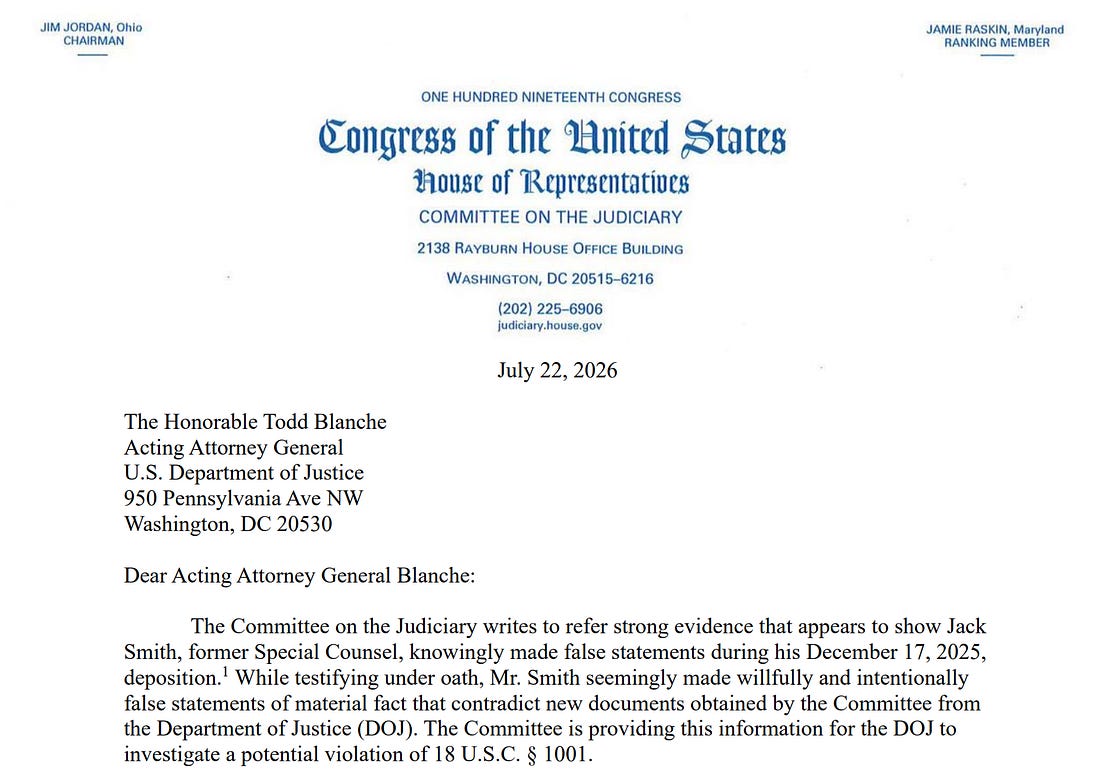
Ohio Congressman Jim Jordan, the House Judiciary Committee Chairman, sent a referral to DOJ, asking them to bring charges against former Special Counsel Jack Smith. Jordan says Smith misled Congress in his deposition about the investigation that resulted in two indictments against Donald Trump. That’s the context here—the referral is about revenge. It’s little more than an effort to curry favor with Donald Trump, who needs revenge and wants to use the nation’s criminal justice system to exact it.
 |
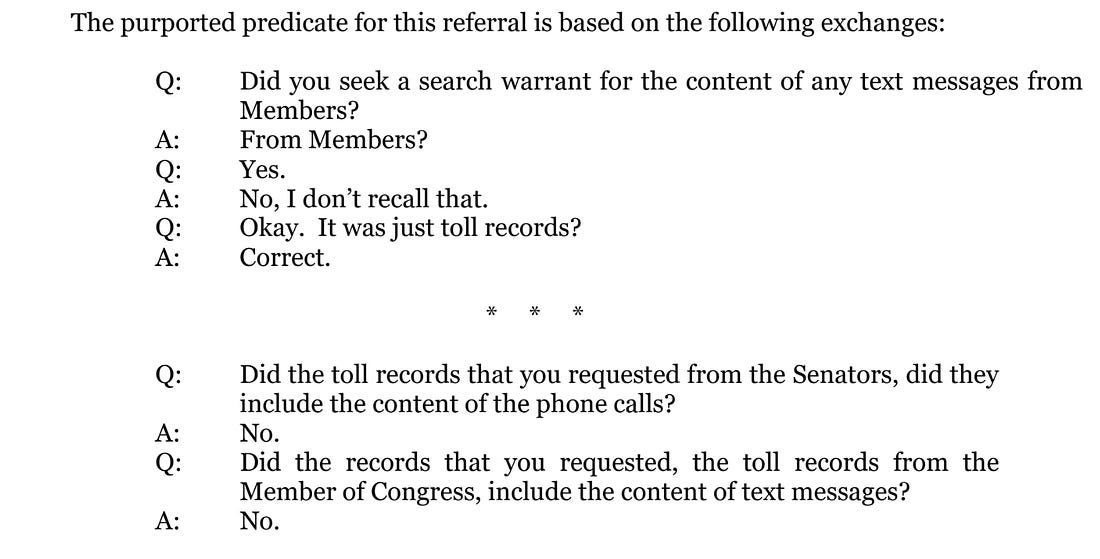
The precise claim of criminality by Smith centers around allegations that when he was asked questions about obtaining toll records—something federal prosecutors routinely do to understand who was in communication around the time a crime was committed—he failed to volunteer that his team had separately received records from the National Archives. Witnesses are required to answer each question they are asked fully. But they aren’t obligated to volunteer information beyond the scope of the question.
Here’s an example: Mrs A., did you eat lunch at the Big Top on Tuesday?
Mrs. A is required to answer yes or no truthfully. She’s not required to say that she went to the Big Top two weeks later, or that she ate at The Juicery on Tuesday. It’s ludicrous to think that a witness in Smith’s position, asked if he obtained certain records from one source, is then required to exhaustively divulge every item he obtained in the course of his investigation.
So far, this is just a congressional referral. There is no word on how DOJ is responding. But this is the Justice Department that has brought defective cases against everyone from former FBI Director Jim Comey to Kilmar Abrego Garcia, the deported migrant whose challenge to his deportation exposed the administration’s cavalier violation of due process. This is the DOJ that indicted a guy who threw a sandwich, only to be laughed out of court. A DOJ that brought in unqualified people to serve as U.S. Attorneys (here’s looking at you Alina Habba and Lindsey Halligan) when even Trump appointees declined to indulge the president’s incessant desire for revenge.
Smith’s team also sought and obtained executive branch records from the National Archives documenting communications inside of the executive branch—those are public records—around January 6. At the end of every administration, members of the executive branch know that their communications and records go to the Archives, because they belong to the people, the citizens of the United States, and not to those officials. And if members of Congress sent texts or other messages to people in the executive branch, including the president and those close to him, it’s not improper for those communications to be turned over to a special counsel seeking them in an investigation.
But here’s the key point when it comes to Smith’s deposition: He was asked a question about an entirely separate process to obtain toll records. He wasn’t asked, and didn’t volunteer information about, a request made to the National Archives. Nor did he volunteer, in response to that same question, other streams of information about his investigation. He didn’t do that for the simple reason that none of it was responsive to the question he was asked, and that was the question he was obligated to answer. If you’re an investigator, whether at DOJ or in Congress, it’s your job to ask the questions you want answered. The witnesses' responsibility is to answer the questions that are asked. Jordan’s referral gives the whole game up when it concedes, “The Committee questioned Mr. Smith about the toll records subpoenas relating to the private records of Members of Congress” [emphasis added]. The letter goes on to suggest that Smith was required to somehow read members’ minds about what else they might be interested in and provide additional information not called for by the question that was actually asked.
If the Justice Department were even able to obtain an indictment in a case with so little evidence, it would make for a weak prosecution. But by referring the case to DOJ, Jordan and his allies in Congress force Smith to hire expensive lawyers and cause his family hardship and concern, no matter how stoic Smith himself is. For this to happen in a situation with no prosecutive merit is shameful. And Jordan knows that. But anything goes in service to Trump.
One might also ask why certain senators are so sensitive about communications they had with the White House around January 6, 2021.
Smith’s lawyers, in a letter to the Committee that I was able to obtain, wrote, “During his testimony, Mr. Smith provided truthful, responsive answers and candidly discussed his work as Special Counsel. This referral reflects a chilling eagerness to weaponize the justice system by attacking a career, nonpartisan public servant who faithfully and fearlessly performed his duties by following the facts and the law.” It may be chilling, but it is also a feature, not a bug, with this administration. It is commonplace. It is expected. It is still wrong.
You can read Jordan’s referral of Smith here. It alleges Smith violated 18 USC 1001, which prohibits making false statements to the government.
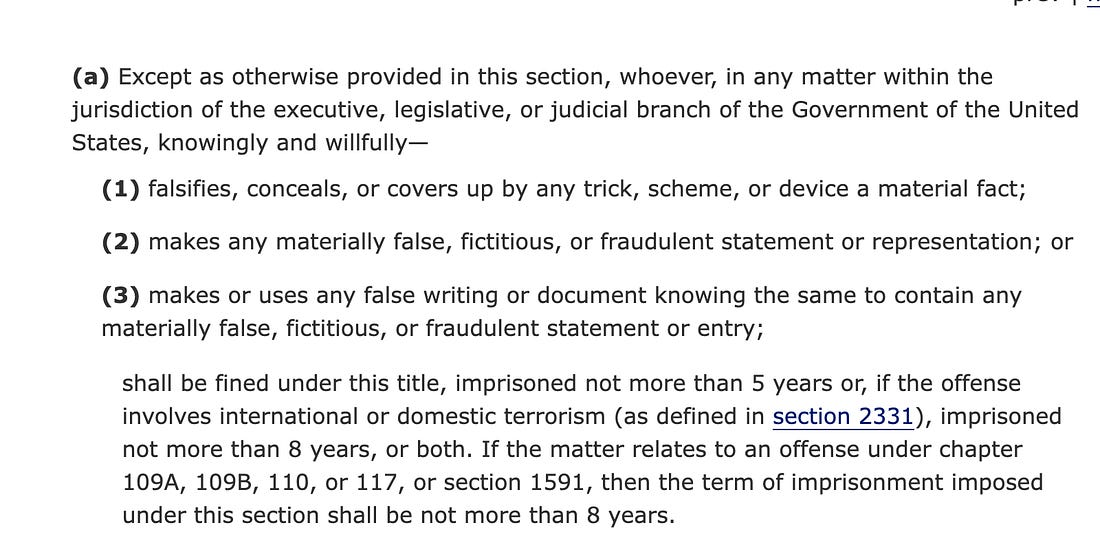 |
Not only does the government have to prove a false statement, it would also have to show that it was made knowingly and on purpose. Jordan explains this in his letter to Todd Blanche: “Mr. Smith ‘knowingly and willfully’ made false statements to the Committee during his deposition. An individual acts knowingly and willfully if he makes statements deliberately and with knowledge that the statement was false. The individual must only act with knowledge of the falsity and need not have any intent to defraud.” So DOJ would have to prove Smith knew his answer was false when he was asked a question about toll records and answered a question about toll records. You don’t have to be a rocket scientist, or a former federal prosecutor, to understand DOJ can’t meet the “beyond a reasonable doubt” standard of proof necessary for conviction.
Smith’s lawyers wrote in their letter, “This dangerous theory of criminal liability has no limiting principle and risks ensnaring every witness who testifies before a congressional committee who does not proactively disclose information that is not responsive to a question asked (i.e., every witness). Accordingly, the D.C. Circuit has rejected it … (‘The government essentially asks us to hold that once an individual starts talking, he cannot stop. We do not think § 1001 demands that individuals choose between saying everything and saying nothing. No case stands for that proposition.’).”
These are the questions Smith was asked:
 |
So, as you see news reports that Jordan has made this referral to DOJ, understand it for what it is: a form of shameful gamesmanship from someone who should know better, someone who went to law school, even if he never passed a bar exam.
Civil Discourse goes behind the headlines to help you understand what they mean, based on my 25 years of experience at DOJ. It’s increasingly important to be able to explain to folks around you why it’s not correct to say that both political parties weaponized DOJ. Republicans are clearly doing that here. They’re doing it because Jack Smith investigated possible crimes and found sufficient evidence to indict cases and move forward with them. Those cases were terminated only because Donald Trump was reelected and DOJ doesn’t prosecute sitting presidents, not because there wasn’t evidence to support what Smith did. Trump, of course, needs to wipe away the stain of his conduct by arguing Smith is the corrupt one. Your support for the newsletter lets me take the time and do the research to bring you analysis and primary documents to refute the lies. Thank you for being here with me.
We’re in this together,
Joyce