| | Oil prices spike and stocks fall on geopolitical volatility and AI spending fears, Donald Trump adds͏ ͏ ͏ ͏ ͏ ͏ |
| |  RIYADH RIYADH |  NEW DELHI NEW DELHI | HANGZHOU |
 | Flagship |  |
| |
|
The World Today | 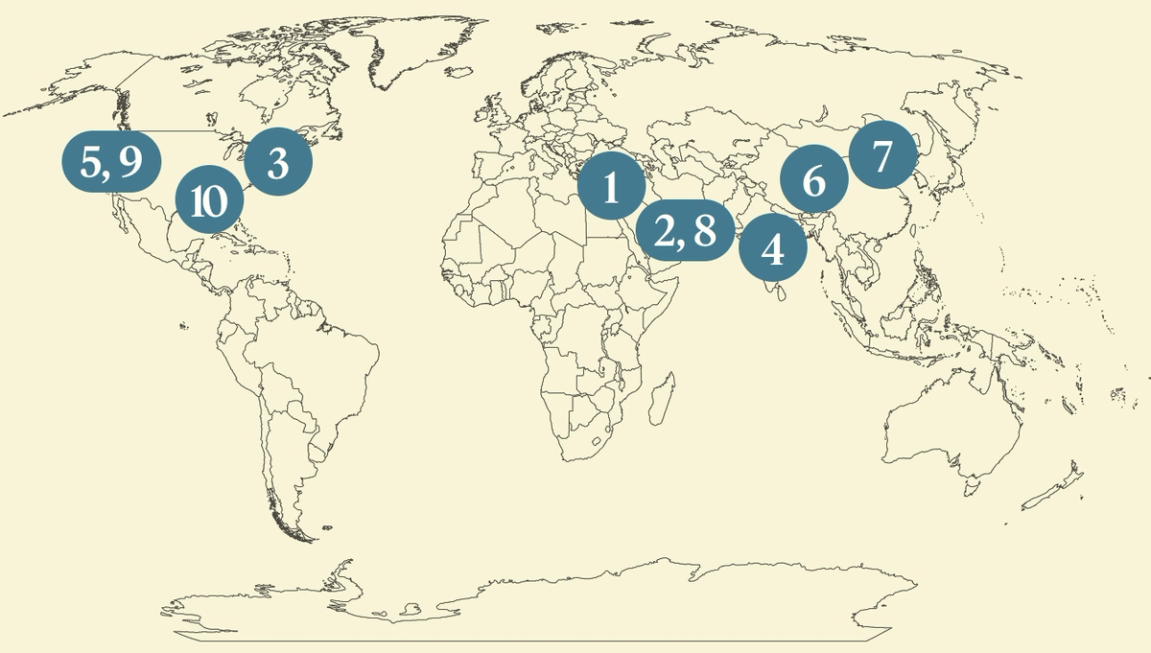 - Oil spikes, stocks fall
- US-Saudi deal in doubt
- Predicting tariffs’ impacts
- Cockroach protests swell
- US tech debate on China AI
- Chinese scholars awarded
- US plans car door rules
- Hormuz’s biosecurity threat
- AI’s tax implications
- The ‘retirement-maxxers’
 A new book brings a ‘rational, literary sensibility’ to a sensationalized murder case. |
|
Oil spikes, stocks fall on Iran and AI fears |
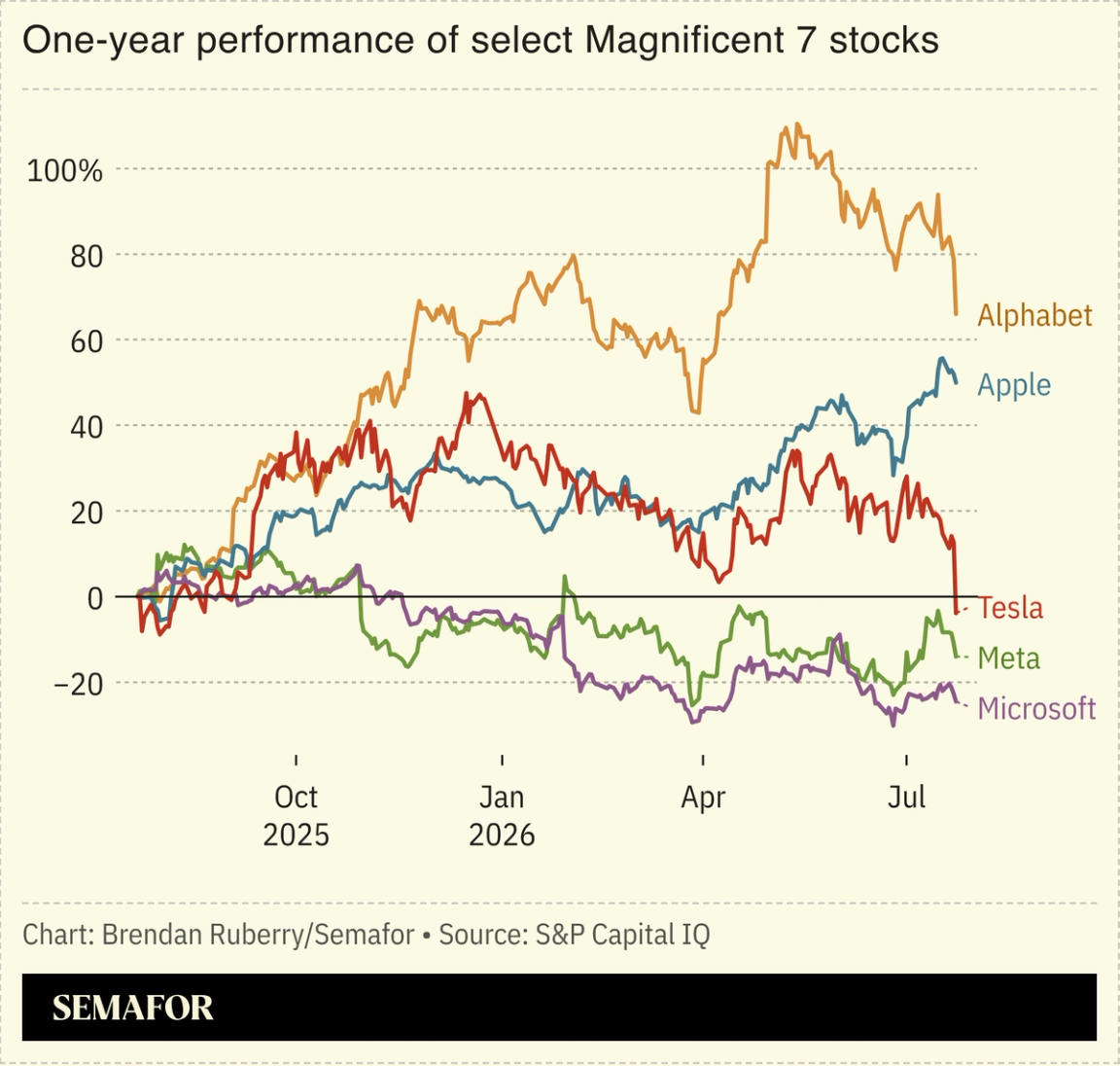 Oil hit $100 a barrel and Magnificent 7 stocks shed nearly $800 billion in market value on Thursday, as pessimism over steep AI spending and the Iran war dragged down global markets. Wall Street’s fear gauge hit its highest level in a month with rising crude prices reigniting inflation fears and exposing “just how fragile the market’s recovery has been,” a Reuters columnist wrote. Tech earnings, meanwhile, failed to satisfy investors hyper-attuned to capital expenditures: “Any chink in the armor and the stocks are being sold off,” an investment strategist said. Still, investors are betting that oil prices will fall in the coming months as Washington comes under pressure to ease tensions with Tehran. |
|
Trump pegs Saudi deal to Israel talks |
 Evelyn Hockstein/Reuters Evelyn Hockstein/ReutersUS President Donald Trump on Thursday injected uncertainty into his newly signed nuclear deal with Saudi Arabia, saying the pact hinges on Riyadh normalizing relations with Israel. The stipulation threatens to stymie the agreement, which allows Saudi to build nuclear power plants with US technology, giving the kingdom a path to an enrichment program. Riyadh has long pegged normalization with Israel to the establishment of a Palestinian state, which Israel’s government opposes. But Iran’s attacks across the Middle East have placed the Gulf and Israel on the same side of the conflict, which could at least “make normalization easier,” Semafor’s Gulf editor wrote. The US-Saudi deal faced criticism from some lawmakers and experts who worry it could unleash an arms race in the Middle East. |
|
Economists predict minor tariff disruption |
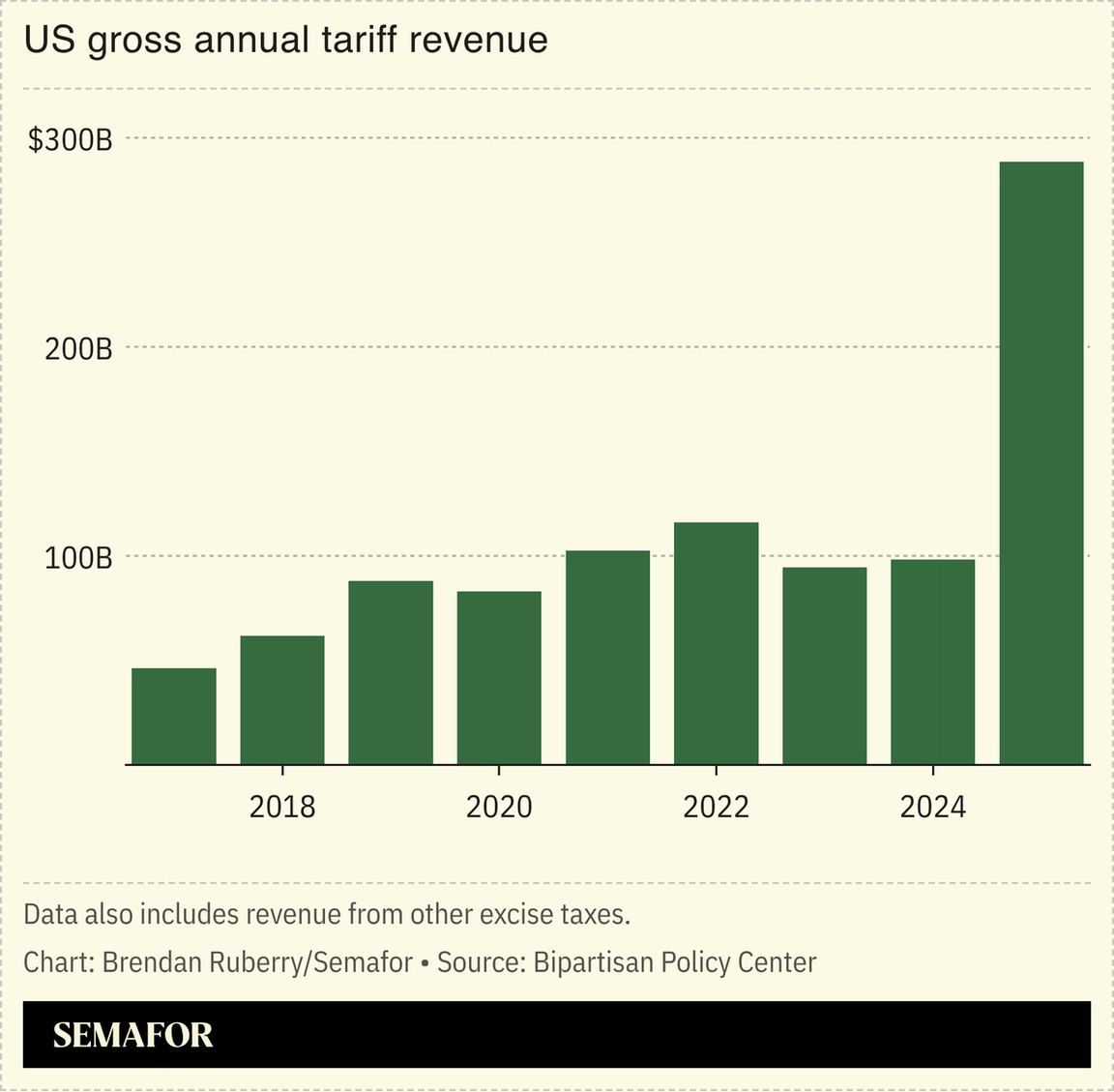 Economists predicted that the US’ sweeping new tariffs, which take effect Friday, will not seriously disrupt the global economy. Tariffs’ inflationary effects are “likely to have already peaked,” Commerzbank wrote, pointing to the Trump administration’s propensity for exempting key consumer goods and failing to implement certain threatened levies. While higher energy prices mean the global economy is weaker than it was during the last trade war, Washington’s announcements have tended to be “more dramatic than their eventual implementation,” an ING analyst noted, suggesting further levies would be “disturbing but not disruptive.” In Washington’s stated aim of reducing trade deficits, tariffs have so far proved negligible, a Financial Times columnist argued, but as a “coercive weapon [are] clearly here to stay.” |
|
The anger fueling India’s ‘cockroaches’ |
 Amit Dave/Reuters Amit Dave/ReutersIndia’s government will likely quell the student-led Cockroach protests, but it will have a harder time suppressing the underlying frustration fueling them, prominent Indian commentators argued. The movement, which began as a satirical campaign after a judge derided India’s unemployed youth as “cockroaches,” has transcended grievances about the education system’s failings to become an outlet for a “generation of desperate and furious young people who have seen their future snuffed out,” Arundhati Roy wrote. Nearly 83% of India’s unemployed are young people who sit through grueling exams and chase job security for a future of “prolonged uncertainty,” academics wrote in Frontline. The authorities have violently cracked down on protesters, Vir Sanghvi wrote, “but what the government can’t fight is an emotion.” |
|
US tech firms debate curbs on Chinese AI |
 Manami Yamada/Evelyn Hockstein/Reuters Manami Yamada/Evelyn Hockstein/ReutersThe US tech industry is divided over how Washington should handle the rise of open-source AI from China. OpenAI and Anthropic, the two leading AI startups that both make “closed” models, have in recent weeks sounded the alarm on what they see as the risks stemming from their cheaper Chinese counterparts: One OpenAI executive warned of a “dystopian hellscape” dominated by Chinese open-source tech. But Nvidia’s CEO argued that American companies shouldn’t be afraid to use “excellent” Chinese models, saying they widen the tech’s access to more people and businesses. A group of US startups urged the White House not to restrict the use of Chinese models, given how widely they’re deployed in Silicon Valley. “There’ll be hundreds of companies that instantly die,” one founder said. |
|
Chinese whizzes win global math prize |
 Simons Foundation Simons FoundationChinese nationals were awarded the prestigious Fields Medal for the first time, in the latest sign of the country’s growing academic prowess. Hong Wang and Yu Deng, both Peking University grads, were among the four winners of the prize, a Nobel-like honor for the world’s top mathematicians under 40. The achievement comes as several prominent scientists, including last year’s chemistry Nobel winner, are moving from the US to China, as global competition for academic talent heats up. Ph.D. admissions at top US institutions fell 15% this year owing to the Trump administration’s federal funding cuts, with one expert saying China is taking “advantage of the United States’ unforced errors.” Both Wang and Deng, though, currently teach at US universities. |
|
US moves to regulate hidden car handles |
 Mike Blake/Reuters Mike Blake/ReutersUS regulators on Thursday said they plan to develop rules to address the safety risks linked to the hidden electric car door handles popularized by Tesla. Investigations from Bloomberg have uncovered more than a dozen deaths from crashes in which people became trapped inside a Tesla because the doors wouldn’t open. The EV giant said it is working on a redesign. China earlier this year became the first country to ban the modern handles, in a move analysts said could influence norms around the world and cement China’s status as a global “rule-setter” for new vehicle tech. Beijing’s ban takes effect next year; safety advocates don’t expect a US rule to come into force before 2030. |
|
Iran conflict risks invasive species spread |
 Stringer/Reuters Stringer/ReutersThe Strait of Hormuz blockade could cause a “super-spreader event” of invasive species, researchers said. Marine species attach to cargo ships, and are carried around the world: The North American Great Lakes ecosystems, which connect to the Atlantic Ocean, are being devastated by invasive mussels. The roughly 1,500 ships that sat for months in Hormuz, meanwhile, will have picked up a particularly heavy load, and operators must work to “abate this extraordinary biosecurity threat,” Springer Nature wrote. Conflict often acts as a species-transport system: The Colorado potato beetle came to Europe with World War I troop food shipments and the Australasian brown tree snake reached Guam with the US Navy in the post-war years. |
|
AI could erode tax systems |
One result of the rise of AI could be the collapse of the global tax system. If AI means capital and corporate profits, rather than labor, become the dominant source of value in the economy, then states’ revenue-raising machinery — built around wages — becomes inadequate, a Bloomberg columnist argued. Upheaval that leaves millions out of work for years, as was the case after the Industrial Revolution, could lead to huge demands on social safety nets and a withered tax base to meet it. A separate issue will be the democratization of tax advice: Previously only available to major corporations, such expertise could be deployed to find loopholes for smaller taxpayers, although it could also be used by governments to find them. |
|
Gen Z drinks less, invests more |
 Jason Reed/Reuters Jason Reed/ReutersGen Z is “retirement-maxxing.” Despite a reputation for financial nihilism — think cryptocurrency, concert tickets, and $GME — the average person born in the late 1990s or later began saving and investing at 19, more than a decade sooner than Gen X and Baby Boomers, a Charles Schwab survey found. Young people also report drinking less, having less sex, and being more pessimistic about marriage, suggesting that beyond financial security, Gen Z may be “even more resistant to high-stakes investments in other people,” a Free Press columnist argued. Though Gen Z’s thriftiness may stem from profound discomfort with uncertainty, it’s also giving them a stronger launchpad for taking bigger chances later in life, a wealth management executive told Bloomberg. |
|
|


