
|
We asked too much of the American university
Our one remaining functional institution is going downhill.
|

| |||||||||||||||


 |
The story of the rise and possible impending fall of the American university system is, in many ways, the story of modern America. It ties together the changes in our culture, our economy, and our politics since the mid-20th century. Understanding why universities came to be our most important and most functional institution, and why that model is now under threat, can help us understand how our country might look different going forward.
Let me try to tell a condensed version of that story.
The United States used to have a bunch of institutions that bound us together and forged us into a unified society. Many American communities were centered around churches; these facilitated networking, helped people find spouses, provided community services like day care and mutual aid, and homogenized values and culture at the local level. During the World Wars (and to a lesser extent, the Vietnam War), the military was very large and threw together Americans from various social classes. In the early postwar decades, corporations were also a unifying institution. Mass media provided us with shared cultural context. Even public transit put people of various backgrounds in close social contact on a daily basis.
In the half-century from around 1970 to 2020, those unifying institutions became much weaker. Church attendance slowly declined and then fell off a cliff in the 2010s. The military shrank into a small, professionalized volunteer force. Corporations ended their brief flirtation with lifetime employment, and outsourced many of their roles. Mass media fragmented in the age of the internet. Public transit dwindled in importance as Americans moved to the suburbs and drove.
As the country’s unifying institutions withered, one new institution attempted to step into the void: the American university. Universities were not new in the late 20th century, of course, but mass attendance certainly was. From 1970 to 2020, the share of Americans age 25-29 with a bachelor’s degree went from 16.4% to 39.6%. Around two out of three have completed some college.
College went from something that only the upper crust did, to something that most people were expected to do if they wanted to be economically successful in life. This expansion inadvertently but inevitably thrust a new role on American universities — that of a broad socially unifying institution. College was where people from a variety of backgrounds mingled and mixed — not just in classes, but in dorms, campus activities, and college towns.
College became the new church, the new military, and the neighborhood bowling alley all rolled into one. Instead of preachers homogenizing Americans’ values from the pulpit, university administrators taught college kids to value things like diversity, consent, and so on, and college students hashed out their own differences in millions of late-night dorm room discussions. Instead of meeting their first love in high school, Americans increasingly delayed sex until college; many of these relationships turned into marriages. Young people went into college as children and came out adults.
This was a heavy burden to bear for an institution that hadn’t been designed for it. But American universities were accustomed to taking on big new duties. Our universities began as essentially a copy of the British model — teaching-focused institutions designed to provide broad education and mentorship to the upper class. In the early 20th century they tacked on the German model — a research-focused lab apprenticeship system by which top scientists taught other top scientists and readied them for research jobs while also producing cutting-edge basic research.
This dual system enabled a remarkable form of cross-subsidization. Undergrad tuition payments — and state support for undergrad education, and undergrad alumni gifts — created a flood of money that paid for grad student stipends, lab facilities, professor salaries, and more. The federal government and companies also funded university research, of course, through grants and sponsorships. But undergrad money was a huge tailwind. And the prestige generated by successful and famous researchers helped universities charge undergrads more.
The hybrid of the old British and German models was naturally symbiotic, and it meant that even as America’s other institutions came under pressure, universities thrived and grew — especially once they used their prestige to attract high-paying and highly skilled foreign students from around the globe. Universities became the lynchpin of America’s research effort:
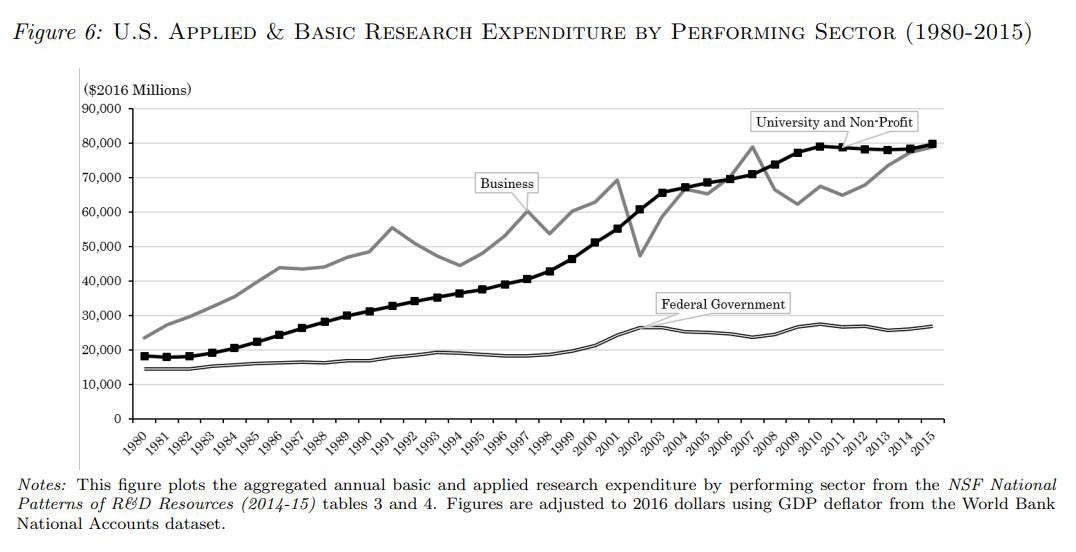 |
American universities had a lock on both the nation’s research output and on its production of human capital, and those roles were mutually reinforcing.
I suspect that their success at handling education and research at the same time probably gave American universities a lot of confidence about their ability to handle society and culture as well. Colleges spent more and more on dorms and “student services” and hired administrators (many of whom dealt with undergrad life) at an astonishing rate.¹
But replacing churches, the military, and the neighborhood bowling alley proved harder than replacing the corporate lab had been. There was just one basic problem with college as America’s primary unifying institution, which is that not everyone can go to college.
First of all, college is difficult. To complete college courses, you need some degree of raw intelligence, but you also need work ethic and a certain degree of independence. As much as we might like to believe otherwise, not everyone in America has those traits, and we don’t yet know how to instill them in everyone. As a result, there’s a limit to how much you can expand college enrollment — and college completion — without loosening standards.
In fact, loosening standards is exactly what American colleges have done. Universities have necessarily become less and less selective over the years, as they have taken in a larger and larger fraction of the young American population. For a while, this led to lower college completion rates, but in the 1990s, more and more students began finishing their bachelors’ degrees. Why? Because colleges implemented grade inflation, making it easier to finish school without learning the material well. Here’s Denning et al. (2021):
We find that most of the increase in graduation rates can be explained by grade inflation, and that other factors such as changing student characteristics and institutional resources play little or no role. This is because GPA strongly predicts graduation and that GPAs have been rising since the 1990s. This finding holds in national survey data and in records from 9 large public universities. We also find that at a public liberal arts college, grades increased holding performance on identical exams fixed.
At some point, though, this process hits a wall. A large fraction of young Americans just isn’t prepared for college, even with grade inflation, and doesn’t end up going. College enrollment by recent high school graduates plateaued in the early 2000s and actually fell back to early 1990s levels during and after the pandemic: