| | In this edition: US looks to secure Red Sea shipping route, Cyril Ramaphosa gets a reprieve in impea͏ ͏ ͏ ͏ ͏ ͏ |
| |  | Africa |  |
| |
|
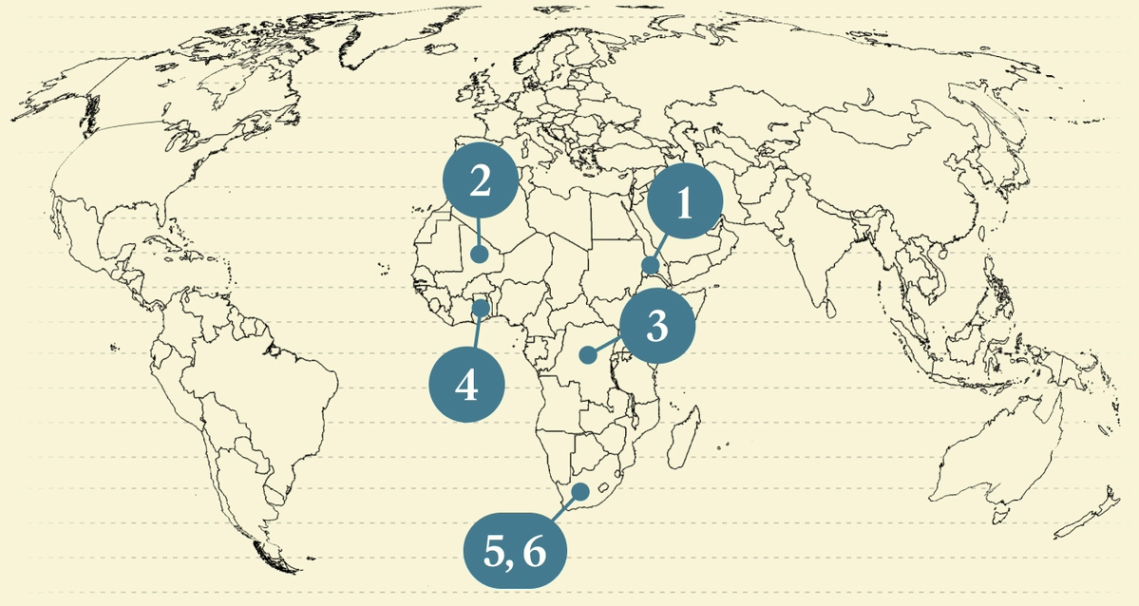 - Securing Red Sea shipping
- US ‘weighs’ Mali strikes
- Getting more from mining
- Ghana’s illegal gold risk
- S. Africa holds rates
- Ramaphosa gets a reprieve
 A gritty hip-hop subgenre takes off in Addis Ababa. |
|
US urges safe Red Sea shipping |
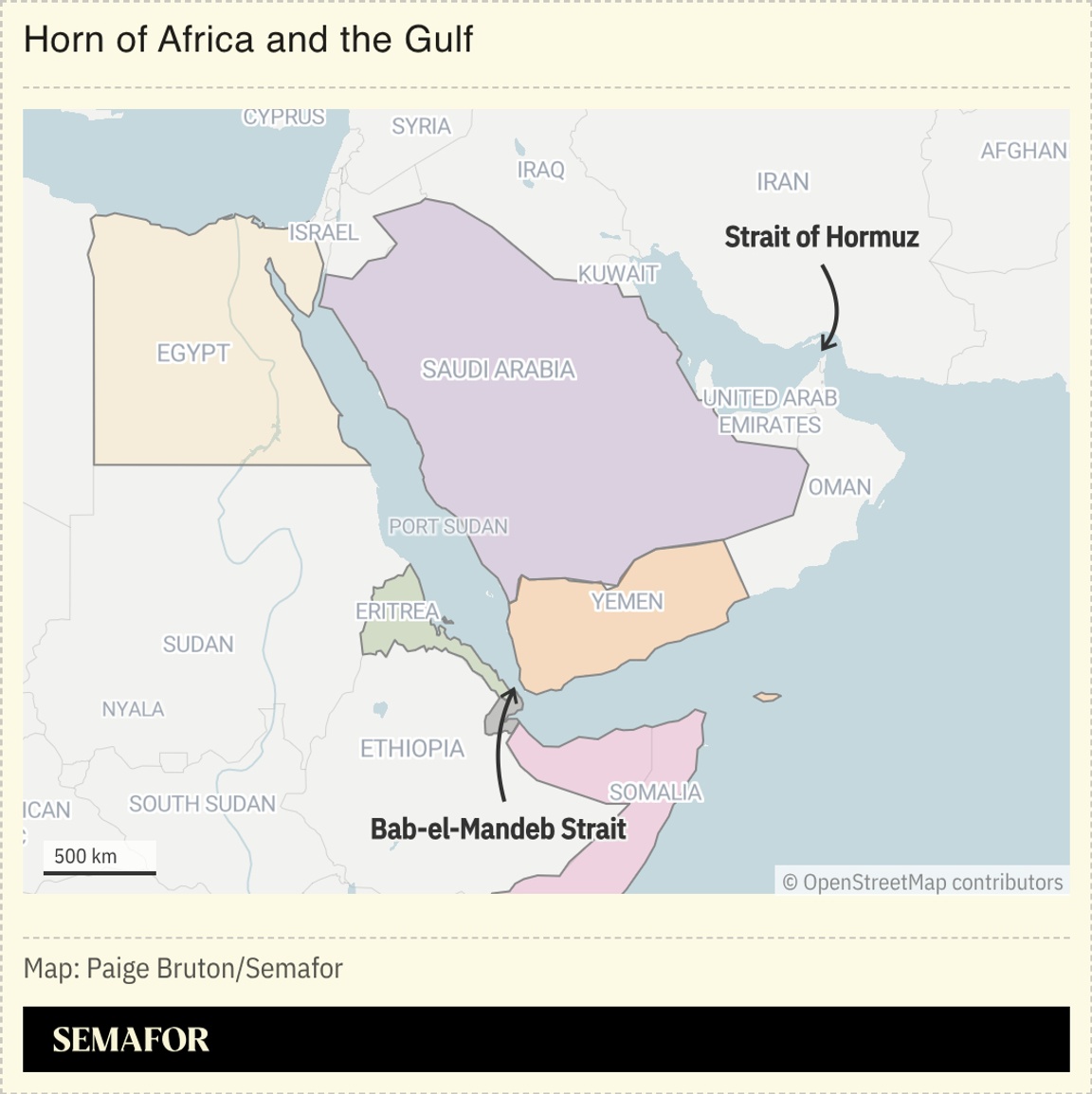 A widening campaign of attacks on shipping in the Red Sea is forcing Washington to pay renewed attention to the African side of the Bab el-Mandeb Strait, where the Trump administration has quietly stepped up engagement with governments including Eritrea and Somalia. The narrow waterway between Yemen and Djibouti forms the western gateway to the route linking the Indian Ocean with the Suez Canal. With shipping also under pressure in the Strait of Hormuz, the risk of disruption at both ends of the Gulf’s oil export corridor has heightened concerns over global energy supplies and caused a spike in crude prices. Against that backdrop, senior White House adviser for Arab and African affairs Massad Boulos met the foreign ministers of Somalia and Eritrea in Cairo this month, alongside Egyptian officials, to discuss security in the Horn of Africa and the Red Sea. Cameron Hudson, a White House official during the George W. Bush administration, said African countries must not become another source of instability. “The US seems to be saying, ‘You can’t be helpful to us in the Red Sea, so let’s at least make you a neutral actor,’” he said. — Yinka Adegoke |
|
Semafor Exclusive US senators in dark on Mali plans |
| | Lauren Morganbesser and Adrian Elimian |
| |
 Kent Nishimura/Reuters Kent Nishimura/ReutersUS senators said they had not been briefed on Trump administration plans for military strikes in Mali, underscoring growing frustration on Capitol Hill over the White House’s handling of foreign military operations. The reaction followed a Washington Post report that the administration was weighing strikes against an al-Qaeda affiliate group that has expanded across Mali and the wider Sahel. Such an operation would mark a significant escalation of US military engagement in West Africa at a time when Washington is quietly rebuilding ties with Mali’s military junta after years of strained relations following coups and Bamako’s growing partnership with Russia. The US’ new Africa envoy visited Bamako last week, and the administration this year lifted sanctions on three senior Malian officials linked to the Wagner Group. The administration appears to be exploring a model similar to one used in Nigeria, where the US carried out strikes against militant targets at Abuja’s request last Christmas. |
|
Semafor Exclusive DRC seeks greater gains from mining |
| |  | Ruben Nyanguila |
| |
 Aaron Ross/Reuters Aaron Ross/ReutersTwo sustainability-linked bond deals worth at least $100 million each are under discussion for mining projects in DR Congo, an executive told Semafor, as African governments look for new ways to ensure mining investment delivers broader economic benefits. One project involves an electricity company in Lualaba, the center of DR Congo’s copper and cobalt industry, while the second involves a mining company in the gold-producing province of Ituri, according to Rob Karpati, finance director at Canadian advisory firm Veridicor, which is developing the structures. He declined to identify the companies. The proposed financing would fund shared infrastructure, including electricity networks serving both mines and nearby communities, as well as programs to professionalize artisanal mining. Governments across Africa are pushing to capture more income from the mining value chain; although the continent holds roughly a third of the world’s critical mineral reserves, it captures less than 5% of the value added from processing those resources. |
|
Ghana’s illegal gold mining poses risk |
 Francis Kokoroko/Reuters Francis Kokoroko/ReutersGhana’s booming illegal gold mining sector poses a national security threat that risks opening the country up to terrorist activity, a new analysis warned. Revenue generated by small-scale gold mining in Ghana topped $11 billion last year, compared to $9 billion for large-scale mining. Backed largely by criminal networks and illicit money channels, galamsey — as illegal gold mining is known in Ghana — has evolved beyond a challenge of lost tax revenue “into a security and governance problem,” the Africa Center for Strategic Studies warned. The Washington-based think tank said Ghana must “strengthen financial intelligence, border coordination, and regional information-sharing mechanisms.” Much of the revenue from illegal gold mining operations is smuggled out of the country instead of reaching government coffers. This week, Accra signed an agreement with the World Gold Council to work towards increased formalization of the artisanal sector. — Alexander Onukwue |
|
South Africa holds interest rates |
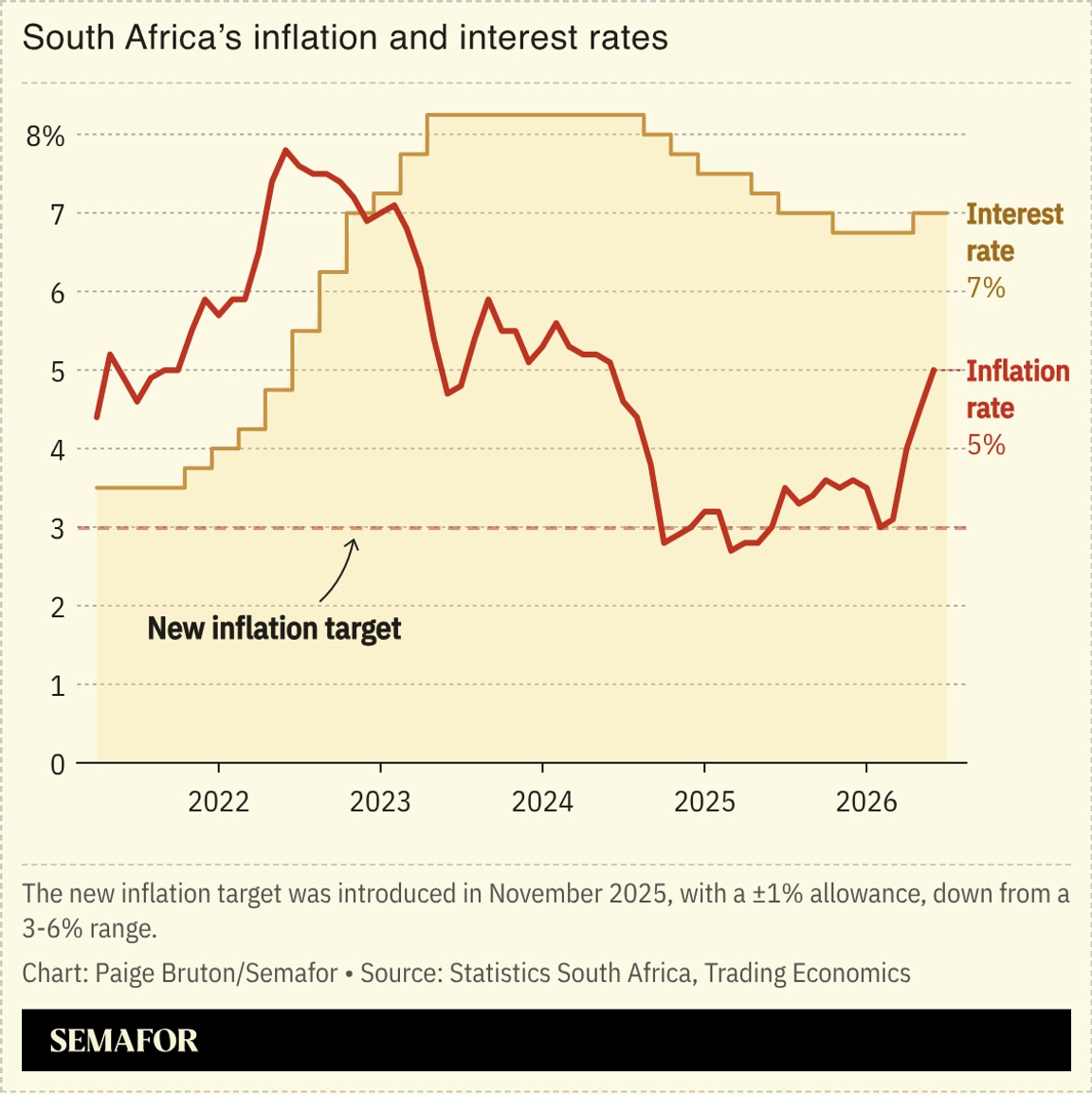 South Africa’s central bank kept its benchmark interest rate on hold, resisting market expectations for another hike after June inflation surged past its target. The decision triggered a market sell-off, sending the rand down more than 2% — making it the world’s worst performing currency on the day — while benchmark bond yields rose. “The inflation outlook has improved slightly since our last meeting, but inflation is still too high, while growth is weak,” Governor Lesetja Kganyago said. Economists predicted the pause may be short-lived. Citibank’s Gina Schoeman said she remained concerned by underlying inflation and maintained her baseline forecast for a 25 basis-point rate hike in September. The inflation spike has been driven primarily by higher energy costs, fueled by the Middle East conflict. — Tiisetso Motsoeneng |
|
Court win buys Ramaphosa time |
 Adriano Machado/Reuters Adriano Machado/ReutersSouth African President Cyril Ramaphosa secured a reprieve after a court decision on Friday temporarily halted a parliamentary impeachment probe into the leader of Africa’s biggest economy. The order pauses what threatened to be a damaging political spectacle over the theft of $580,000 in cash from Ramaphosa’s Phala Phala private game farm. It also shields Pretoria’s fragile government — a market-friendly coalition formed after the African National Congress lost its majority in 2024 — from political rifts. The ruling freezes public hearings and witness subpoenas until a full judicial review of the report underpinning the inquiry. The court will sit in September to decide whether to strike down the statutory foundation of the inquiry, delaying one of South Africa’s biggest political risks. — Tiisetso Motsoeneng |
|
 - The motorcycle has become both weapon and currency in Nigeria’s conflict zones, writes Mansir Muhammed for HumAngle, tracing how insurgents from Boko Haram to northwestern “bandit” groups have built a logistics system in which ransom payments increasingly include motorcycles as well as cash. Muhammed examines Nigerian Army seizure records, satellite imagery, and interviews with middlemen who source bikes for kidnapped victims’ families. He then maps how trans-Saharan corridors linking Libya, Niger, and northern Nigeria carry motorcycles alongside arms and gold even as governments have imposed bans on the vehicles and curfews in attempts to choke off the supply.
- Companies owned by a US army veteran have been linked to a fleet of Boeing aircraft that flew to key logistics hubs that are used by the Rapid Support Forces paramilitary group in Sudan, according to a Reuters investigation. US officials have said the RSF committed genocide against Sudanese civilians during the country’s civil war. One Boeing 727 operated by staff contracted by a US military veteran’s firm was hit by a Sudanese army strike in 2025, killing 51 RSF fighters and three others.
- Tunisia’s panic over falling marriage and fertility rates is mixed with racialized fears of “Africanization” by sub-Saharan migrants, writes Shreya Parikh for Africa Is a Country. President Kais Saied’s rhetoric about demographic replacement, echoed in everyday conversation, has translated into policy proposals pushing Tunisian women to have more children while targeting migrant women, with a lawmaker calling for forced birth control. Parikh follows how Tunisia’s future has been framed in terms of racial purity and reproductive control.
- Hoping to trace the myth behind The Gods Must Be Crazy, the writer Carey Baraka travels to remote Namibia to find descendants of N!xau ǂToma, the star of the wildly popular 1980 South African film, for this piece in Equator. Baraka uncovers how director Jamie Uys fabricated a “noble savage” backstory that obscured N!xau’s real life and the apartheid-era conscription and displacement surrounding the film’s making. He also reveals how little of the film’s fame or fortune ever reached N!xau’s family, who remain in poverty in his hometown of Tsumkwe despite the film being one of the most successful African movies ever made.
|
|
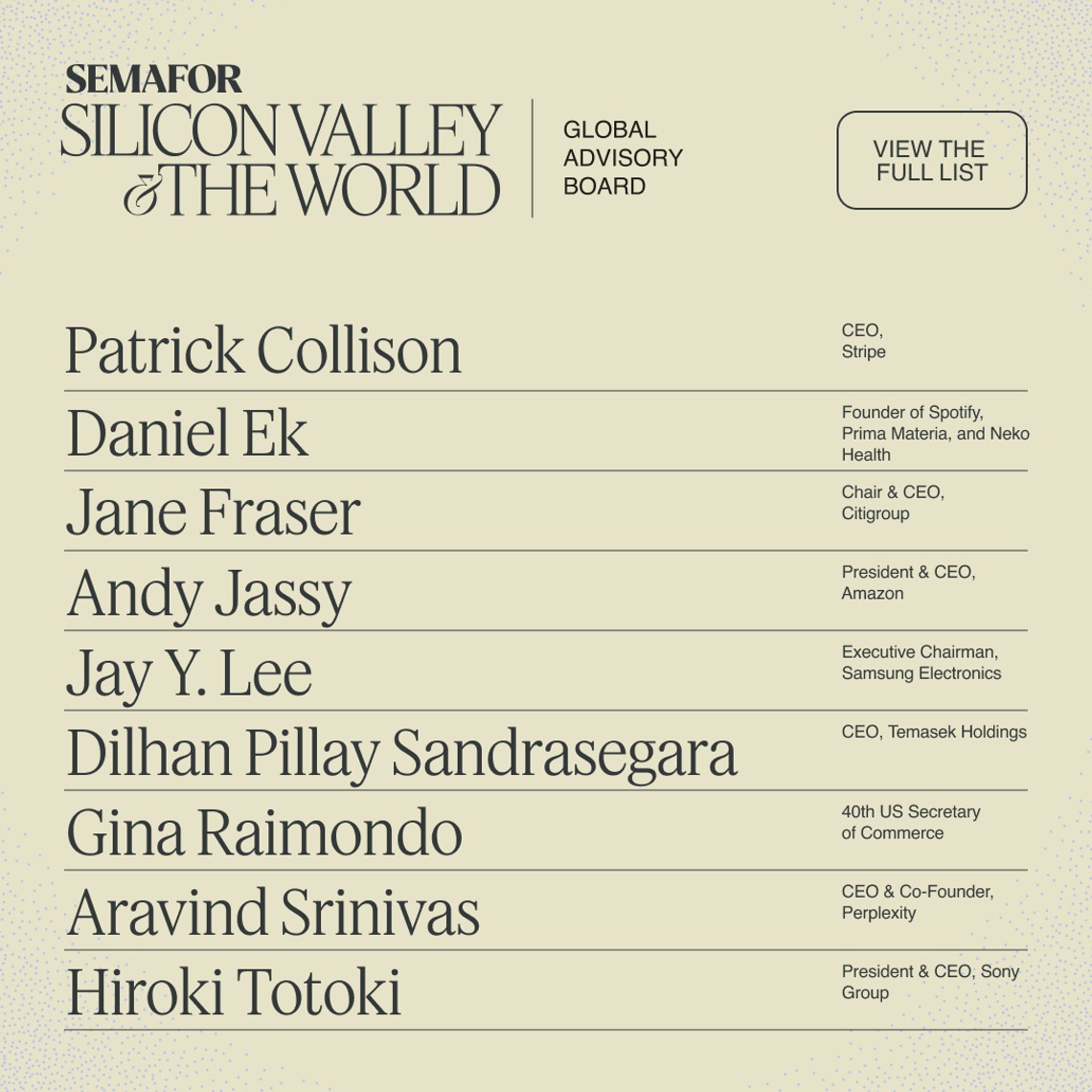 Semafor has announced the expanded Global Advisory Board for Silicon Valley & The World — a first-of-its-kind, multi-year initiative bringing together the leaders building transformative technologies with the policymakers shaping how they are deployed. With more than 40 global figures joining the board — including Patrick Collison, Daniel Ek, Jane Fraser, Andy Jassy, Jay Y. Lee, Dilhan Pillay Sandrasegara, Gina Raimondo, Aravind Srinivas, and Hiroki Totoki, alongside co-chairs Jensen Huang, Divesh Makan, Satya Nadella, Ruth Porat, and Lisa Su — this group reflects the full spectrum of power driving the AI economy. Designed to move the conversation beyond debate, the platform will bring together more than 350 founders, CEOs, investors, and policymakers in November, uniting the leaders with the ability to fund, scale, and implement new ideas. |
|
|


