
|


 |
Today’s reviews by historian John Fea explore the history of education, particularly in the United States. As a former homeschooler myself, I was especially intrigued by Dixie Dillon Lane’s Skipping School, a history of the homeschooling movement. But I also learned plenty about education’s purpose and even cultural propaganda from the books by Michael S. Roth and Jonathan Zimmerman.
Happy Reading,
Taylor Berglund
Senior Features Editor, Christianity Today
A portion of this newsletter appeared as a column at Christianity Today. Join CT for full access to all our journalism.
This email may contain affiliate links that help support CT at no additional cost to you.

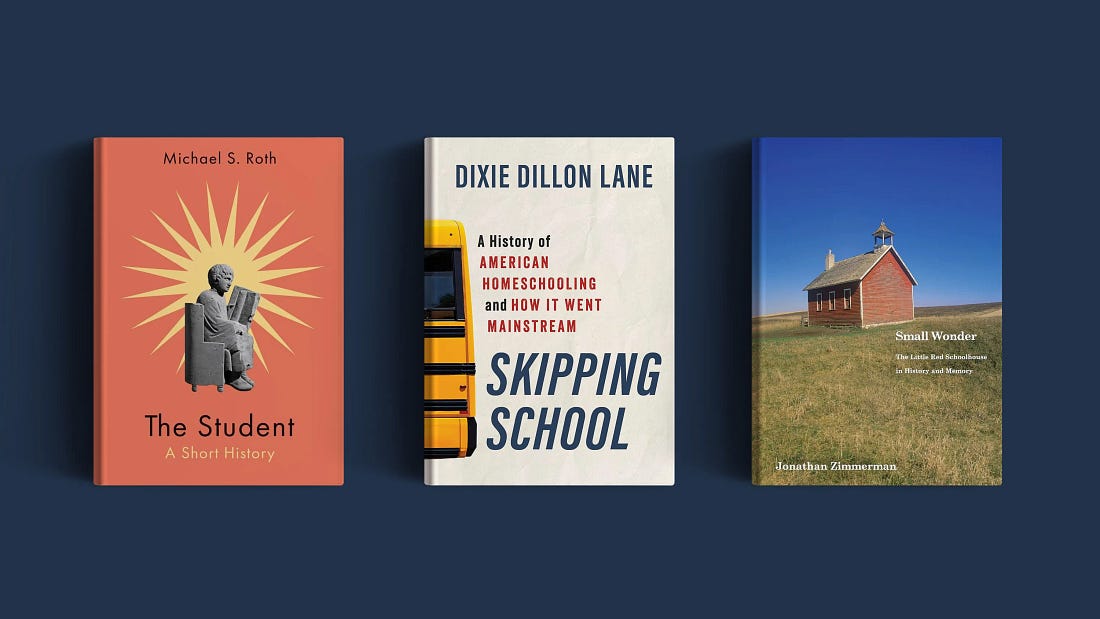 |
Three Books on History
Dixie Dillon Lane, Skipping School: A History of Homeschooling and How it Went Mainstream (Eerdmans, 2026)
Currently, more than 5 percent of kids in the United States are homeschooled, including some of historian Dixie Dillon Lane’s own children. In Skipping School, Lane traces the homeschooling movement from its “hidden” roots—driven largely by fear of government education reforms during the Cold War—to its status as a “lasting, representative fixture of the American educational landscape.”
According to Lane, homeschoolers are motivated by a strong libertarian streak regarding their children’s education. She argues that, after World War II, Americans chose homeschooling mainly because they rejected the idea that the state should override parental control in education. This libertarian impulse—rather than reactions to public school desegregation or a desire for religious indoctrination—has been the main driver.
Today, Lane notes, homeschooling cuts across class, religion, and race (with the movement surging among African Americans since the COVID-19 pandemic). She writes, “When a parent both understands himself as a homeschooler and retains dominant influence over the child’s day-to-day schooling, this is homeschooling.”
Skipping School blends history, sociology, and memoir. At times the book reads like an accessible treatment of the homeschooling movement since 1950, and at other times like an apology for this approach to K–12 education. But Lane’s professed goal is to write a history that homeschoolers themselves will recognize—and in that, she succeeds.
Michael S. Roth, The Student: A Short History (Yale University Press, 2023)
“There are many ways to be a student,” Michael Roth writes, “but at their core, this book argues, is developing the capacity to think for oneself by learning from others. The student learns to be more free.”
Roth, the president of Wesleyan University, one of the United States’ premier liberal arts colleges, traces the history of the student from Confucius to the present, but much of his understanding of learning centers on the 18th-century philosopher Immanuel Kant, who said that education is “freedom from self-imposed immaturity.” Education, Roth suggests, is not about “being trai