




MAGA may be rallying behind Andrew and Tristan Tate, but the White House isn’t interested in spending political capital on protecting the manosphere sex pests from rape charges in the UK. Asked yesterday whether the White House would block the brothers’ extradition, Press Secretary Karoline Leavitt was terse: “No. We’ve already answered that question.”
Some housekeeping: You may have noticed that Morning Shots looks a little different today. This is part of a wider refresh for The Bulwark that we’re excited to share with you today. We hope you like what you see, but as with all home renovations, there’s always a punch list. Happy Friday.
Join JVL and special guest Paul Krugman for Receipts Live at 12:30 p.m. EDT today on Substack and YouTube.
 |
Cancel Culture at the Pentagon
by William Kristol
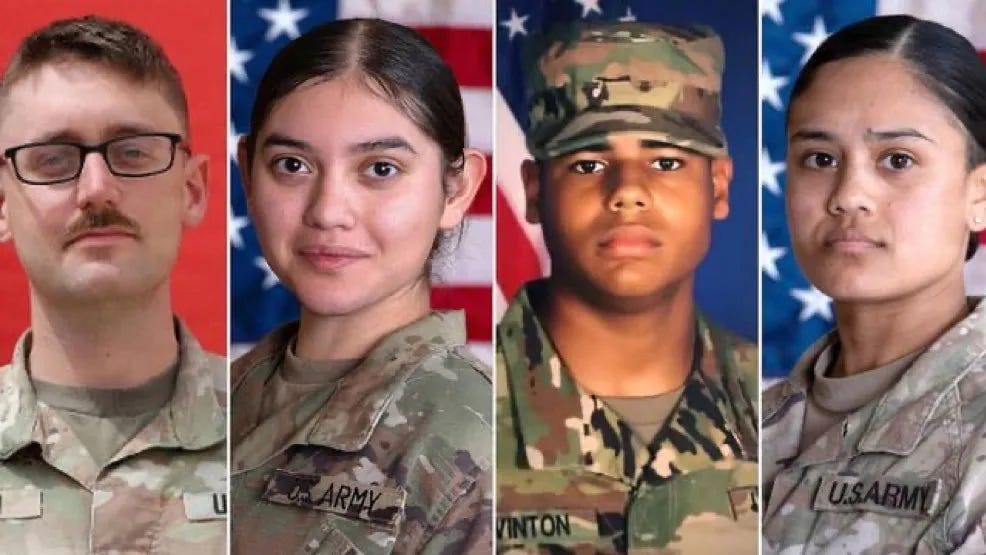
1st Lt. Tyler James Feehan, 25, of Hawaii.
Pvt. Isabella Gonzales, 19, of Texas.
Sgt. Angel Rampersad, 28, of New York.
Sgt. Michael Emmanuel Swinton, 30, of North Carolina.
These soldiers died in the past week in the war against Iran. Lt. Feehan, Sgt. Rampersad, and Pvt. Gonzales were killed by an Iranian ballistic missile attack in Jordan. Sgt. Swinton died as a result of the demolition of an Iranian drone in Iraq. Their service to our nation should be honored. It certainly should not be erased.
But Donald Trump’s Defense Department has tried to erase these four service members from its official list of Iran war casualties.
As the New York Times reported last night, on Wednesday, the Pentagon’s casualties website listed eighteen service members who had been killed during the war with Iran. By Thursday, the Defense Department had lowered that number to fourteen—apparently excluding Lt. Feehan, Pvt. Gonzales, Sgt. Rampersand, and Sgt. Swinton.
 |
Three military officials told the Times that “one reason behind the change was that the Trump administration decided to remove four service members killed this past weekend from the list—three in Jordan and one in northern Iraq—because their deaths occurred after President Trump declared a cease-fire in the war in April.”
Trump’s Defense Department responded to the Times report on Thursday evening by claiming that the change was due to “temporary data disruptions” and that “these site anomalies are currently being resolved in coordination with the Military Services.”
But as I write on Friday morning, the “anomalies” haven’t been “resolved.” The Pentagon’s Defense Casualty Analysis System website still lists only fourteen deaths as a result of the Iran conflict—even though the Pentagon’s press release earlier in the week in connection with the dignified transfer of the four soldiers’ remains stated, “The deaths are related to Iranian aggression.”
But the administration, from the president on down, has been preoccupied with trying to downplay the costs of Trump’s war. The president has been regularly posting and talking about how many fewer casualties there have been compared to prior conflicts. And he has gone out of his way to call the war an “excursion” or a “skirmish.”
And the administration does have a particular interest in pretending these latest deaths aren’t somehow part of the Iran war. At his appearance Tuesday before the Senate Appropriations Committee, Hegseth was once again challenged about the lack of congressional authorization for the war. Then on Thursday, there were votes in both the House and Senate on war powers resolutions. One of many disingenuous arguments the Trump administration made to try to beat back demands for congressional authorization was that the clock for requiring congressional approval should restart after pauses in the war. The claim that these four soldiers’ deaths can’t be attributed to Trump’s Operation Epic Fury because they happened after the collapse of the ceasefire is part of the effort to avoid congressional accountability.
But it is also, of course, part of a broader phenomenon. As retired Army Lt. Gen. Ben Hodges told the Times, “The administration seems to have a real hard time being honest about what is going on—not just about casualties, but about the whole war in general.” And about much else besides.
The erasure of the deaths of Lt. Feehan, Pvt. Gonzales, Sgt. Rampersand, and Sgt. Swinton is only one of many, many instances of the dishonesty of the Trump administration—though it’s an extraordinarily petty and a strikingly callous one. It goes without saying that the administration’s dishonesty cannot diminish the honor due to these soldiers. But it does stain the honor of our country.
Do We Have a Deal?
by Andrew Egger
On Wednesday, the landmark nuclear agreement permitting Saudi Arabia to develop a civilian nuclear program with American uranium looked like a done deal: agreed to, signed, and announced with great fanfare by both nations. One day later, Trump threw the whole thing into confusion with—what else?—a post on Truth Social. The deal, he now said, would be “totally subject to Saudi Arabia joining the very respected and successful Abraham Accords.” In other words: No deal unless Saudi Arabia agrees to diplomatically recognize Israel. Why sandbag the Saudis with this extra demand after the agreement was signed, rather than as part of the negotiating process? Who knows? Art of the deal, baby!
Whatever the reason, the White House insists—for now—that Trump’s eleventh-hour concern is official U.S. policy. What U.S. negotiators said until now matters little, White House Press Secretary Karoline Leavitt told reporters yesterday: Trump alone is the “final dealmaker.” “If they don’t join the Abraham Accords,” Leavitt said, “the deal is off.”
What happens next is far from clear. The Saudis have not publicly tipped their hand, although one Saudi source suggested to veteran foreign policy reporter Laura Rozen that they may try to stare Trump down: A deal “was signed, so nothing to renegotiate,” the source said. “Tweets don’t overturn signed agreements.” (I’m sorry: Have they met this guy?)
Trump has never been shy during his presidency about ripping up other people’s deals—NAFTA, say, or the JCPOA. Lately, though, the deals he’s ripping up have been his own. The same thing happened last month with Iran: The ink was barely dry on the memorandum of understanding before he was assuring his hawkish critics that the U.S. would hold Iran to stricter concessions than Iran had actually agreed to. It didn’t matter that Iran hadn’t agreed to permanently dismantle its nuclear program, Trump insisted: “If it’s not, we will bomb them. . . . We’re going to bomb the hell out of you.”
This shouldn’t come as a surprise, exactly. Dating all the way back to his pre-political business career, Trump has never seen his word as his bond; contracts and agreements, to him, aren’t so much mutually binding pledges as momentary branding exercises intended to get a little leverage. An ordinary negotiator gets the best deal he can, then goes home and tries to sell the deal to the public; Trump, b