




 |
A COUPLE OF MONTHS BACK, I highlighted the strange reaction to Christopher Nolan’s then-upcoming film, The Odyssey, in certain portions of the conservative media ecosystem. Particularly among the grifter set on Twitter, where Elon Musk had whipped people into a fury over the casting of Lupita Nyong’o as Helen of Troy (because Helen of Troy couldn’t possibly be black and to suggest otherwise is a betrayal of Western civilization) and Elliot Page as a Greek soldier (because a trans actor couldn’t possibly play a Greek soldier).
I was fascinated by this story because it combined so many of my different interests: social media as a vector for disinformation, as chuds insisted that Page was playing Achilles even though no one associated with the production had suggested anything of the sort; conservatives turning against Christopher Nolan, who had long been seen on the right as, if not a fellow traveler, at least sympathetic to classically liberal/Tory-ish ideals; and amateur box office sleuths predicting disaster in the face of all evidence that Nolan and his studio, Universal, had a triumph on their hands via massive presales.
But the reason they felt so confident attacking Nolan was, ultimately, because they fundamentally misread the effect of previous outrage campaigns against major motion picture releases. They looked at the outrage directed at 2022’s Lightyear (because the film featured a brief lesbian kiss), last year’s Snow White (because the actress playing Snow White is Hispanic and had said she didn’t much care for the original), and this year’s Supergirl (because the lead actress said male audiences have a problem with strong superheroines), and concluded that those films all failed because loud people were angry on Twitter.
This impulse is, perhaps, understandable. It was also, quite obviously, incomplete. I think it’s safe to say that those movies failed because they were movies that nobody wanted, really. Lightyear was a weird digression from the Toy Story franchise featuring none of the previous films’ voice actors that was too complicated to explain to audiences in a one-sentence pitch. The original Snow White (1937) is too old to hit the nostalgia sweet spot, where parents take kids to see the live-action versions of movies that they themselves grew up with (like Aladdin or Beauty and the Beast). And no one is interested in Supergirl because outside of a handful of big names (like Superman or, as we’ll see next week, Spider-Man), the superhero boom seems to be over.
I’m bringing this back up not to take a victory lap—though I will do that in a second—but as a reminder that we all live in bubbles that we’ve built for ourselves on social media and elsewhere. And the Odyssey bubble on Twitter was exacerbated by the fact that someone at the site must have juiced the algorithm to highlight content about the film: Anecdotally, everything I tweet about the movie does huge numbers. These people were absolutely convinced that The Odyssey was going to bomb, that they were going to claim a great triumph for Western civilization by waging war on the forces of woke. They were blinded by a number of very obvious signals that this movie was going to put up numbers, like near-record presales.
And here’s where the victory lap comes in: In its first six days of release, The Odyssey has grossed nearly $200 million domestically. It’s running roughly 60 percent ahead of Oppenheimer at the same point, a gap that suggests this film will gross in the neighborhood of $500 million domestically and could make a run at $600 million. This means that, with the worldwide grosses included, the film will likely earn well over a billion dollars, in the range of $1.2–$1.4 billion. This means that it will handily make money for Universal, which reportedly spent about $375 million on production and advertising. Even if you assume theaters are keeping half of the take, that means that the film “only” needs to gross $750 million or so worldwide to edge into the black … and I don’t think any serious observer thinks it won’t get there. Elon Musk and his chud brigade have been soundly defeated.
The lesson, as always, is this: Twitter is not real life, and we should all keep in mind the bubbles we live in and what they blind us to.
One of the things we try to do here at The Bulwark is poke holes in bubbles. Right now we’ve got a deal going: New subscribers get fourteen days for free. That’s two weeks of bubble-busting. Sign up and hang out in the comments section with the rest of the cool kids:
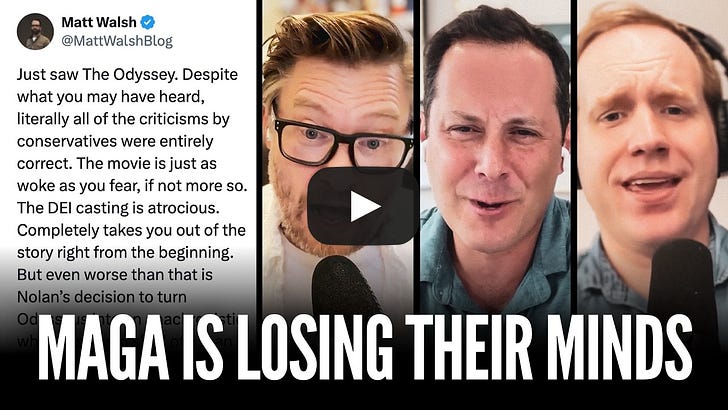
I could’ve talked about this Odyssey nonsense on a thousand podcasts; I just love the story so much. But I’ll limit myself to linking to the video on the topic I did with Sam Stein and Will Sommer. It’s a fun one; I think you’ll enjoy it.
SPEAKING OF FUN PODCASTS, I had Nate Jones from Vulture on to discuss his new feature ranking the hundred most powerful directors. Check it out and leave your picks in the comments!
