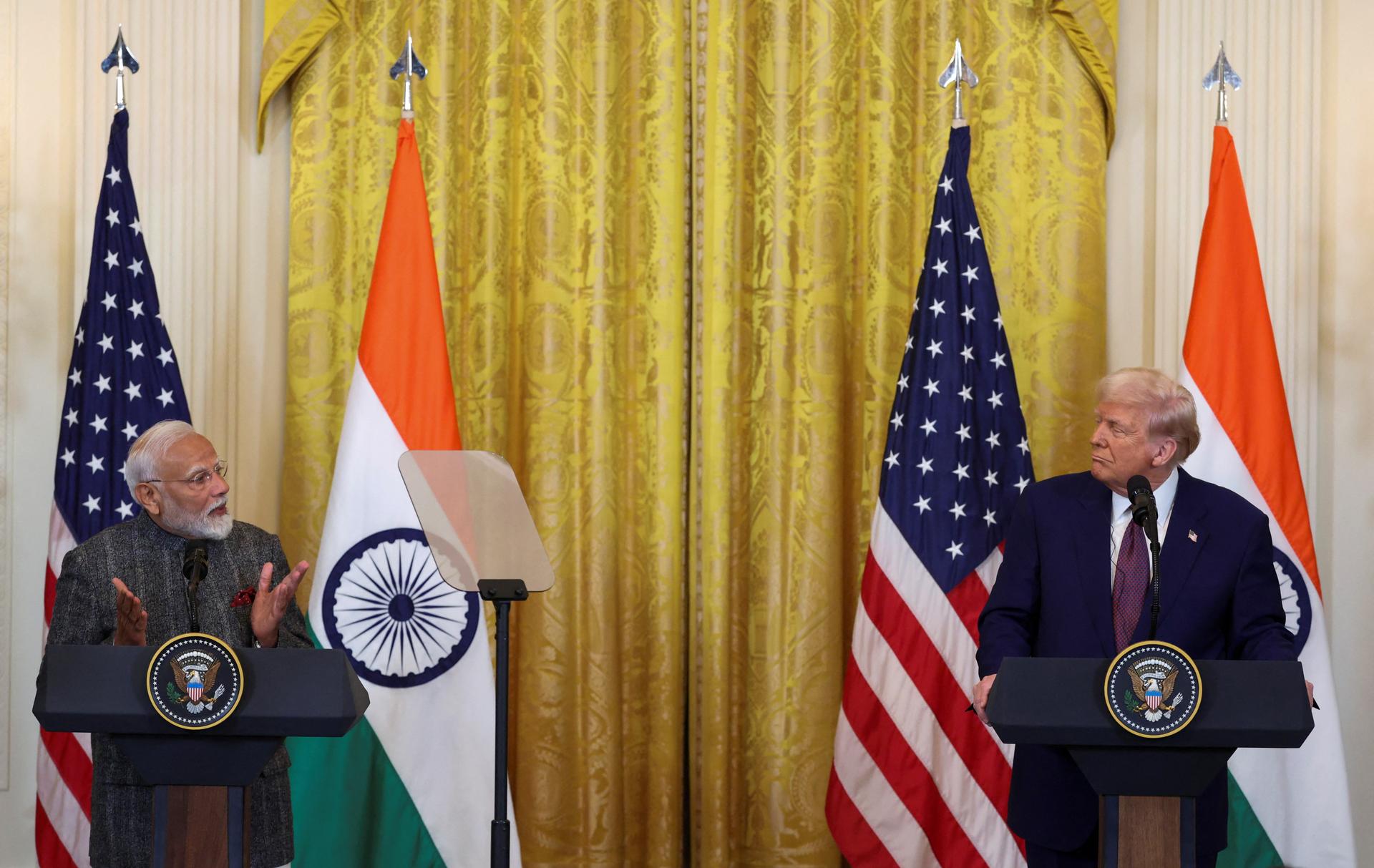
In this month’s newsletter, Council on Foreign Relations (CFR) experts explored the growing global artificial intelligence (AI) race, Indian foreign policy, and rising authoritarianism in Asia, as well as China’s economic challenges and its growing global investment in ports, airports, and other infrastructure, among other topics. |
|
|
|
India’s Balancing Between China and the United States |
|
|
|
On an episode of the CFR podcast The President’s Inbox, Senior Fellow for India, Pakistan, and South Asia Sadanand Dhume discusses the deep current strains in the U.S.-India relationship. He also examines why tariffs, security concerns, and a détente with China have reframed the importance of the U.S.-India relationship, and what it could take to put it back on track. Hear more
|
In an article for CFR.org, Kurlantzick argues that the Iran war has provided such a massive shock to Asian economies that it could finally get them to transition toward more balanced energy mixes. He warns, however, that inertia, political obstacles, and the lack of regional coordination stand in the way. Get the full take
|
In a column for the Wall Street Journal, Dhume argues that the intense global AI race is pushing India closer to the West, even as it has built friendlier ties overall with China in recent months. Read on |
In a column for the Wall Street Journal, Dhume argues that India’s wide range of quotas in higher education, job markets, and other areas is holding back the Indian economy, especially compared to China, which functions as more of a meritocracy. Get the full take |
In an op-ed for the Financial Times, Senior Fellow Manjari Chatterjee Miller argues that actions taken by the Trump White House have revived the idea of nonalignment, a term common during the Cold War. She contends that “nonalignment, or ‘strategic autonomy’ in today’s parlance, calls for countries to put their own interests above great-power politics and refuse to take sides,” and that the White House’s own transactional politics have led other countries to act similarly. Read her entire article
|
|
|
|
In a chapter in the new Johns Hopkins University Press edited volume Geopolitics of AI: Power, Conflict, and the Future of Global Order, Ira A. Lipman Chair in Emerging Technologies and National Security and Director of the Digital and Cyberspace Policy Program Adam Segal argues that the AI race has been driven more by the private sector than many other periods of intense competition over new technologies, and particularly by a small number of private-sector firms. That concentration, he notes, makes the current AI arms race unnecessarily unstable and dangerous. Read his chapter
|
The Rising Strength of Autocracy in Asia—and Beyond |
In an article for CFR.org, Senior Fellow for Southeast Asia and South Asia Joshua Kurlantzick argues that, five years after its generals seized power, Myanmar has collapsed into Asia’s deadliest war and a nearly unequaled humanitarian catastrophe—with the Myanmar military winning now because of support from a network of authoritarians including Belarus, China, Iran, Russia, and others. And yet, the rest of the world has decided to ignore the horrific conflict amid other major geopolitical developments. Get his take
|
In an article originally written for World Politics Review, Kurlantzick examines the detention of U.S. citizen Min Zin on dubious espionage charges, after he was invited to a conference in China and then vanished. He also argues that this is just the latest evidence that Beijing’s campaign to silence dissidents and critics abroad is expanding in scope and audacity. Without a forceful U.S. response, which has not been forthcoming regarding Min Zin, China’s willingness to target academics, activists, and diaspora communities on foreign soil will likely grow. Learn more or read a Chinese translation
|
|
|
|
China’s Investments in Critical Global Infrastructure
|
|
|
|
As part of her series of trackers on Chinese global investment in infrastructure, Maurice R. Greenberg Senior Fellow for China Studies Zongyuan Zoe Liu released the latest version of her interactive map tracking China’s growing maritime influence through investments in strategic overseas ports. Users can plot each port’s location and view satellite images alongside detailed information on the share of Chinese ownership, the total amount of Chinese investment, and the port’s suitability for Chinese military use. See the interactive
|
Liu also released updates to her interactive map that tracks China’s growing network of investments in overseas airports. Users can plot the location of each airport and view satellite images alongside detailed information on which Chinese entities are involved in each project, the share of Chinese ownership (if any), the total dollar value of Chinese investment, and the physical attributes of the runways. View the airport interactive
|
Liu published a new version of her interactive map examining China’s global economic expansion through investments in overseas industrial parks. Users can plot the location of each industrial park and view detailed information about the type of economic activity, the specific Chinese investors involved, and the proximity to strategic Chinese investments in ports and airports. View the interactive
|
|
| |
China’s Economic Challenges |
In a joint post for CFR.org with Brian Peters, a former risk manager and supervision officer at the Federal Reserve Bank of New York, Whitney Shepardson Senior Fellow Brad W. Setser argues that China’s customs–balance-of-payment (BOP) gap, which is bigger than previously reported, is a further sign that the country’s current account surplus is far larger than its reported $735 billion. Get their take
|
In an article for CFR.org, Setser argues that China’s recent release of what was supposed to be clearer and more detailed information on its BOP data is not much of an improvement at all, leaving China’s economic statistics basically as opaque as before. Read on |
|
|
|
In an article for the Economist, C.V. Starr Senior Fellow for Asia Studies and Director of the China Strategy Initiative Rush Doshi contends that scale “has always mattered in the rise and fall of great powers. Once countries reach similar levels of economic productivity, those with larger populations and continental size eventually surge ahead.” Now, however, he writes, China will surpass the U.S. in scale, which will create a daunting geopolitical challenge. Read the full article
|
|
|
|
- Bollywood Just Surrendered to Censorship. Hollywood Could Be Next (Vox, Sadanand Dhume)
-
Indian Filmmakers Fear Rising Censorship as Film Is Blocked (Bloomberg, Sadanand Dhume)
-
Modi Has Few Good Options to Quell India’s “Cockroach” Protests (Bloomberg, Sadanand Dhume)
-
U.S.-China Trade War Reaches India’s Streets as Modi Weighs Risks of Washington Bet (South China Morning Post, Sadanand Dhume)
-
Not So Strait-Forward: Hormuz, Iran, and the Future of Gulf Oil and Gas Flows (CFR.org, Clara Gillispie)
-
Hormuz Reopening Faces Costly Hurdles (Bloomberg, Clara Gillispie)
-
Iran War Spurs Jump in Coal, Energy Markets (Bloomberg, Clara Gillispie)
-
A Tale of Two Speeches: As Trump Relitigates the Past, Xi Paints a Future Led by China (NBC News, Joshua Kurlantzick)
-
ASEAN Flexes “Convening Power” on South China Sea and Other Issues (Nikkei Asia, Joshua Kurlantzick)
-
China Has Become More Popular Than U.S. in Much of World, Survey Finds (Washington Post, Joshua Kurlantzick)
-
China’s Strategic Interests in Myanmar Behind U.S. Citizen Arrest: Sources (Newsweek, Joshua Kurlantzick)
-
Duterte’s Impeachment Trial Begins (World Politics Review, Joshua Kurlantzick)
-
Philippines Impeachment Trial Deepens a Dynasty War (GZero Media, Joshua Kurlantzick)
-
Trump Declassifies Documents to Fuel Claims of China’s Interference in 2020 Election (NBC News, Joshua Kurlantzick)
-
Trump’s Election Security Claims Threaten China Truce, Raise Questions Over Xi’s U.S. Trip (NBC News, Joshua Kurlantzick)
-
Are “Middle Power” Countries Having a Moment? (WBUR, Manjari Chatterjee Miller)
-
“Even Politburo Members Can Be Touched”: What the Latest Purge Says About Xi Jinping’s China (The Guardian, Joseph Torigian)
-
How Xi Jinping Steamrolls Dissent With Tactics From Stalin and Mao (Wall Street Journal, Joseph Torigian)
-
Purge Shows That Xi Is Struggling to Find a Successor He Trusts
- (The Times [UK], Joseph Torigian)
-
What Americans Need to Understand About China (New York Times, Joseph Torigian)
-
What China’s Latest Power Purge Tells You About Xi Jinping (in Spanish) (El Confidencial, Joseph Torigian)
|
|
|
|
|