





 |
St. Helena Island, South Carolina
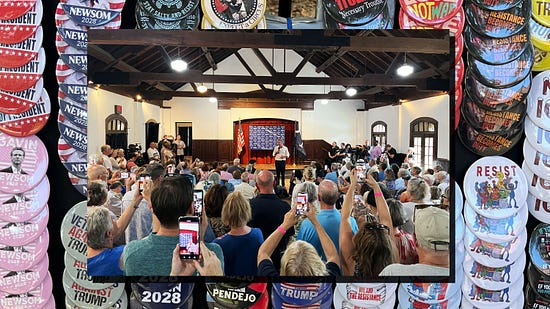
BY THE TIME GAVIN NEWSOM stepped onto the Penn Center’s campus on Thursday afternoon, there was hardly any standing room left. Not even the lack of air conditioning in the sweltering heat of South Carolina’s Lowcountry was enough to deter hundreds of Democratic voters from gathering.
They had come to hear from the flashy Democratic governor with Pacific Coast sensibilities who was venturing out east to, ostensibly, help the party make inroads in states like theirs—but who understood, as they did, the new responsibility the Palmetto State had as the first in the calendar to select a 2028 presidential nominee.
The Penn Center was a symbolic spot for such a stop. To get there requires a pilgrimage through history. Situated along a street shaded by oak trees and Spanish moss, the original Penn School was built during Reconstruction to educate freedmen and women. Renamed the Penn Center in 1950, it served as a meeting site for Martin Luther King Jr. and the Southern Christian Leadership Conference. To reach it, you drive past both weathered plantation-style houses and Gullah Geechee restaurants—a contrast that nods to the region’s complicated past. And you have to understand that past if you want to reach the voters here.
The prize for that could very well be the presidential nomination. Because this coming cycle, black voters in the South will have an outsized impact. David Plouffe, Barack Obama’s 2008 campaign manager, recently laid out the case in an op-ed, pointing to South Carolina’s prominence and Virginia’s new slot early in the calendar. “A candidate who wins the Black vote in South Carolina, navigates the rest of the early states respectably and wins the demographic again in Virginia will be close to inevitable,” he wrote.
Newsom’s visit here was a recognition of that reality. And it was an early attempt to communicate that he understands the complexities of the South.
But it also showed how difficult it will be to bridge those significant cultural gaps. Those who came to see Newsom were largely retirees—many of whom told me they were transplants from New York or New Jersey. They wore sundresses and golf polos emblazoned with logos from nearby resort communities. They knowingly nodded their heads when Newsom joked about how he’d self-medicated in the early days of the second Trump administration by binge-watching Rachel Maddow. They smiled in agreement when he mentioned his love of Ken Burns. And they gushed over former CNN anchor turned independent media star Don Lemon when he and his entourage strutted through the door.¹
These voters matter, of course. They’re another bedrock of the Democratic coalition. That Newsom could draw so many of them out on an oppressive summer day in the South underscores his early frontrunner status. He’s charismatic, able to get attention, and can raise money. He’s positioned himself as a political brawler in an era where Democratic voters are desperate for one. And his successful redistricting effort—which very well could be what delivers Democrats the House in November—has earned him an enormous amount of goodwill within the party.
But in conversations with South Carolina Democratic officials and operatives, the tone around Newsom was
Ideally, this would be the part where you simply kept reading. Less ideally—but more sustainably—this is the part where we ask you to help us keep doing our work by joining Bulwark+.


