|
 |


Here are some of the top legal stories we’ll be watching for this week:
The Boston Cases Challenging Trump’s EO on Mail Voting
Today, Sunday, the Justice Department asked the Supreme Court to stay Judge Talwani’s order, which blocks it from implementing new Postal Service rules just in time to deliver mass chaos for the midterm elections. Those orders are currently on appeal to the First Circuit, but apparently, they haven’t blessed the White House’s efforts quickly enough for Donald Trump—they’ve asked for briefs on the stay from the parties on Monday and Tuesday—so his Solicitor General went straight to the Court, where he “respectfully requests an immediate administrative stay of the order to prevent ongoing irreparable injury while this application is pending.”
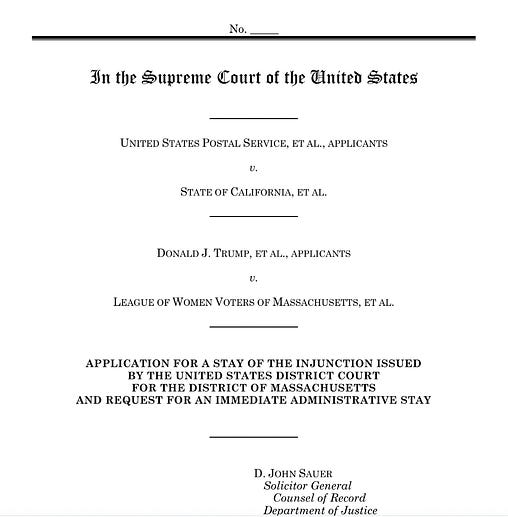 |
The Solicitor General, John Sauer, references his earlier win in the Court on this matter, which was due, explicitly, to the Court’s view that the issue wasn’t yet ripe for a decision because the government hadn’t yet issued rules for the Postal Service to implement Trump’s EO. Now it has, but the Solicitor General is still trying to bootstrap himself to the win on the ripeness issue, writing to the Court, “the preliminary injunction [that Judge Talwani issued now that the Postal rule is public] is materially identical to the temporary restraining order, both in its substantive scope and its minimal, conclusory reasoning … The district court’s continuing prejudgment of the rule is baseless, and an immediate stay is warranted because ‘the District Court’s errors deal ‘a serious setback’ to the Executive’s ‘goals’ while this litigation unfolds.’”
Hoping that the Court is willing to accept any characterization he offers them, no matter how patently untrue, Sauer argues, “Contrary to the claims of the district court and respondents that the Postal Service is trying to federalize the rules for mail-in voting … the Postal Service’s final rule imposes only modest envelope-design and addressee-information requirements for federal-election ballots.” Sure, Jan. He also argues to the Court, “The Rule thus plainly does not seize control of States’ administration of elections—it simply imposes reasonable preparation requirements for certain election-related mail.” We know that there are at least two Justices who are likely ready to side with the government on this one. The question is whether there are five votes to keep control and oversight of elections where the Founding Fathers put them, in the hands of the states, and for precisely such an instance as this, given that the Federalist Papers are rife with explanation of the risk of centralizing too much power in the hands of the executive branch.
Judge Talwani’s preliminary injunction was modest in scope, addressing only the midterm elections and not precluding states that wanted to from voluntarily turning over control of their own elections to Donald Trump. It is narrowly tailored to address the legal issues before the Court, and normally, we would expect it to be affirmed. Of course, this is not “normally.”
The case has now expanded beyond technical ripeness to consider whether the government’s plan could work. One issue raised in the appeal to the First Circuit is whether states have time to comply with the new rules, given how close to election day they are coming online. In a piece for Democracy Docket, Yunior Rivas writes that “DOJ argued that states facing the earliest deadlines for mailing ballots have not shown compliance is impossible. It pointed to North Carolina’s statement that absentee ballots would go out ‘flawlessly and smoothly,’ and noted that Alabama, Florida, Indiana, Oklahoma and South Dakota have not argued they cannot comply.” But Judge Talwani, in her opinion, found that:
“Now, 60 days before the November 3, 2026 midterms, the Final Rule would require 10,000 different election jurisdictions to conform to new ballot design requirements (requiring many to re-design their ballots), have a wave of new designs undergo Mail Design Analyst review … print new designs from their vendors typically ranging from four to sixteen weeks in lead time)…and then, contingent on technological capabilities, collate and submit voter information to a portal that does not yet exist and has not been proven to work.”
Judge Talwani wrote that she was “mindful of the fact that any minor malfunction will result in the denial of mail ballots” and concluded that “disenfranchisement for Plaintiff Organizations’ members, regardless of residence, is practically inevitable.”
In a separate case before the District of Columbia Circuit, League of Women Voters v. DHS, the court ruled that the government may not use its SAVE database for mass voter purges ahead of the midterm elections, writing “The public interest does not favor interim restoration of a system the government has not made a strong showing it may lawfully operate.” The court denied a stay of the lower court’s order and expedited the case, giving the parties 10 days from September 4 to agree upon a schedule for the appeal.
Leon Black Tries to Avoid His Subpoena
Leon Black, the American billionaire private equity investor whose name shows up in the Epstein files, doesn’t want to talk with Congress about it. Black, who was Epstein’s single largest investor—according to information released by Senator Ron Wyden in connection with work done by the Senate Finance Committee, Black paid Jeffrey Epstein between $158 million and $180 million, although Epstein wasn’t exactly a top flight investment advisor. Epstein used the money to fund his operations in the Virgin Islands. According to Wyden, Black paid $62 million as part of a settlement he reached with the Attorney General for the Virgin Islands to “obtain criminal immunity from Epstein matters not just for himself, but also for his attorneys and individuals acting as his agents.”
In other words, there is every reason for a Congressional Committee interested in conducting a thorough investigation to want to question him. In June, Black walked out of voluntary testimony he had agreed to give the Committee, when he was asked to answer questions about nondisclosure agreements. Black was subpoenaed to testify last Thursday. But Black decided to duck, filing a lawsuit instead of showing up to testify.