
|
 |
Here are the facts:
In 2021, 34,594 people subscribed to Popular Information after organically seeing our reporting on Google, Facebook, and Twitter (now X).
We are more than two-thirds of the way through 2026, and just 1153 people have subscribed to Popular Information from those same platforms.
Our work is better than it was five years ago. (We were recently awarded the David Nyhan Prize for Public Policy Journalism by Harvard’s Shorenstein Center.)
But the billionaires who control Google, Facebook, and X have made the decision to choke off traffic to independent outlets like Popular Information. They are not interested in building an audience for stories like the one you are about to read.
This means that in order to survive, we need to decouple our success from the whims of tech oligarchs. That will require investing in new ways to spread the word about our journalism.
To do this, we need your help. If just a small percentage of free subscribers like you upgrade to a paid subscription ($50/year or $6/month), we can expand our reach and magnify our impact.
Thank you for your readership and consideration.
— Judd
Corporate mercenary is a bipartisan profession
The AI industry tapped Jay Carney to rebuild ties with Democrats. He spent years at Amazon fighting AI regulation.
| |||||||||||||||


 |
The AI industry has placed a huge bet on President Donald Trump and the Republican Party. For example, in the 2026 cycle alone, AI executives and corporations have donated $42 million to MAGA Inc., Trump’s super PAC.
But the political winds may be changing. Trump’s popularity is near an all-time low. Republicans could lose control of one or both chambers of Congress in November’s midterm elections.
This all comes at a time when the public is increasingly concerned about the safety of frontier AI models, data center construction, and the impact of AI on their jobs. AI companies are looking to the federal government for help.
In a essay this month, Anthropic CEO Dario Amodei called for “regulation that targets all US frontier AI companies.” While this is framed around an altruistic concern about safety, Amodei acknowledged that government regulation would allow AI incumbents to coordinate their activities while avoiding “antitrust” issues. Amodei’s letter was endorsed by the two other biggest AI players, OpenAI CEO Sam Altman and xAI CEO Elon Musk.
Trump, however, immediately rejected the idea. “The only control or ‘guardrails’ that AI needs is a STRONG AND SMART (High IQ!) PRESIDENT, and the U.S.A. has that, in spades!” Trump wrote on Truth Social.
According to reports, the AI industry may now be hedging its bets.
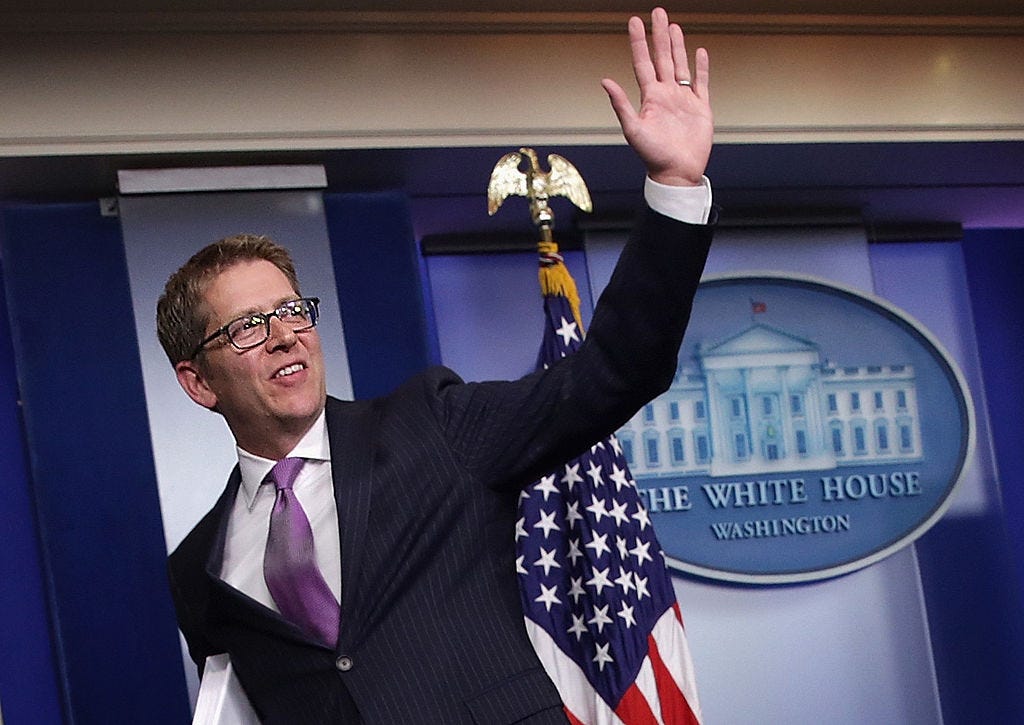
According to Politico, Jay Carney, who served as White House press secretary during the Obama administration, has been tapped “to run a new initiative aimed at shaping national AI policy.” Carney has been hired by SV Angel, an investment firm led by Ron Conway, a major Democratic donor.
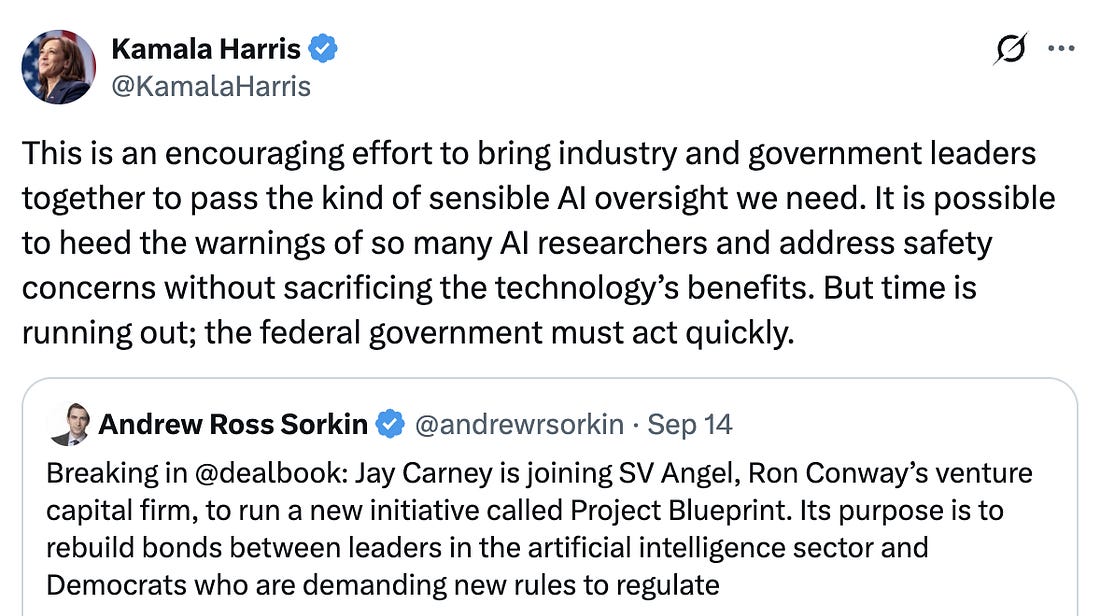
The new initiative is called “Project Blueprint,” which the New York Times reports is an effort to “rebuild bonds between leaders in the artificial intelligence sector and Democrats who are demanding new rules to regulate the technology.”
On X, former Vice President Kamala Harris called Carney’s hiring an “encouraging effort to bring industry and government leaders together.”
 |
It is unclear who should be encouraged by Carney’s new role. While Carney worked for a Democratic administration, he abandoned public service more than a dozen years ago.
After leaving the Obama administration, Carney spent seven years as a hired gun for Amazon, where he reported directly to Jeff Bezos. (His official title was Senior Vice President, Global Corporate Affairs.) In that role, Carney fought against government efforts to protect privacy and regulate AI.
A 2021 Reuters article describes Carney as the “architect of [an] under-the-radar campaign to smother privacy protections.” Internal documents obtained by Reuters revealed that Carney’s “mission included defeating restrictions on artificial intelligence and biometric technologies, along with blocking efforts to make companies disclose the data they keep on consumers.”
A memo reviewed by Reuters said that such restrictions could “impede growth for [Amazon’s] Alexa-powered devices.” It celebrated Carney’s role in “killing or amending privacy bills in ‘over 20 states.’”
Early in his tenure, Carney’s team targeted “a Washington state bill to regulate biometrics, including voice recordings, fingerprints and face scans.” The bill eventually passed “but only after lobbyists for Amazon and other firms had chiseled away at its privacy protections by convincing lawmakers to insert alternative language, often verbatim.” Among other concessions, voice recordings were exempted, sparing Amazon’s Alexa voice assistant from regulation. In an internal document, Amazon celebrated that the revised legislation “would have ‘little, if any, direct impact on Amazon’s practices.’”
After joining the company, Carney criticized Amazon’s lobbying efforts as “frugal” and “narrow.” Under Carney’s leadership, by 2020, “Amazon had registered at least 180 lobbyists in 44 U.S. states, up from at least 62 lobbyists in 27 states in 2014, the year before Carney arrived.”
At Amazon, Carney expanded a program called “Watering the flowers.” According to a 2019 CNBC report, “The flowers represent elected officials, and the goal is to create a well-tended ‘garden’ of pro-Amazon policymakers, from state governors and senators down to local officials and economic development teams.”
In a 2025 interview, Carney said in his corporate roles he spent “a lot of time thinking