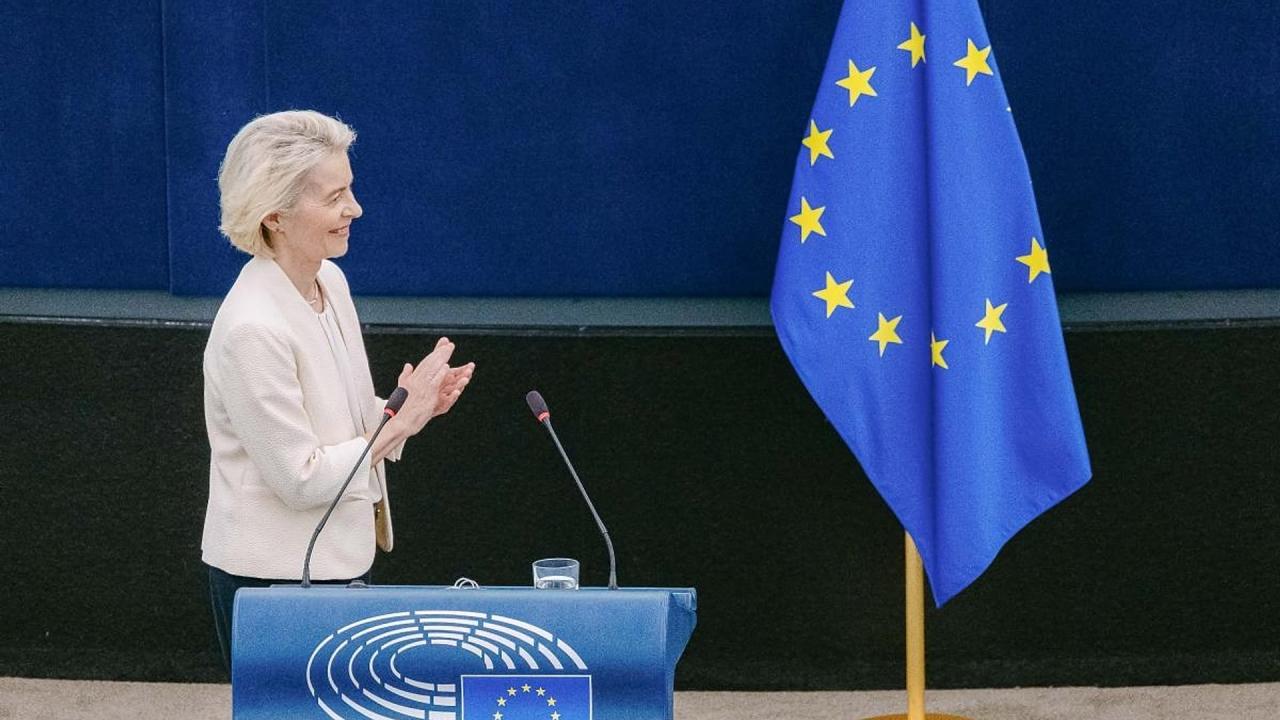
Good morning. This is Vincenzo Genovese writing from the corridors of the European Parliament in Strasbourg, which are slowly filling up ahead of Canadian Prime Minister Mark Carney’s highly-anticipated speech at 11.30.
Expectations are high after European Commission President Ursula von der Leyen on Wednesday offered to create a tailor-made status of “associate EU membership” for Canada, and pitched closer collaboration on tech, energy and defence (if you missed von der Leyen’s landmark annual speech, here are our five takeaways).
Trump strikes back: The announcement has already created ripples across the Atlantic, with US President Donald Trump overnight describing the invite as “hostile” and “laughable”, threatening “very serious tariffs” or to even “stop trading with Europe”.
It’s a nightmare scenario for Brussels. The bloc has been treading carefully in its rapprochement with Ottawa, refraining from taking sides or intervening as a negotiator in the escalating trade spat between the North American neighbours.
Carney’s dash to the UK: Carney returned to Strasbourg late last night after a quick dash to the north of England where he met UK Prime Minister Andy Burnham in Manchester. Both leaders held bilateral talks at the home of Everton football club, which they both support.
Burnham and Carney discussed defence cooperation, with Canada formally applying to join the British-led Joint Expeditionary Force, a UK-led northern European military coalition.
Questions linger over special status: Meanwhile here in Strasbourg, questions are mounting over what “associate membership” – a status that does not yet exist – would mean in practice. Von der Leyen’s announcement is widely understood to be an aspirational political signal, but as the Irish deputy prime minister said in Strasbourg yesterday, “the devil is always in the detail”.
Several third countries are “associated” with the EU through association agreements, from the Western Balkans to Eastern Europe and the Middle East. But no country so far is an “associated member”, a definition that seems to align with Carney’s pitch for a “unique alliance” with the bloc.
Canada’s status could entail a preferential trade relationship, building on the EU-Canada trade deal known as CETA, institutional cooperation and a close defence partnership. Talks on joining EU programmes such as Erasmus+ and Horizon Europe are also ongoing, as my colleague Luca Bertuzzi reports.
The picture could come clearer after an EU-Canada summit in Montreal at the end of October, when Brussels and Ottawa are expected to put some meat on the bones. EU leaders are also expected to gather for a summit in Brussels in mid-October.
More clues could also come from Carney’s speech in the hemicycle today and from the following press conference in Strasbourg. Meanwhile, the Canadian Prime Minister met separately on Wednesday with von der Leyen and Parliament President Roberta Metsola, who gave him a steel combat helmet used by Canadian forces in France during the Second World War.
“We have so much in common,” Metsola told our EU Editor Maria Tadeo in an interview, adding that this will “absolutely” open the door for more countries to seek associate status.
“I think in the big picture (...) friends matter, and if we can do more things with our friends, then let’s do them,” Metsola said. Watch.
Lasting love: The rapprochement between Brussels and Ottawa is not just a “short-term honeymoon”, as Socialist MEP Tobias Cremer, author of a parliament report on EU-Canada cooperation, put it during a dinner with reporters in Strasbourg.
There’s no love lost, however, among parliament’s political groups over the crisis in Ceuta.
Ceuta crisis divides chamber: After a heated debate on Tuesday, the chamber is set to vote today on a resolution “on the recent hybrid attacks and instrumentalisation of migrants”, following the massive influx of 80,000 irregular migrants into the Spanish exclave last July.
Each political family put forward a different version of the text, with right-wing parties attacking the Spanish government and left-wing forces denouncing the exploitation of the crisis by the far right. The deadlock could produce the unusual situation of no resolution being adopted at all.
After all, in the European Parliament, every word matters — and political battles are not confined to the chamber.
Even an exhibition in the corridors has become a political flashpoint. “Just EUman”, a display currently on show and promoted by a conservative MEP with a pro-life association, features pictures of a fetus developing during pregnancy.
The Socialists and Democrats, the Left and the Greens/EFA have called on President Metsola to withdraw it, as they consider it to be “part of a broader anti-choice campaign”, with a “clear attempt to question access to abortion, even if this is not explicitly stated”.
|