|
iza,
Somebody asks what you got done this week.
It's Friday afternoon. You were in meetings for something close to forty hours. You answered everything inside the hour. You were on every call with your camera on. And you stand there, because you can't name one thing you finished.
You didn't have a bad week. You had a great week by the only measure anyone was taking.
Cal Newport calls this pseudo-productivity. His definition, word for word, is “the use of visible activity as the main way of approximating actual productive effort.” In plain words, your job measures how busy you look, because measuring what you actually produced is much harder. That's a design flaw in knowledge work, not a flaw in you. Output used to be countable. You could see the shoes come off the line. Then the work went into people's heads, and everyone fell back on presence: answering fast, being in the meeting, still online at six.
Your boss isn't imagining the problem, either. Microsoft surveyed leaders in 2022 and found that 85% of them said hybrid work had made it hard to feel confident their people were actually productive. Read that from the other side of the desk. When a leader can't measure the work, they start watching the person. So you answer at 9pm, and the watching feels justified, and around it goes.
Your own brain runs the same broken measurement. It can't count work it can't see, so on Friday it has nothing to weigh except how tired you are. Make the work visible to yourself first. A journal works. Here's ours.
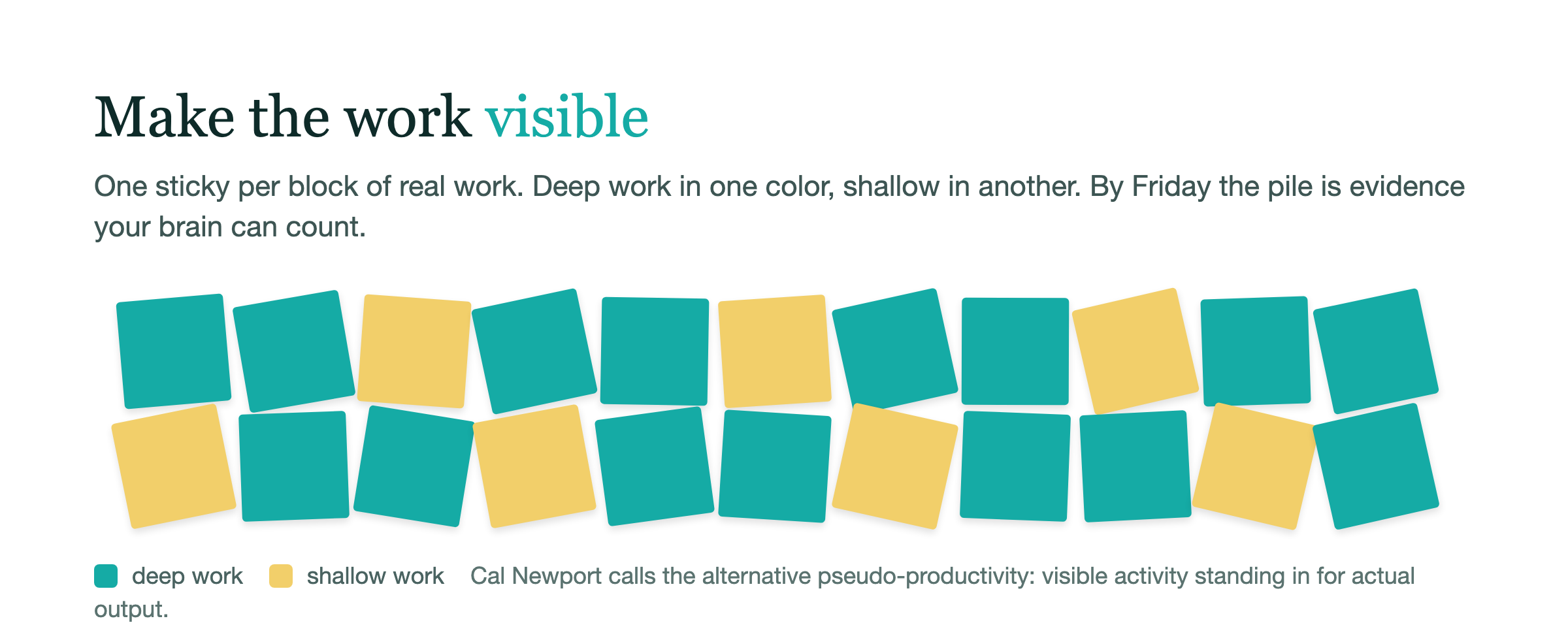
We play something we call the sticky focus game. Every block of focused work gets a sticky note on the wall before you start it. When you finish the block, the note comes off and goes in a pile. Deep work gets teal. Shallow work, the necessary admin, gets gold. That's the entire system. No app, no login, no dashboard!
By Friday you're looking at a physical record of the week. You can see at a glance how much of it mattered, because the colors tell you. Some Fridays the pile is embarrassing, mostly gold, and that's information too. Same hours as before. Now there's evidence, and your brain finally gets to count it.
One more thing about the gold pile. When Friday shows you a week that was mostly shallow, the temptation is to feel bad and promise to focus harder. Skip that. The pile is telling you something more useful: which blocks got scheduled. Deep work that never got a time slot never got a sticky, and never got done. So the fix for a gold Friday is on the calendar, before the week starts, and it takes one decision: which two mornings next week are teal, no matter what.
A pile of crumpled sticky notes did more for my sense of a week than any productivity app I've ever paid for, and I have paid for a lot of them.
So here's the experiment: THIS WEEK, PUT EVERY BLOCK OF REAL WORK ON A STICKY NOTE, AND KEEP THE PILE UNTIL FRIDAY.
I filmed the whole thing, including what the pile looks like on my desk:
Newport named the problem. Making the work visible is how you stop being part of it. |