|
|
|
|
Good morning. In today’s newsletter, we’re tracking the showdown between Ottawa and the U.S. owner of Stelco, which recently announced hundreds of layoffs despite commitments made as part of its takeover of the Canadian steelmaker. |
|
|
|
|
|
|
|
|
|
|
|
|
|
|
|
|
|
|
|
|
|
|
|
|
|
|
|
|
Travel: Vancouver airport privatization may be the first to take flight. |
|
|
|
|
|
|
|
|
|
|
|
|
|
|
|
|
|
|
|
|
|
Rolls of coiled coated steel at a Stelco facility in Hamilton. Peter Power/The Canadian Press
|
|
|
|
|
|
|
|
|
|
|
|
|
|
|
|
|
A lot of assumptions have been challenged over the last couple of years, including the very premise of a promise. |
|
|
|
|
The high-stakes showdown between the federal government and Cleveland-Cliffs, the American steel giant that recently announced layoffs at its Stelco operations in Southern Ontario, is exposing how the U.S. trade war can upend foreign-investment commitments. |
|
|
|
|
|
|
|
|
To gain Ottawa’s approval of the $3.4-billion takeover of the storied Canadian company in 2024, the American giant had agreed to keep at least the same number of unionized employees in Canada for five years, along with the vast majority of non-unionized workers. |
|
|
|
|
When the deal was finalized on Nov. 1, 2024, Cleveland-Cliffs chief executive Lourenco Goncalves said the company was “excited” about how the acquisition would integrate steelmaking across the border and appreciated the “warm welcome we have received from all government officials in Canada.” |
|
|
|
|
|
|
|
|
|
|
Tomorrow, Cliffs is set to lay off about 500 workers as it idles major Stelco operations in Hamilton and Nanticoke, Ont. The company said in a memo obtained by The Globe’s Niall McGee that the move was “an unfortunate but necessary action to ensure survival of Stelco” in a challenging and “unsustainable” steel market. |
|
|
|
|
“The underlying condition of the market changed a lot, and it was beyond my control,” Goncalves later told McGee. |
|
|
|
|
A few days after the takeover was made official, Donald Trump was re-elected president of the United States. Among his wall of protectionist measures, steel has been one of his top priorities. Since taking office, he has raised tariffs on imported steel from zero to 25 per cent and then to 50 per cent, effectively shutting Canadian steelmakers out of their most important export market. |
|
|
|
|
It is a policy supported by none other than Cliff’s Goncalves, who thanked the Trump administration on an earnings call shortly after the first wave of tariffs for having the “courage” to implement them. |
|
|
|
|
The duties would strengthen the U.S. steel industry, he said, but they would also benefit Stelco because Canadian steel prices tend to track the U.S. market. |
|
|
|
|
Flash-forward to today: Cliffs is now pointing to the tariffs as the reason it cannot meet its commitments to Ottawa, saying Trump’s subsequent increase from 25 per cent to 50 per cent made it impossible. |
|
|
|
|
|
|
|
|
|
|
If you’re wondering how a company can point to the trade policy of its own government as justification for breaking the terms of a multibillion-dollar agreement, you’re not alone. |
|
|
|
|
“The company made representations, and has legal obligations for employment,” Prime Minister Mark Carney said last week. “We intend to use all powers that we have, and pursue them to the fullest extent of the law.” |
|
|
|
|
Industry Minister Mélanie Joly issued an ultimatum to the Cleveland-based steelmaker this week: Map out a plan within five business days for complying with its employment guarantees or face potential legal action. |
|
|
|
|
Goncalves said he would fight any legal action from Ottawa and promised that laid-off workers will be called back if the trade war ends soon. |
|
|
|
|
Even if Canada signs a “Fortress North America” trade deal with the U.S., as Goncalves is urging the government to do, it’s hard to know exactly when the broader war will end. |
|
|
|
|
In a trading relationship that now seems permanently up for renegotiation, there is always another chance for Washington to demand concessions, and always another opportunity for a U.S. company to say the economics have changed – to throw up its hands and say: We couldn’t see this coming. Promise! |
|
|
|
|
|
|
|
|
|
|
|
|
|
|
|
|
|
|
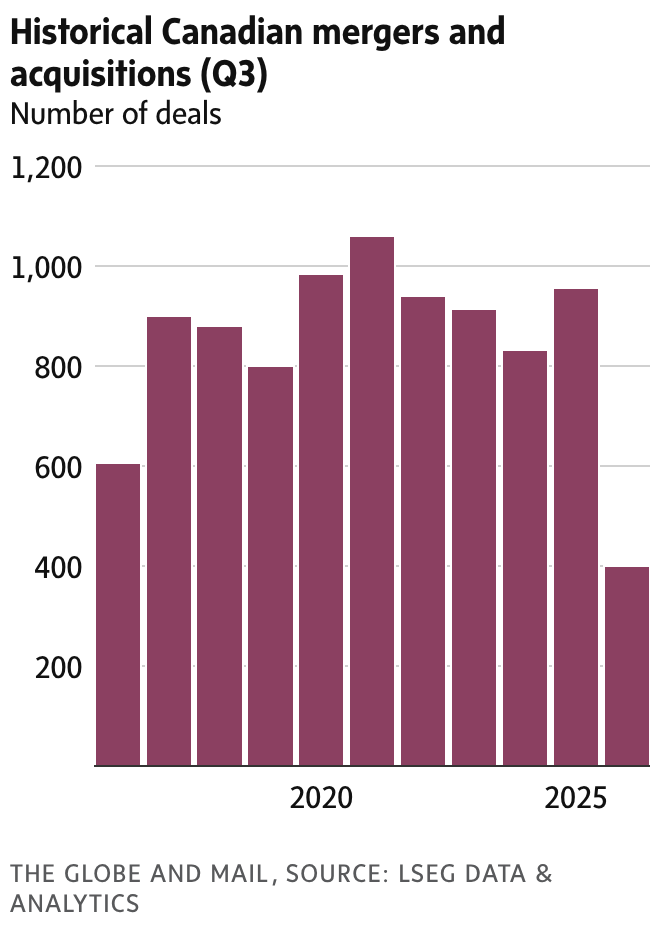
Corporate takeovers involving Canadian co |